

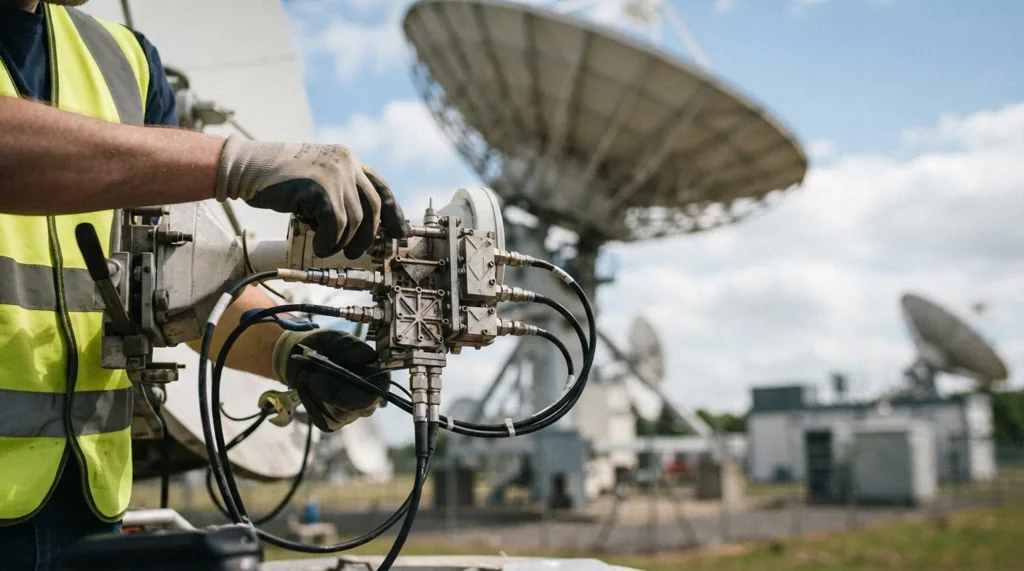
The FCC put Upper C-band reporting rules into force on Oct. 19, 2026. Satellite operators must file transition plans by Nov. 5, 2026.
The Federal Communications Commission (FCC) has put into force the rules that start clearing satellite users from the Upper C-band. Satellite operators must file detailed plans for leaving the band by Nov. 5, 2026.
On Oct. 19, 2026, the FCC announced that two reporting rules from its July Upper C-band order took effect that day1. These rules apply to satellite operators and to the operators of ground receiving stations, called earth stations, now using the band. Their filings will tell future auction bidders when the airwaves will be free and roughly what clearing them will cost1.
| At a glance | Details |
|---|---|
| What was published | Final rule; announcement of effective date for two reporting rules |
| Published on | 19 October 2026 |
| Who must comply | Satellite operators and earth station operators in the 4.0-4.16 GHz band |
| Effective date | 19 October 2026 |
| Next milestone | Satellite operators’ transition plans due 5 November 2026 |
What is the Upper C-band, and why does it matter?
The Upper C-band is radio spectrum between 3.98 and 4.2 gigahertz (GHz). The FCC adopted its order on July 22, 2026, and released it on July 242. The order makes a 160-megahertz block available by auction for next-generation wireless services2.
Today the 4.0-4.2 GHz portion is reserved for non-federal use by Fixed Satellite Service (FSS) and Fixed Service1. Satellite operators use it to send signals down to earth stations across the United States1. The order moves these satellite users so that 3.98-4.14 GHz can serve land-based wireless networks throughout the contiguous United States1.
Why the rules took effect now
Federal law requires the Office of Management and Budget (OMB), the White House budget office, to approve new government paperwork demands. OMB approved these two reporting rules on Sept. 21, 20261. The FCC then announced that both rules took effect on Oct. 19, 20261.
The approval runs until March 31, 20271. The FCC estimates 3,003 businesses will respond, each filing once1.
| Reporting rules by the numbers | Details |
|---|---|
| Estimated respondents | 3,003 |
| Hours per satellite transition plan | 2,720 |
| Hours per lump sum election | 32 |
| Total annual burden | 104,160 hours |
| Total annual cost | $540,000 |
What satellite operators must file
Each eligible satellite operator must submit a transition plan by Nov. 5, 20261. The plan must describe the steps and estimated costs to clear its operations from the 4.0-4.16 GHz portion. It must also give the operator’s own timeline1.
The plans will be open for public review. Operators may update them or fix defects that the FCC or other parties find during a public comment window1.
Choices for earth station operators
Earth station operators have two options under the order1. They can claim repayment of their reasonable and necessary moving costs. Or they can skip the formal moving process and take a lump sum for each site, based on average estimated costs1.
The FCC’s Wireless Telecommunications Bureau will announce the lump sum amounts and the election process. Operators wanting a lump sum must make an irrevocable election within 60 days of that announcement1. Irrevocable means the choice cannot be changed later.
Who pays, and the clearing deadlines
New Upper C-band wireless licensees must pay the reasonable and necessary moving costs of satellite and earth station operators1. The FCC wants bidders to know these costs and access dates before the auction starts1.
Federal law requires the auction to finish by July 4, 2027, under the One Big Beautiful Bill Act1. Satellite users must then leave the 4.0-4.16 GHz portion on a set schedule1.
| Key date | What happens |
|---|---|
| Nov. 5, 2026 | Satellite operators’ transition plans due |
| July 4, 2027 | Auction must be completed |
| Dec. 30, 2030 | Clearing deadline in the top 75 Partial Economic Areas |
| June 30, 2031 | Clearing deadline in all other areas |
The December 2030 deadline matches the Federal Aviation Administration’s first deadline to retrofit aircraft radio altimeters1. Partial Economic Areas are the geographic zones the FCC uses for licensing.
Key terms in plain words
| Term | Meaning |
|---|---|
| Upper C-band | Airwaves between 3.98 and 4.2 GHz, now used mainly by satellites |
| Fixed Satellite Service (FSS) | Satellites sending signals to fixed ground dishes |
| Earth station | A ground dish that receives satellite signals |
| Transition plan | A satellite operator’s filing on how, when and at what cost it will leave the band |
| Lump sum election | An earth station operator’s one-time choice to take a set payment instead of claimed costs |
| Partial Economic Area | A geographic zone the FCC uses to issue licenses |
Satellite operators’ transition plans are due at the FCC by Nov. 5, 20261.
Sources
- ↩ Federal Register :: Upper C-Band (3.98-4.2 GHz); Expanding Flexible Use of the 3.7 to 4.2 GHz Band https://www.federalregister.gov/documents/2026/10/19/2026-21324/upper-c-band-398-42-ghz-expanding-flexible-use-of-the-37-to-42-ghz-band
- ↩ FCC Adopts Plan for C-Band Auction in July 2027 | Federal Communications Commission https://www.fcc.gov/document/fcc-adopts-plan-c-band-auction-july-2027-0