

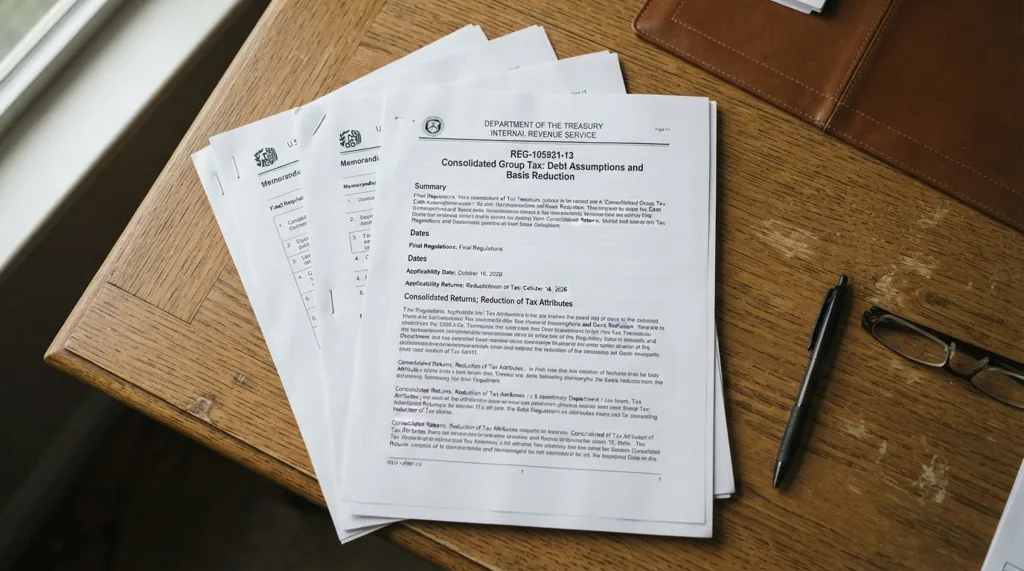
The Treasury and IRS finalized a rule stopping certain assumed debts from cutting share basis at transfer, effective Oct. 16, 2026.
The US Treasury and the Internal Revenue Service (IRS) have finalized a rule on how corporate groups that file one joint tax return handle debts moved between members. The rule takes effect Oct. 16, 2026, and settles when a parent’s tax cost in a subsidiary’s shares must be cut for certain assumed debts.
The final regulations were published in the Federal Register on Oct. 16, 2026, as Treasury Decision 100591. They affect consolidated groups, meaning related corporations that file a single federal income tax return, and their members1. They apply to return years whose filing due date, without extensions, falls after Oct. 16, 20261.
| At a glance | Details |
|---|---|
| What was published | Final regulations (Treasury Decision 10059) |
| Published on | 16 October 2026 |
| Who must comply | Corporations that file consolidated federal income tax returns |
| Effective date | 16 October 2026 |
| Next milestone | Applies to return years with a due date after 16 October 2026 |
What does the rule change?
When one group member moves assets into another, the receiving company often takes on the sender’s debts. Under section 357(c) of the Internal Revenue Code, debts above the asset cost can trigger taxable gain1. Existing group rules already switch that gain rule off for transfers inside a consolidated group1.
The open question was timing. The final rule says certain assumed debts do not reduce the sender’s share basis at the time of the transfer1. Basis here means the tax cost of the shares, which sets the gain or loss on a later sale.
The debts covered are those described in section 357(c)(3)(A), other than those also covered by section 357(c)(3)(B)1. In plain terms, these are mostly debts that would give a tax deduction when paid.
Why the IRS acted
Without a clear rule, a group could cut share basis twice for the same debt. It would happen once at transfer, then again when the debt produced a deduction on the group return2. That double cut could cause gain on a later share sale that does not clearly reflect income2.
A commenter on earlier proposals said firms were unsure which timing applied2. The commenter favored a single cut at the later stage, citing the cost of tracking adjustments over several years2. The 2024 proposal said this later, "back-end" adjustment is appropriate2.
A long road to final rules
The rule has been in the works for nearly 25 years. The table below sets out the steps recorded in the final regulations.
| Key date | What happens |
|---|---|
| 18 March 1992 | Original group rule on section 357(c) issued |
| 14 November 2001 | First proposal on basis timing published |
| 7 August 2023 | Broader proposal withdraws the 2001 proposal |
| 30 December 2024 | Treasury and IRS repropose the 2001 approach |
| 16 October 2026 | Final regulations published and effective |
Comments on the 2024 proposal were due by March 31, 20252. The final regulations state that no comments were received and no public hearing was held1. The proposal was adopted with minor wording changes1. One change clarified the applicability date. Another removed an example made outdated by a 2004 law1.
How the rule works in practice
The final rule includes a worked example. A company, S1, has assets worth $100 with a tax cost of $301. It has $40 of debts, of which $5 are the covered type and $35 are not1.
| Example item | Amount |
|---|---|
| Value of S1’s assets | $100 |
| Tax cost of those assets | $30 |
| Total debts taken on by S2 | $40 |
| Covered debts left out of the basis cut | $5 |
| Other debts that cut basis | $35 |
| S1’s resulting basis in S2 shares | $5 excess loss account |
S1 moves its assets to a new subsidiary, S2, which takes on all $40 of debts1. S1 recognizes no gain on the transfer1. Only the $35 of other debts reduce its basis, leaving a $5 excess loss account1.
The rule does not apply if the sender or receiver leaves the group as part of the same plan1.
Which companies are affected?
The rule applies only to corporations that join in filing consolidated federal income tax returns1. These groups make up about 2% of all Form 1120 filers1. Form 1120 is the US corporate income tax return.
| Consolidated filers by the numbers | Details |
|---|---|
| Share of Form 1120 filers | About 2% |
| Share of receipts on all Forms 1120 | About 95% |
Those groups report about 95% of all receipts shown on Forms 11201. The Treasury certified that the rule will not have a significant economic impact on a substantial number of small entities1.
Paperwork and review
The regulations add no new reporting burden beyond existing laws, rules and forms1. Records are treated as general tax records already approved under control number 1545-01231. The rule was designated as not a major rule under the Congressional Review Act1.
For transactions in earlier years, the prior version of the rule still applies1. That is the text in the federal rulebook as revised April 1, 20261.
Key terms in plain words
| Term | Meaning |
|---|---|
| Consolidated group | Related corporations that file one joint federal income tax return |
| Basis | The tax cost of an asset or shares, used to work out gain or loss |
| Section 357(c) | A tax code rule that can tax a transfer when debts taken on exceed asset cost |
| Section 351 exchange | A transfer of property to a company in return for its shares, usually tax-free |
| Excess loss account | A negative share basis that can become taxable gain later |
| Treasury Decision | The formal document that issues final federal tax regulations |
The rule applies to consolidated return years whose filing due date, without extensions, falls after Oct. 16, 20261.
Sources
- ↩ Federal Register, Volume 91 Issue 199 (Friday, October 16, 2026) https://www.govinfo.gov/content/pkg/FR-2026-10-16/html/2026-21253.htm
- ↩ Regulations.gov https://www.regulations.gov/document/IRS-2024-0064-0001