

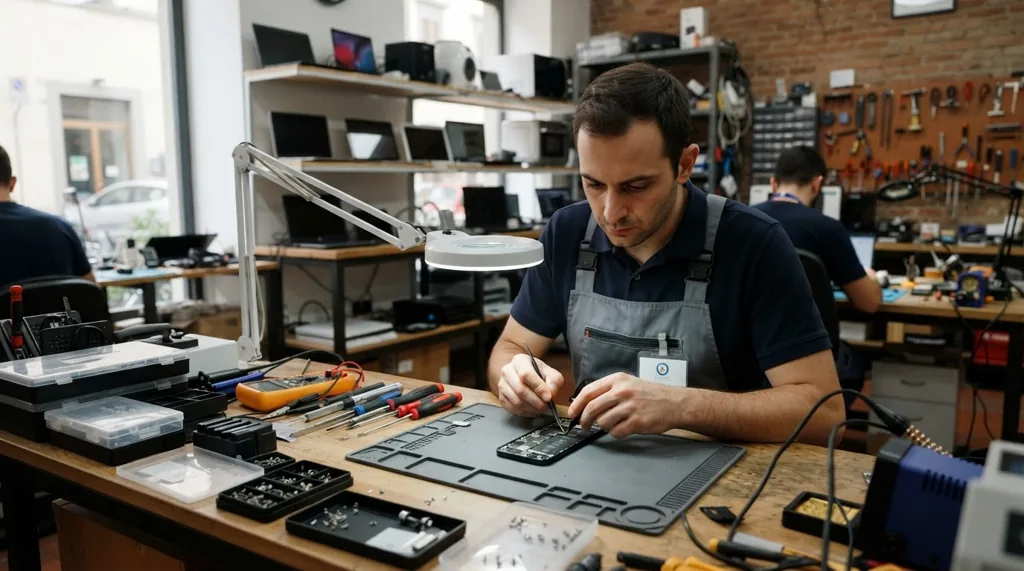
Italy will require manufacturers of goods covered by EU repairability rules to repair them on consumer request from Oct. 22, 2026.
Italy’s government has published a legislative decree that gives consumers a right to have certain household goods repaired, placing new duties on manufacturers, importers, distributors and repair businesses from Oct. 22, 2026.
The measure is Legislative Decree No. 176 of Sept. 25, 2026, published in the Gazzetta Ufficiale, Italy’s official gazette, on Oct. 7, 20261. It brings into Italian law EU Directive 2024/1799, the European Union’s common rules to promote the repair of goods2.
In short, makers of products covered by EU repairability rules must repair them on request, even after the seller’s legal guarantee has ended. Repairers gain a standard EU form for quoting prices and timelines, and manufacturers may no longer block independent repair with contract terms or software.
How did Italy adopt the repair decree?
The Council of Ministers, Italy’s cabinet, gave the decree a first reading on July 2, 20262. Parliamentary committees in the Chamber of Deputies and the Senate then gave their opinions. The cabinet approved the final text on Sept. 16, 2026, and its press release said the text took those opinions into account3.
From cabinet to force
The decree was proposed by the minister for European affairs and the Minister of Enterprises and Made in Italy, Italy’s industry ministry2. It works by adding a new section, Title II-bis "On the repair of goods", to the Consumer Code, Italy’s main consumer protection law of 20052. The gazette notice gives Oct. 22, 2026 as the date the decree enters into force1.
Which goods fall under the repair duty?
The new rules apply to goods bought by consumers when a defect appears outside the seller’s legal responsibility under the Consumer Code2. In practice, this covers faults that arise once the seller’s guarantee no longer applies.
The core repair duty is narrower. It applies only to goods for which EU laws, listed in a new annex to the Consumer Code, set specific repairability requirements2. These are design rules that make a product easier to take apart and keep spare parts, repair information and tools available.
The decree’s preamble cites the EU design rules it draws on. They cover these products2:
- vacuum cleaners, fridges, dishwashers, washing machines and washer-dryers
- tumble dryers, electronic displays and welding equipment
- servers and data storage products
- smartphones, mobile phones, cordless phones and tablets
- batteries and household local space heaters
A "good" under the decree is any physical movable item, except water, gas and electricity2. It also includes items that need built-in digital content or a digital service to work.
What must manufacturers do under the decree?
On a consumer’s request, the manufacturer must repair covered goods, unless repair is impossible2. It may hand the job to a third party. The repair must be free or at a reasonable price, and done within a reasonable time after the maker receives the item2.
Manufacturer duties for covered goods
| Requirement | Standard / Details |
|---|---|
| Repair on request | Unless impossible; free or at a reasonable price |
| Timing | Within a reasonable time after receiving the item |
| Spare parts and tools | Reasonable price that does not discourage repair |
| Price transparency | Indicative repair prices on a free website |
| Repair blocking | No clauses, hardware or software preventing repair |
| Independent repairers | May use original, second-hand, compatible or 3D-printed parts |
During the repair, the manufacturer may lend a replacement item, free or at a reasonable cost. When repair is impossible, it may offer a refurbished product instead2.
The decree also sets these further obligations for manufacturers of covered goods2:
- sell spare parts and tools at a reasonable price that does not discourage repair
- publish indicative repair prices on a free website
- avoid contract clauses, hardware or software that prevent repair, unless justified by legitimate and objective factors such as intellectual property
- allow independent repairers to use original, second-hand, compatible or 3D-printed parts that meet legal requirements
- not refuse a repair only because someone else repaired the item before
Consumers remain free to use any repairer they choose2. Makers, or the firm responsible in their place, must also publish free, clear information on their repair services for the whole period of the repair duty2.
Who repairs goods made outside the EU?
The decree sets a chain of responsibility for manufacturers based outside the European Union2. Their authorised representative in the EU must carry out the repair duty. If there is no such representative, the duty falls on the importer. If there is no importer, it falls on the distributor2.
Who carries the repair duty
Each of these firms may also hand the repair to a third party2. This places a direct obligation on Italian importers and distributors of covered products from non-EU brands.
What is the European repair information form?
The decree introduces the European repair information form, a standard quote document set out in a new annex to the Consumer Code2. Repairers may choose to give it to consumers. It must be provided free, on a durable medium, before the consumer signs a repair contract2.
The form must state, clearly and simply2:
- the repairer’s identity, address, phone and email
- the item, the defect and the proposed repair
- the price, or how it is calculated plus a maximum price
- the time needed to finish the repair
- whether a temporary replacement item is available, and its cost
- any extra services, such as transport or installation, and their cost
A repairer may charge for a diagnostic check needed to estimate the price, but must say what it costs2. Once the form is issued, the repairer may not change the terms for 30 days2. If the consumer accepts within that period, the repair must be done on those terms. If the repairer then fails to do the work, the consumer is entitled to a refund of the diagnostic costs2.
A repairer that gives a complete and accurate form is treated as having met its main pre-contract information duties under Italian consumer law2.
How will the national repair platform work?
Italy will run a national section of the European online repair platform once the European Commission activates it2. Repairers, sellers of refurbished goods, buyers of defective goods for refurbishment and community repair initiatives may register. Use of the national section is free for consumers2.
The Ministry of Enterprises and Made in Italy will be the national contact point with the Commission2. It will grant access for registration and monitor the data, removing information that is not valid. The ministry, the environment ministry, the competition and consumer authority and the national consumers’ council must also publish web pages explaining the new consumer rights2.
Summary of Italy’s right-to-repair decree
The table sets out the main points of Legislative Decree 176/2026.
| Key Dimension | Details |
|---|---|
| Regulating Authority & Jurisdiction | Italian government, proposed with the Ministry of Enterprises and Made in Italy; applies in Italy2 |
| Legal basis | Transposes EU Directive 2024/1799 by amending the Consumer Code2 |
| Scope & Who Must Comply | Manufacturers, EU representatives, importers, distributors and repairers of consumer goods2 |
| Core Mandate / Key Change | Repair on request for goods with EU repairability rules, free or at a reasonable price2 |
| Compliance Requirements | Reasonable spare-part prices, indicative repair prices online, no repair-blocking clauses or software2 |
| Repair Quote Rules | Optional EU repair information form, binding for 30 days2 |
| Key Dates & Implementation Milestones | Cabinet final approval Sept. 16, 2026; gazette Oct. 7, 2026; in force Oct. 22, 20263, 1 |
| Oversight | Ministry of Enterprises and Made in Italy acts as national contact point for the repair platform2 |
The next milestone is Oct. 22, 2026, when the decree enters into force and makers of covered goods must be ready to accept repair requests1.
Sources
- ↩ Gazzetta Ufficiale https://www.gazzettaufficiale.it/eli/id/2026/10/07/26G00191/SG
- ↩ Content from www.gazzettaufficiale.it https://www.gazzettaufficiale.it/atto/serie_generale/caricaArticolo?art.versione=1&art.idGruppo=0&art.flagTipoArticolo=0&art.codiceRedazionale=26G00191&art.idArticolo=1&art.idSottoArticolo=1&art.idSottoArticolo1=10&art.dataPubblicazioneGazzetta=2026-10-07&art.progressivo=0
- ↩ Comunicato stampa del Consiglio dei Ministri n. 189 | www.governo.it https://www.governo.it/it/articolo/comunicato-stampa-del-consiglio-dei-ministri-n-189/32596