

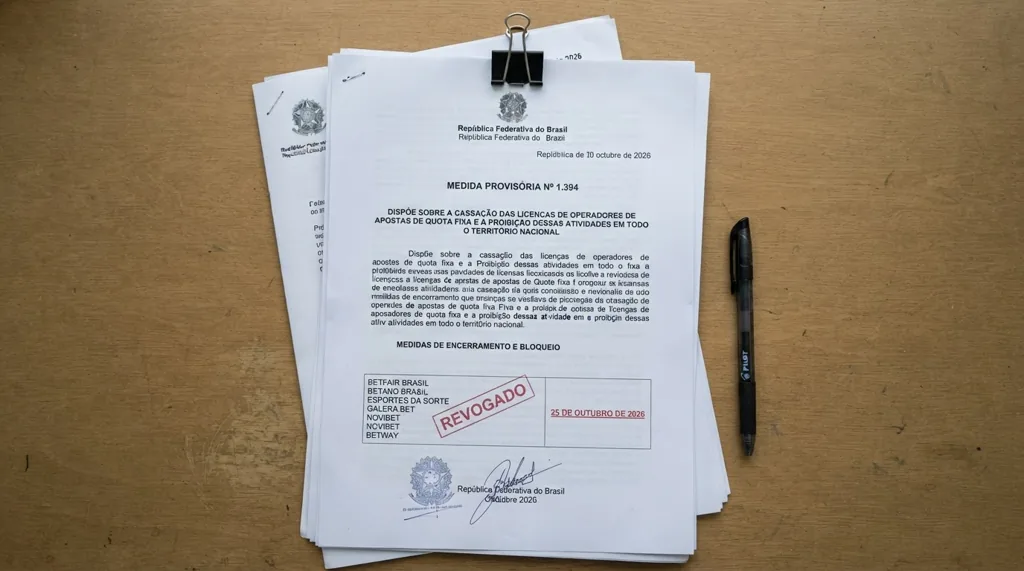
Brazil banned fixed-odds betting with immediate effect on Sept. 25, 2026, ordering sites offline from Oct. 6 and ending all licences on Oct. 25.
Brazil’s president issued Provisional Measure 1,394 on Sept. 25, 2026, banning fixed-odds betting on sports and online games nationwide with immediate effect and cancelling every operator licence within 30 days1.
A provisional measure is a decree with the force of law that takes effect at once but must be approved by Congress. The measure is already in force, and Congress has 120 days to vote on it before it can become permanent law2.
In short, Brazil is shutting down its licensed betting market. Operators must close their sites and apps, refund players, and stop all advertising, while banks, payment firms, app stores and online platforms must help enforce the ban.
What does Brazil’s betting ban cover?
The measure bans the operation, offering, brokering and advertising of fixed-odds betting, in person or online1. Fixed-odds betting means staking money for a prize set by a multiplier, the model used by sports betting sites. The ban covers bets on real sports events and on online games driven by random number generators1.
It also reaches companies based abroad that take bets from people in Brazil1. Licences granted by Brazil’s states and the Federal District will also end within the same deadline1. Other lottery products allowed by law are not affected2.
The measure amends Law 14,790 of Dec. 29, 2023, the law that set up the licensed market, and repeals most of its articles1. No new licences may be granted, and pending applications fall away1.
When must betting operators shut down?
Licences issued under Law 14,790 end on Oct. 25, 2026, 30 days after publication2. The government says the cancellation is in the public interest. Operators get no refund of the licence fees they paid and no compensation1.
The betting wind-down timetable
| Date | Who | What falls due |
|---|---|---|
| Sept. 25, 2026 | Operators | Ban in force, no new deposits |
| Oct. 5 | Players | Last day to withdraw balances, until 11:59 p.m. |
| Oct. 6 | Operators | Sites and apps must be offline |
| Oct. 14 | Banks and payment firms | Refunds to players completed |
| Oct. 25 | Operators | All licences end |
Platforms must stop operating well before that date. Since publication, players cannot deposit new money into their betting accounts2. Players may withdraw their balances until 11:59 p.m. on Oct. 5. From Oct. 6, sites and apps must be unavailable, including in app stores, or face blocking2.
Bets still open when the 10-day window closes will be void, and players get their full stake back with no deductions1. Winnings on bets settled within that window must still be paid1.
How will players get their money back?
After taking platforms offline, operators have two days to act1. They must:
- secure enough money to repay all balances, voided stakes and winnings;
- send their banks a list of players, with each player’s CPF tax number and the amount owed;
- send the same list to the Secretariat of Prizes and Betting, the Finance Ministry unit that supervises betting, with proof of funds.
Banks and payment institutions then have seven days to transfer the money to an active account in the player’s name, preferably the account it came from1. The Senate calendar puts the deadline for these refunds at Oct. 142. Money that cannot be returned goes to a dedicated account at Caixa Econômica Federal, the state bank, under Finance Ministry oversight1.
Operators that miss these duties face a daily fine of R$ 200,000 until they comply, plus other penalties1. Pending enforcement cases against operators are suspended, and they will be closed for good if operators meet all wind-down duties on time1.
What duties remain after the licences end?
Closing does not wipe out obligations from the licensed period1. Operators remain bound by tax and regulatory duties and by anti-money laundering rules, the laws that require firms to check where customer funds come from1. Responsible gambling and sports integrity duties also continue.
Operators must keep records for five years, covering players, bets, financial transactions and prize payments1. They must also report their activity to the betting secretariat through Sigap, its betting management system, including deposits, withdrawals, refunds and revenue2.
What must banks, app stores and platforms do?
Banks, payment institutions and payment schemes, including instant payments, may no longer process transactions for fixed-odds betting1. The only exception is money needed to close operations and refund players. The Central Bank of Brazil must set up an electronic system to reject such transfers and return funds between banks1.
What is now banned
All betting advertising, marketing and sponsorship is banned in any medium1. Existing ads and sponsorship signs must come down within 10 days of publication1. Content published before the measure, where betting ads appear only in passing, is exempt1. Breaches count as abusive advertising under the Consumer Defence Code, Brazil’s main consumer protection law1.
Online platforms have a duty of care to stop betting promotions circulating on their services, even when posted by users1. They must remove such content when notified by consumer authorities or the Ministry of Justice and Public Security. App stores and operating system providers must keep banned betting products off their services1.
The Justice Ministry can punish breaches with a warning, a fine of up to 10% of the group’s Brazilian revenue, or daily fines1. Where a firm has no revenue, the fine is R$ 10 to R$ 1,000 per registered user, capped at R$ 50 million per breach1. Repeat offenders may have their activities suspended or banned1.
Who enforces the betting ban?
The Finance Ministry and the Justice Ministry may order betting sites blocked or redirected1. Anatel, Brazil’s telecoms regulator, will pass blocking orders to internet providers. CGI.br, the Brazilian Internet Steering Committee, will handle orders for ".br" domain names1.
Expected lost tax revenue, R$ billion
A new inter-agency committee led by the presidency’s Chief of Staff office will coordinate action against illegal betting and advertising1. Its make-up will be set by later regulation2. The Federal Police, the Federal Revenue Service and Coaf, the financial intelligence unit, must share information to enforce the ban1.
The government expects lost tax revenue of R$ 1.541 billion in 2026, R$ 5.150 billion in 2027 and R$ 5.330 billion in 20282. The next fixed date is Oct. 6, when every licensed betting site and app must go offline2.
Sources
- ↩ mpv1394 https://www.planalto.gov.br/ccivil_03/_ato2023-2026/2026/mpv/mpv1394.htm
- ↩ MP proíbe bets e determina encerramento das operações em 30 dias — Senado Notícias https://www12.senado.leg.br/noticias/materias/2026/09/28/mp-proibe-bets-e-determina-encerramento-das-operacoes-em-30-dias