
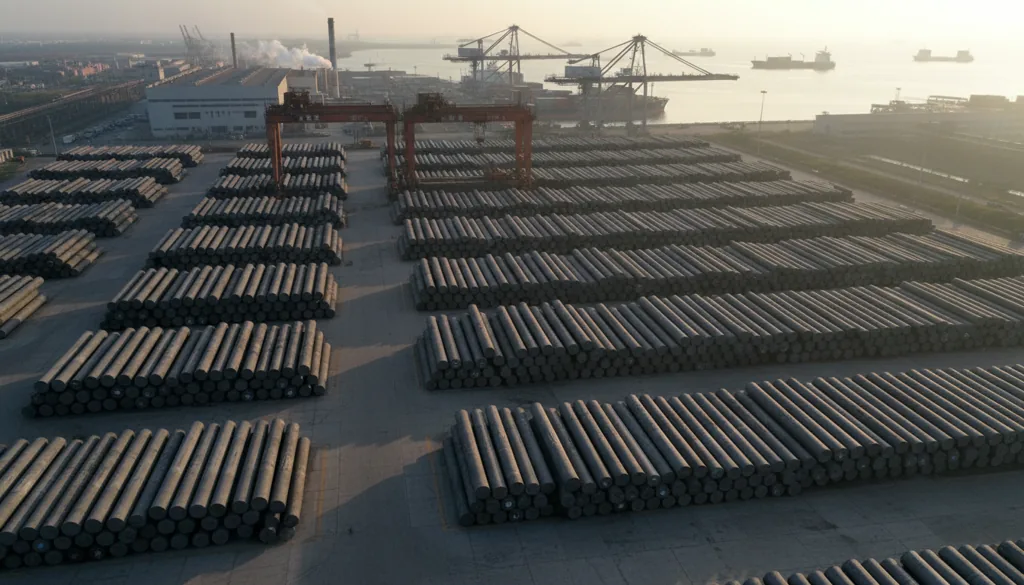
United States announced a preliminary affirmative critical circumstances determination on imports of large diameter graphite electrodes from China, applying applicable measures from September 24, 2026.
The US Department of Commerce has preliminarily found “critical circumstances” for large diameter graphite electrodes from China, bringing applicable trade measures into play from Sept. 24, 2026.
The decision covers graphite electrodes investigated under both countervailing-duty and less-than-fair-value proceedings. The products are mainly identified in US customs records under tariff number 8545.11.0020, with some entries also possible under 3801.10.5090 and 3801.90.0050.1
The purpose is to address a sharp rise in imports while the US trade investigation is under way. The immediate financial exposure falls on US importers, which may face additional trade-remedy charges connected with covered shipments rather than a cost paid by Commerce.
The Sept. 24 electrode action
Commerce’s preliminary affirmative determination applies to large diameter graphite electrodes from China and takes effect on Sept. 24, 2026. The notice was published in the Federal Register under agency case number C-570-221 and document number 2026-19518.2
A critical-circumstances finding is an early decision in a trade-remedy case. It allows the government to treat the timing of imports as significant when deciding whether measures should reach shipments made before a final determination. The finding is preliminary, so the case can still change as the investigation continues.
The determination concerns the countervailing-duty investigation, which examines whether Chinese producers and exporters received subsidies that can be offset through duties. Commerce had already made a preliminary finding that countervailable subsidies were being provided to the industry.1 For importers, that means the case is no longer only about a possible future duty rate. It also concerns the treatment of entries during the period covered by the critical-circumstances finding.
The notice invites interested parties to submit comments on the preliminary result. That process gives the agency a chance to consider arguments and information before the final determination, but it does not suspend the effective date of the preliminary action.
The 2025 investigation
The underlying period of investigation runs from Jan. 1 through Dec. 31, 2025.2 The products covered are large graphite electrodes from China, while certain small diameter electrodes already subject to an existing antidumping order are outside this case.
How the case timetable moved
That boundary matters at the border because the scope is controlled by the written product description, not simply by the tariff numbers printed on an entry. The covered goods may include electrode pin-joining systems used with large electrodes. Customs classifications are provided for convenience, while the legal description decides whether merchandise belongs in the investigation.1
The product line therefore cannot be identified safely by tariff number alone. The same general customs territory includes entries under more than one statistical number, and the existing small-electrode order can control where its scope applies. This makes product specifications and the written scope central to the import review.
The investigation began as a less-than-fair-value case on March 16, 2026. Commerce later postponed its preliminary determination by 50 days, moving the deadline to no later than Sept. 22, 2026, after a request to allow more time to examine questionnaire responses.3 The critical-circumstances decision arrived almost immediately after that revised timetable.
A 105.43% import jump
The critical-circumstances allegation was filed on Sept. 1, 2026. It relied on monthly import information covering November 2025 through June 2026 and compared shipments in a four-month base period with those in a later four-month comparison period.4
The surge behind the finding
The comparison showed imports from China rising by 105.43% by quantity. The petitioners argued that this was a “massive” increase under the US regulation governing critical circumstances. The allegation also said there was a reasonable basis to believe that subsidies in the investigation were inconsistent with the World Trade Organization’s subsidies agreement.2
Commerce accepted the import surge as sufficient for a preliminary affirmative determination for the relevant exporters and producers. The agency’s reasoning focuses on shipment quantities rather than the value of the goods, so the finding is tied to the volume pattern recorded during the comparison periods.
That timing gives the action its commercial importance. A surge during an active trade case can shift the financial risk onto goods that entered before the final outcome was known. Even without a final duty rate in this notice, the finding makes the arrival date of covered electrodes a material customs issue.
The data used for the broader exporter group came from Trade Data Monitor because Commerce had no cooperating mandatory respondents from which to build the normal shipment comparison. The agency compared monthly import data for a base period and a comparison period to test whether a massive increase had occurred.2
The two Chinese exporters
Commerce treated Dantan New Materials and Shanxi Juxian separately from the wider group of Chinese producers and exporters. The agency said both companies did not cooperate in the investigation and that it preliminarily applied total adverse facts available under sections 776(a) and (b) of the Tariff Act.4
Two routes to the same finding
| Question | Dantan New Materials and Shanxi Juxian | All other Chinese exporters |
|---|---|---|
| Cooperation | Did not cooperate | No cooperating mandatory respondents |
| Basis used | Total adverse facts available, sections 776(a) and (b) | Import-surge comparison |
| Data source | Adverse inference from non-cooperation | Trade Data Monitor import data |
That finding supports a preliminary critical-circumstances result for imports linked to those companies. In practical terms, the companies face the most direct exposure within the notice because the agency used an adverse inference after the lack of cooperation.
The broader exporter analysis took a different route. Commerce normally subtracts shipments reported by cooperating mandatory respondents from total shipment data before testing the remaining volume. Here, there were no cooperating respondents, so the agency relied on the external import data for all other producers and exporters.2
The distinction does not produce a single, simple risk profile for every Chinese shipment. Entries connected with the two named companies are assessed through the adverse-facts route, while other exporters are assessed through the import-surge comparison. Importers therefore face a scope and supplier-identification question as well as a tariff-classification question.
The preliminary action also sits beside a separate less-than-fair-value investigation. That proceeding examines whether the electrodes were sold in the US at less than fair value, while the countervailing-duty case examines subsidies. The two proceedings can result in different findings, but Commerce has linked their final timetables.
December alignment
Commerce aligned the final countervailing-duty determination with the final determination in the companion less-than-fair-value investigation. The final decision in both proceedings is currently scheduled for no later than Dec. 7, 2026, unless the deadline is postponed.1
ITC injury review windows, days
That alignment compresses two legal tracks into one important date for customs planning. A final countervailing-duty result will not arrive on an isolated schedule, and the antidumping outcome is expected to be issued alongside it. The combined timetable may clarify the longer-term treatment of covered Chinese electrodes, but it comes after the preliminary critical-circumstances action has already taken effect.
The US International Trade Commission has a separate role if Commerce reaches affirmative final findings. The commission would determine whether imports materially injure, or threaten material injury to, the US industry. Its review is due by the later of 120 days after the preliminary countervailing-duty determination or 45 days after the final determination.1
That sequence means the Commerce finding is not the last step before any permanent order. The agency’s preliminary subsidy decision, the critical-circumstances ruling, the final trade-remedy determinations and the commission’s injury decision each carry a separate place in the process.
For now, the key operative date remains Sept. 24, 2026, when the published critical-circumstances determination became applicable. The investigation covers shipments during 2025, while the surge analysis reaches into June 2026, leaving importers with a case whose financial consequences extend across several different entry periods.
The measure is therefore narrower than a blanket restriction on all graphite products from China, but more consequential than a routine case milestone. It targets large diameter electrodes within a defined written scope and attaches importance to the timing of imports. The final December decision will determine whether that preliminary finding becomes part of the lasting US treatment of the goods.
Sources
- ↩ Preliminary Affirmative Countervailing Duty Determination for Large Diameter Graphite Electrodes from China https://www.federalregister.gov/documents/2026/07/30/2026-15397/large-diameter-graphite-electrodes-from-the-peoples-republic-of-china-preliminary-affirmative
- ↩ Preliminary Affirmative Critical Circumstances Determination for Large Diameter Graphite Electrodes from China — 2026 19518 / large diameter graphite electrodes from the … https://www.federalregister.gov/documents/2026/09/24/2026-19518/large-diameter-graphite-electrodes-from-the-peoples-republic-of-china-preliminary-affirmative
- ↩ Postponement of Preliminary Determination for Large Diameter Graphite Electrodes from China https://www.federalregister.gov/documents/2026/06/26/2026-12878/large-diameter-graphite-electrodes-from-the-peoples-republic-of-china-postponement-of-preliminary
- ↩ Preliminary Affirmative Critical Circumstances Determination for Large Diameter Graphite Electrodes from China — 2026 19518 https://public-inspection.federalregister.gov/2026-19518.pdf