

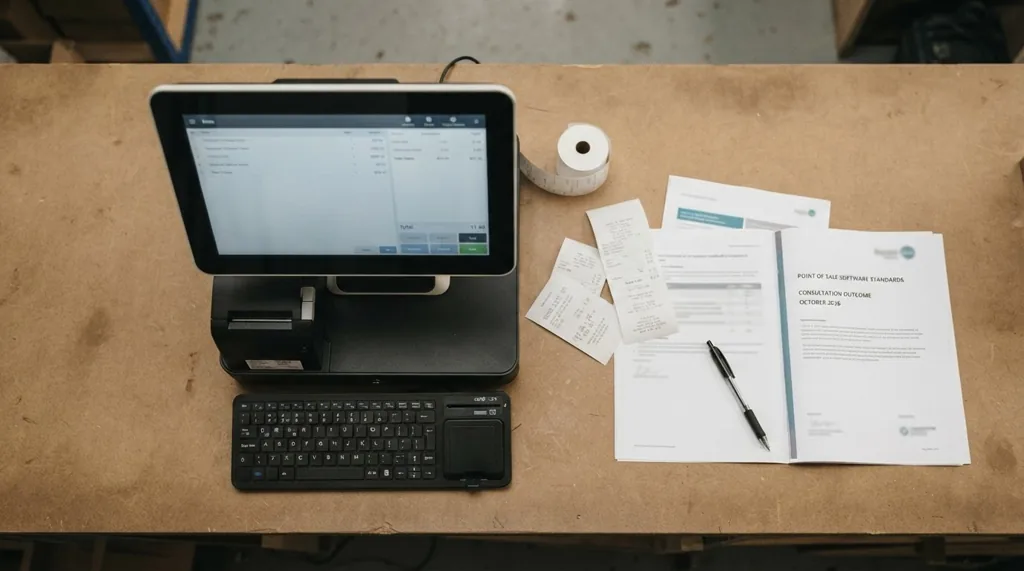
HMRC confirmed the UK will make software standards mandatory for till systems to stop tax fraud. Detailed proposals follow in summer 2027.
The UK government will make software standards mandatory for till systems to stop businesses hiding sales from tax. HM Revenue and Customs (HMRC) plans a technical consultation with detailed proposals in summer 2027.
On 28 October 2026, HMRC, the UK tax authority, published the outcome of its consultation on electronic sales suppression, a form of till fraud1. The rules will cover Electronic Point of Sale (EPOS) and Mobile Point of Sale (MPOS) systems, the tills and card devices businesses use to record sales2. HMRC will first work with software providers, businesses and trade bodies before setting out a detailed plan2.
| At a glance | Details |
|---|---|
| What was published | Consultation outcome and summary of responses |
| Published on | 28 October 2026 |
| Who must comply | Makers, providers and users of EPOS and MPOS systems |
| Feedback deadline / Effective date | Consultation closed 18 August 2026; no start date set |
| Final rules / Next milestone | Technical consultation in summer 2027 |
What is electronic sales suppression?
Electronic sales suppression (ESS) happens when a business changes digital sales records to hide sales or cut their value2. This lowers the turnover and tax the business reports, while the records can still look genuine2. HMRC says the problem is most common among small retailers, takeaways and hospitality businesses3.
Till fraud by the numbers
In one case, HMRC investigators found hidden functions in a business’s till software3. The owners used them to swap high-value items sold for cheaper ones, in bulk and at the press of a few buttons3.
A 2019 HMRC report found the risk of VAT losses alone could exceed £450 million a year3. HMRC estimated the small business tax gap at £28 billion in 2023 to 2024, or 60% of the overall gap3.
What the government has decided
The government announced in Budget 2026 that it will introduce mandatory software standards for EPOS and MPOS devices2. Today there are no mandatory standards for these systems in the UK3. The consultation paper notes that countries such as Austria, Germany and Norway already have them3.
The decision in brief
| Dimension | Provision |
|---|---|
| Authority | HM Revenue and Customs (HMRC) |
| Core mandate | Mandatory software standards for EPOS and MPOS devices |
| Announced in | Budget 2026 |
| Current position | No mandatory UK standards today |
| Existing law | Finance Act 2022 offences for sales suppression tools |
The new standards add prevention to existing law. The Finance Act 2022 already made it an offence to have, make, sell or promote sales suppression tools3. Those powers mainly apply once unlawful tools or behaviour have been found2.
What businesses and providers told HMRC
The consultation ran for eight weeks, from 23 June to 18 August 20263. It drew 17 written responses, and 4 more stakeholders took part in roundtable discussions2.
| Response | Number |
|---|---|
| Strongly supportive | 5 |
| Supportive with caveats | 13 |
| Mixed | 1 |
| Concern | 1 |
| Opposed | 1 |
Of the 21 responses analysed, 18 supported software standards2. Support often depended on the rules being proportionate, practical and suited to different technologies2.
The main worries were cost and how the rules would be put into practice2. Respondents feared fixed testing and approval costs could hit smaller providers and businesses hardest2. Older systems, such as basic cash registers, could face higher upgrade costs2.
How the standards could work in practice
The detailed design is still open. The responses point to the main areas HMRC will need to settle.
| Area | What respondents said |
|---|---|
| Tamper-evident records | Records should show any later change or deletion2 |
| Data format | Systems should export data in a standard format2 |
| Technology | Rules should set outcomes, not a specific technology2 |
| Timing of protection | Most wanted records protected when a sale is created2 |
| Existing systems | Upgrades should be allowed where practical2 |
Several respondents backed an export format called the Standard Audit File for Tax (SAF-T)2. They preferred systems to produce data in that format when needed, rather than store it that way2. Any rules must also allow normal events such as refunds, voids, discounts and split payments2.
Who is affected
The consultation paper named sole traders and small and medium-sized firms in retail and hospitality as key groups3. It also named till software and hardware developers, providers and resellers3. Government figures cited by HMRC show about 547,000 retail and wholesale businesses in the UK3.
Respondents said businesses using tills could face software or hardware upgrades, staff training and higher subscription costs2. Resellers could face costs from changing product lines and retraining staff2.
What happens next
HMRC will work with software providers, businesses, trade bodies and technical specialists on the issues raised2. That work will shape a technical consultation in summer 20272. It will set out a detailed plan meant to keep burdens on business low2.
From consultation to detailed rules
The outcome sets no start date or penalties for the new standards yet.
Key terms in plain words
| Term | Meaning |
|---|---|
| Electronic sales suppression (ESS) | Changing digital till records to hide sales and pay less tax |
| EPOS | Electronic Point of Sale: a till system that records sales and payments |
| MPOS | Mobile Point of Sale: a portable device used to take payments |
| SAF-T | Standard Audit File for Tax, a common format for sharing tax data |
| Tamper-evident record | A record that shows if anyone changed or deleted it |
| Technical consultation | A later round of feedback on detailed rules |
The next official step is HMRC’s technical consultation, due in summer 20272.
Sources
- ↩ Electronic Sales Suppression: Introduction of software standards – GOV.UK https://www.gov.uk/government/consultations/electronic-sales-suppression-introduction-of-software-standards
- ↩ Electronic Sales Suppression — Summary of responses – GOV.UK https://www.gov.uk/government/consultations/electronic-sales-suppression-introduction-of-software-standards/outcome/electronic-sales-suppression-summary-of-responses–2
- ↩ Electronic Sales Suppression — Introduction of software standards in EPOS/MPOS systems – GOV.UK https://www.gov.uk/government/consultations/electronic-sales-suppression-introduction-of-software-standards/electronic-sales-suppression-introduction-of-software-standards-in-eposmpos-systems