

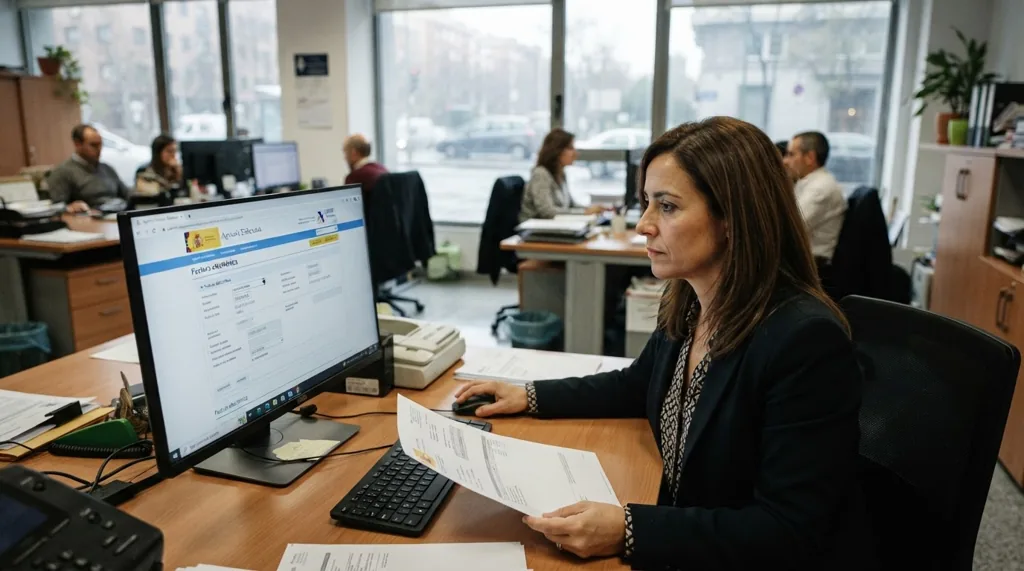
Spain’s Order HAC/1028/2026, in force since Oct. 6, 2026, starts the countdown to mandatory business e-invoicing, beginning Oct. 6, 2027 for firms with turnover above €8 million.
Spain’s Ministry of Finance has set the technical rules for the tax agency’s free public e-invoicing platform, starting the clock on mandatory electronic invoices between businesses and professionals from Oct. 6, 2026.
The measure is Order HAC/1028/2026 of Oct. 2, published in the BOE, Spain’s official state gazette, on Oct. 51. It came into force the next day, Oct. 6, 20262.
In short, every Spanish business and professional that invoices other businesses will have to issue, send and receive electronic invoices. Large firms with turnover above €8 million must start on Oct. 6, 2027, and everyone else a year later2.
What does Order HAC/1028/2026 regulate?
The order sets out the technical and functional rules for the public electronic invoicing solution1. This is a platform run by the State Tax Administration Agency (AEAT), Spain’s national tax authority. The order draws its powers from Royal Decree 238/2026 of March 25, which built the wider system of mandatory electronic invoicing between businesses1.
The public solution has two jobs. It is a basic, low-cost invoicing platform aimed especially at small and medium-sized companies and professionals1. It also acts as a universal and mandatory store of every electronic invoice issued, sent or received under the law1.
Access to the public solution and all of its uses is free for users1. The tax agency must also build a web form that generates electronic invoices1.
Which Spanish businesses must use e-invoices?
The obligation covers businesses and professionals that must already issue invoices under Spain’s invoicing rules1. They must use electronic format when the customer is a business or professional based in Spain, or with a permanent establishment or home there1.
Firms can choose how they exchange invoices. They may use private invoice-exchange platforms, the public solution, or a mix of both1. Private providers must make their platforms connect with one another free of charge1.
Firms that do not issue invoices through the public solution still have a duty to it. They must send a faithful electronic copy of each invoice to the public solution at the same moment they issue it1. That copy must use UBL (Universal Business Language), a common digital format for business documents1.
When do the e-invoicing obligations start?
The order’s entry into force on Oct. 6, 2026 starts the countdown set by Law 18/2022 and Royal Decree 238/20262. The obligations then apply in three stages, counted from that date2:
- Oct. 6, 2027: businesses and professionals with turnover above €8 million must issue, send and receive e-invoices and report invoice status and payments2.
- Oct. 6, 2028: all other businesses and professionals must issue, send and receive e-invoices; legal entities with turnover of €8 million or less must also report invoice status and payments2.
- Oct. 6, 2029: individuals and entities taxed under the income attribution regime must report invoice status and payments2.
Three waves of Spain’s e-invoicing duty
| Deadline | Who it catches | What falls due |
|---|---|---|
| Oct. 6, 2027 | Turnover above €8 million | E-invoices plus status and payment reports |
| Oct. 6, 2028 | All other businesses and professionals | E-invoices; status and payment reports for legal entities |
| Oct. 6, 2029 | Individuals and income attribution entities | Status and payment reports |
The tax agency must put the public solution online at least two months before the obligations first apply1. Detailed technical specifications and volume limits will be published on the agency’s electronic office1.
What technical standards apply to invoices?
Invoices issued or passed through the public solution must follow EN16931, the European Committee for Standardization’s data model for e-invoices, in UBL format1. When the public solution itself generates the invoice, its content must match the items listed in Annex I of the order1.
Invoice rules under the order
| Requirement | Standard / Details |
|---|---|
| Data model | EN16931 in UBL format |
| Attachments | Not allowed on invoices or copies |
| Unique code | Issuer tax ID, series, number and issue date |
| Availability | Immediately available to the tax administration |
The order also sets several rules on invoice content and handling1:
- Invoices must be immediately available to the tax administration.
- Attachments are not allowed on invoices or on faithful copies.
- Each invoice gets a unique code built from the issuer’s tax ID, series, number and issue date.
- Faithful copies must be marked as copies and meet minimum content rules.
Firms can send invoices and copies through web forms or web services, a machine-to-machine link1. The platform validates each submission, replies, and may reject it for listed reasons. The order sets out how to correct rejected files and special deadlines when technical problems occur1.
How must firms report payments and invoice status?
A key aim of the system is to cut late payment between businesses1. Law 18/2022 seeks reliable data on real payment times so that measures can encourage firms to pay on time1.
Customers that receive e-invoices must tell the public solution electronically when they have paid an invoice in full or rejected it1. The order’s payment reporting service covers rejection, actual payment, collection and non-payment1. Customers report these, and the issuer may do so voluntarily1.
Each report must identify the invoice, and the platform validates it and replies. Firms can cancel a report sent in error1.
How do private platforms connect with the tax agency?
Private platforms must retrieve the invoice messages exchanged through the public solution1. The order also provides automated access so platforms and customers can retrieve invoices at once1.
Users can look up and download invoices, faithful copies and payment status through a machine-to-machine service or a form1. Access requires an electronic certificate or, in some cases, Cl@ve, the Spanish government’s digital identity system1. Representatives may act for a business under tax rules1.
Personal data handled by the platform falls under the EU General Data Protection Regulation and Spain’s Organic Law 3/20181. The platform must also meet Spain’s National Security Framework, the public sector’s cybersecurity standard1.
Summary of Order HAC/1028/2026
The table sets out the main points of the order and the timetable it starts.
| Key Dimension | Details |
|---|---|
| Regulating Authority & Jurisdiction | Spain’s Ministry of Finance; platform run by the AEAT tax agency1 |
| Instrument | Order HAC/1028/2026 of Oct. 2, BOE of Oct. 5, 20261 |
| Scope & Who Must Comply | Businesses and professionals invoicing business customers in Spain1 |
| Core Mandate / Key Change | Issue, send and receive e-invoices; report payment and invoice status2 |
| Technical Standards | EN16931 data model in UBL format; no attachments1 |
| Compliance Threshold | €8 million turnover splits the first two waves2 |
| Key Dates | In force Oct. 6, 2026; waves on Oct. 6 of 2027, 2028 and 20292 |
| Cost to Users | Public solution is free to use1 |
| Enforcement | Platform validates and may reject invoices and reports1 |
The next milestone is the tax agency’s launch of the public solution, due at least two months before the first wave. On Oct. 6, 2027, firms with turnover above €8 million must be issuing and receiving e-invoices2.
Sources
- ↩ BOE-A-2026-20587 Orden HAC/1028/2026, de 2 de octubre, por la que se regula la solución pública de facturación electrónica, de acuerdo con lo dispuesto en la disposición final tercera del Real Decreto 238/2026, de 25 de marzo, por el que se desarrolla el sistema de facturación electrónica obligatoria entre empresarios y profesionales y por el que se modifica el Reglamento por el que se regulan las obligaciones de facturación, aprobado por el Real Decreto 1619/2012, de 30 de noviembre. https://www.boe.es/diario_boe/txt.php?id=BOE-A-2026-20587
- ↩ : Public Electronic Billing Solution (SPFE) https://sede.agenciatributaria.gob.es/Sede/en_gb/todas-noticias/2026/octubre/7/solucion-publica-facturacion-electronica.html