

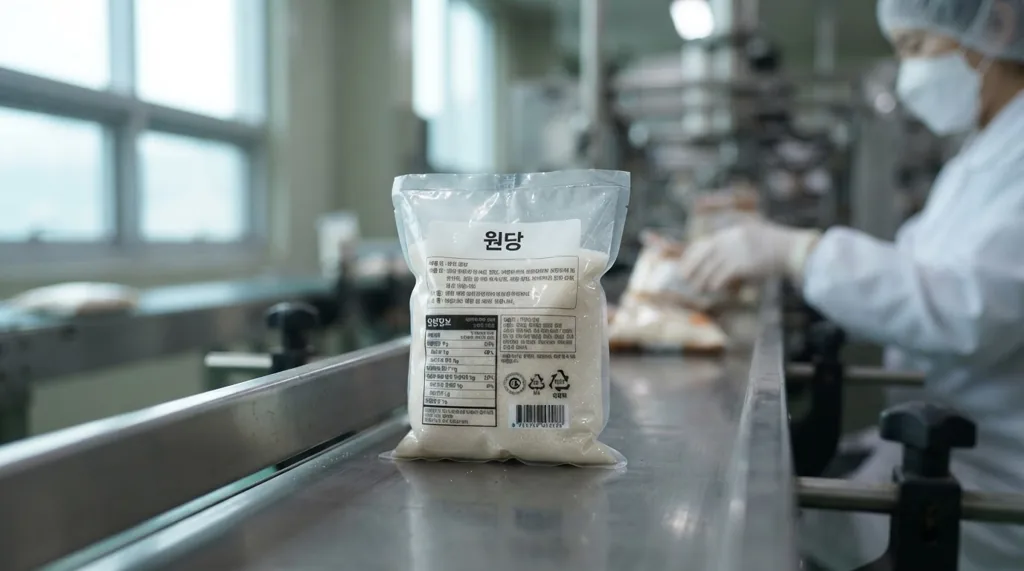
South Korea has introduced comprehensive regulatory frameworks addressing food safety, labeling standards, and advertising requirements across its domestic market.
South Korea has amended its food advertising law to ban ads that use AI-made fake experts to recommend food. From Nov. 27, 2026, violators face up to five years in prison or a fine of up to 50 million won.
The change amends the Act on Labeling and Advertising of Foods, Korea’s main law on how food is labeled and promoted1. It was issued as Act No. 21707 on 26 May 2026 and takes effect on 27 November 20262. It applies to anyone who advertises food and related products covered by the law1.
| At a glance | Details |
|---|---|
| What was published | Amendment to the Act on Labeling and Advertising of Foods (Act No. 21707) |
| Published on | 26 May 2026 |
| Who must comply | Anyone who advertises food and related products covered by the law |
| Effective date | 27 November 2026 |
| Next milestone | The ban takes effect on 27 November 2026 |
What does the new ban cover?
The amendment targets ads built with an artificial intelligence (AI) system. It covers fake sounds, images or videos that are hard to tell apart from real ones1. The ban applies when such an ad could mislead people into thinking an expert backs a food product1.
What the amendment bans
| Dimension | Provision |
|---|---|
| Content covered | AI-made sounds, images or videos hard to tell from real ones |
| Experts named | Doctors, pharmacists and university professors |
| Test | Ad could mislead people into thinking an expert backs a food |
| Status | Unfair advertising practice under the law |
| Start date | 27 November 2026 |
The law names doctors, pharmacists and university professors as examples of experts1. It also covers other experts in a related field. The amendment lists the unfair acts in detail1:
- guaranteeing or vouching for a product
- designating or officially approving it
- recommending it
- giving guidance about it
- appearing to use it
The amendment makes such an ad an unfair advertising practice under the law1. Before this change, the law did not name AI-made experts as a separate type of banned ad.
Why the government acted
The Ministry of Food and Drug Safety (MFDS), Korea’s food and medicine regulator, has tracked these ads for some time. In December 2025, it joined other ministries in announcing a plan against fake AI doctor ads3. The joint plan focused on blocking such ads quickly3.
From plan to ban
Enforcement has also continued under existing rules. On 10 June 2026, the ministry announced it had referred a seller to prosecutors4. The seller had used an AI fake doctor to promote food with exaggerated claims4. The ministry said the products sold were worth about 8.1 billion won4.
The case was handled by the ministry’s central investigation unit for hazardous crimes4. From November, the amendment names this kind of ad directly in the law.
Penalties for breaking the rule
The amendment sets criminal penalties, not just administrative ones. A person who breaks the ban faces up to five years in prison or a fine of up to 50 million won1.
Maximum penalties
The law already allows other tools against unfair ads. A 2024 change raised the maximum penalty surcharge for unfair labeling or ads1. It now stands at up to twice the amount of sales of the product concerned1.
How this fits earlier changes to the law
The food advertising act took effect in March 20191. It brought labeling and advertising rules from three separate laws into one act1. These were the Food Sanitation Act, the health functional foods law and the livestock products hygiene law1.
Several later changes tightened the rules. The table lists the main ones in force or coming soon1.
| Key date | What happened |
|---|---|
| 1 January 2023 | Use-by dates replaced sell-by dates on food labels1 |
| 3 July 2024 | Maximum surcharge raised to twice the product’s sales1 |
| 19 September 2025 | MFDS gained powers to monitor online food ads and ask platforms to act1 |
| 27 November 2026 | Ban on AI-made fake expert ads takes effect2 |
The September 2025 change matters for the new ban. It lets the ministry monitor food ads on the internet1. It also lets the ministry ask online service providers to take needed steps on illegal ads1.
What changes for food sellers and advertisers
From 27 November, food ads can no longer show an AI-made doctor or professor appearing to back a product. The test is whether the ad could mislead people about an expert’s backing1.
The ban is not limited to videos. It also covers AI-made sounds and images that are hard to tell from real ones1. Online ads fall within the ministry’s monitoring powers added in 20251.
Key terms in plain words
| Term | Meaning |
|---|---|
| MFDS | Ministry of Food and Drug Safety, Korea’s food and medicine regulator |
| AI-made fake expert | A doctor, pharmacist or professor created by AI software, not a real person |
| Unfair advertising practice | An ad the law bans because it can mislead consumers |
| Penalty surcharge | A money penalty set by the regulator, based on a product’s sales |
| Use-by date | The last date a food can safely be eaten |
The ban on AI-made fake expert food ads takes effect on 27 November 20262.
Sources
- ↩ 국가법령정보센터|전체 제정·개정이유 https://law.go.kr/LSW/lsRvsRsnListP.do?lsId=013094&chrClsCd=010102
- ↩ 식품 등의 표시ㆍ광고에 관한 법률 > 법령 > 본문 | 국가법령정보센터 https://www.law.go.kr/법령/식품등의표시ㆍ광고에관한법률/(21707,20260526)
- ↩ 식품의약품안전처>알림>언론홍보자료>보도자료 | 식품의약품안전처 — m 99 / view.do https://mfds.go.kr/brd/m_99/view.do?seq=49545&srchFr=&srchTo=&srchWord=&srchTp=&itm_seq_1=0&itm_seq_2=0&multi_itm_seq=0&company_cd=&company_nm=&page=6
- ↩ 식품의약품안전처>알림>언론홍보자료>보도자료 | 식품의약품안전처 — m 99 / list.do https://www.mfds.go.kr/brd/m_99/list.do?srchTp=0&srchWord=가짜 의사