

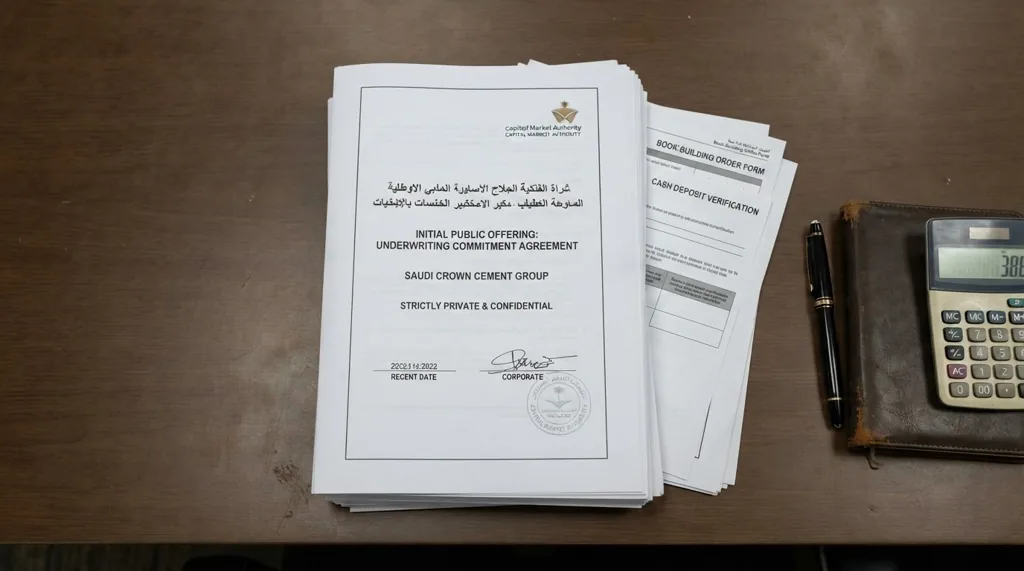
Saudi Arabia’s market regulator now requires IPO underwriters to buy all offered shares, with stricter order checks, effective 2 November 2026.
Saudi Arabia’s Capital Market Authority has approved new rules that make underwriters buy every share in an initial public offering that investors do not take up. The rules took effect on 2 November 2026, the day they were published.
The board of the Capital Market Authority (CMA), the kingdom’s securities regulator, approved the rules to tighten how share sales are run1. They cover underwriters, companies selling shares, their financial advisers and the investors who place orders. The CMA will publish questions and answers on the rules in its guidance for applying its regulations1.
| At a glance | Details |
|---|---|
| What was published | Final rules to improve initial public offering practices |
| Published on | 2 November 2026 |
| Who must comply | Underwriters, issuing companies, financial advisers and investors placing orders |
| Effective date | 2 November 2026 |
| Next milestone | Questions and answers to be added to the CMA’s guidance |
What the CMA approved, and why it matters
An initial public offering (IPO) is when a company first sells its shares to the public. Before the sale, banks gather investor orders to set the price, a step called book-building. The CMA says the new rules aim to reduce risks in securities deals and to supervise the firms it regulates1.
The regulator expects more transparency to make the Saudi market more attractive to companies and investors1. It also wants orders placed during book-building to reflect real demand backed by real money.
Underwriters must buy all offered shares
An underwriter is a bank or broker that guarantees the sale of shares. Under the new rules, the underwriting agreement must be signed and in force before book-building starts1. From the moment book-building begins, the underwriter must buy all shares offered that are not taken up1.
The rules also deal with a failed sale. If the underwriter ends up holding so many shares that the company no longer meets the stock exchange’s listing rules, the company’s shares will not be listed1. The underwriter must still buy all the shares offered. The underwriting agreement may set out how the underwriter can later sell those shares1.
| Area | What the rules require |
|---|---|
| Underwriting agreement | Signed and in force before book-building begins |
| Underwriter’s duty | Buy all offered shares from the start of book-building |
| Listing failure | Shares are not listed and the underwriter buys all shares offered |
| Share disposal | The agreement may set out how the underwriter sells them |
Tighter checks on investor orders
The rules add new checks on orders placed during book-building. Orders must reflect the cash actually available to the investor1. Proof that an investor can pay is now limited to cash or cash equivalents1.
Orders must also become binding for payment no later than the deadline to pay for shares. That deadline is set in the prospectus, the official document describing the offering1. The September draft said the issuer’s financial adviser and any other licensed market firm receiving orders must carry out these checks2.
New forecasts in the prospectus
Issuing companies must now publish forward-looking statements and forecasts in the prospectus and registration document1. These include expected financial performance measures. The forecasts must cover the rest of the latest financial period in the prospectus, plus at least the following financial year1.
The forecasts must be clear, not misleading and based on reasonable, measurable grounds1. Companies must explain how they prepared them, the main assumptions behind them and the key risks that could make results differ. Financial advisers must use proper professional care to reach a reasonable opinion on the forecasts1.
How the final rules differ from the draft
The CMA published the draft on 22 September 2026 for 30 calendar days of public comment2. Comments closed on 22 October 2026, and the draft already named 2 November 2026 as the start date2.
The draft asked for forecasts covering a period of at least one year2. The final rules spell out the period more precisely. They cover the rest of the latest financial period plus at least one full following year1. The final rules also let the underwriting agreement include a way to sell shares the underwriter has to keep1.
Key terms in plain words
| Term | Meaning |
|---|---|
| Initial public offering (IPO) | A company’s first sale of shares to the public |
| Book-building | Gathering investor orders before a share sale to set the price |
| Underwriter | A bank or broker that guarantees a share sale will be completed |
| Prospectus | The official document describing a share sale to investors |
| Forward-looking statements | A company’s own forecasts of its future results |
| Cash equivalents | Assets that can be turned into cash quickly and safely |
The rules are already in force, and the CMA’s next step is to publish questions and answers explaining how they apply1.
Sources
- ↩ The CMA Approves the Regulatory Provisions to Enhance IPO Practices | The Capital Market Authority’s https://cma.gov.sa/en/MediaCenter/NEWS/Pages/CMA_N_4147.aspx
- ↩ The CMA Calls for Public Consultation on the Draft Regulatory Provisions to Enhance IPO Practices | The Capital Market Authority’s https://cma.gov.sa/en/MediaCenter/NEWS/Pages/CMA_N_4123.aspx