
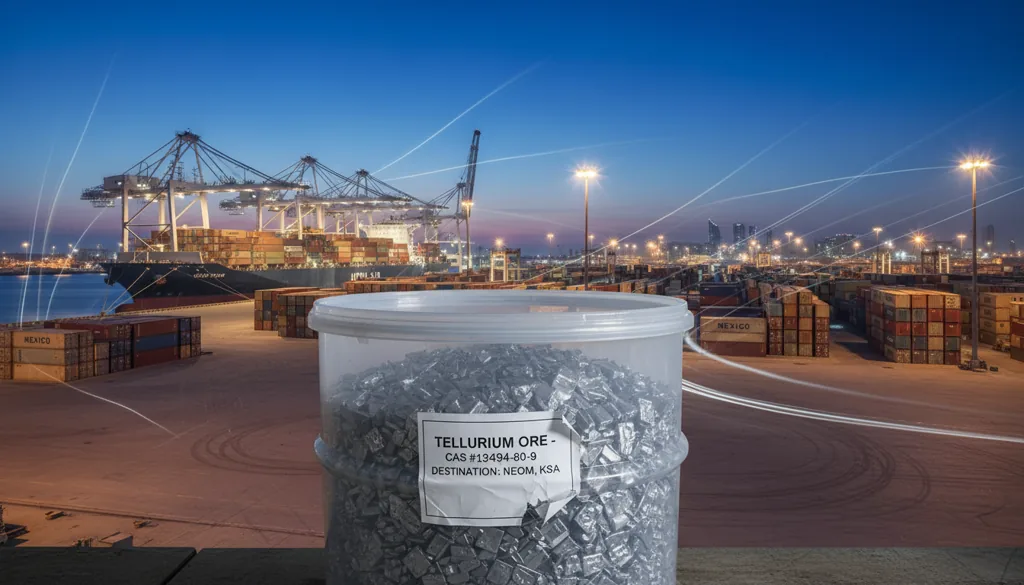
Saudi Arabia continues to impose a 5% import duty on tellurium in 2026, impacting trade flows, particularly from Mexico.
Saudi Arabia keeps 5% duty on tellurium imports as solar demand surges
Saudi Arabia will maintain its 5% import duty on tellurium in 2026, leaving a key cost in place for solar manufacturers as the kingdom ramps up thin-film photovoltaic production1. The duty applies to all shipments of the metal, which is critical for cadmium telluride solar panels used in NEOM’s 2.4 GW solar project. Mexico, the primary supplier, is expected to export 180 tonnes to Saudi Arabia this year, up from 148 tonnes in 20251.
Mexican tellurium exports to Saudi Arabia
The delivered cost of Mexican tellurium in Jeddah now averages $85 per kilogram, a $10 premium over the global benchmark, reflecting both the duty and the security of supply under US-Mexico-Canada Agreement rules1. The trade corridor, which cuts transit time to 18 days via the expanded Panama Canal, now accounts for 12% of global tellurium trade1. For importers, the duty remains a fixed cost that cannot be offset by Saudi Industrial Development Fund subsidies until the material clears customs1.
It comes after two years of rapid growth in Saudi solar capacity, which has tightened global tellurium supply and pushed prices up 12% year-on-year. The kingdom’s demand is set to double again by 2030 as NEOM expands to 10 GW of solar generation1.
The duty stays in place while solar production scales up
Saudi Arabia’s 5% duty on tellurium imports will remain unchanged through 2026, despite calls from solar manufacturers for relief as production costs rise1. The duty applies to all tellurium shipments, regardless of origin, and is calculated on the CIF value of the material. For a 20-tonne container arriving in Jeddah, the duty adds $85,000 to the delivered cost1.
Tariff treatment, tellurium vs other solar inputs
| Question | Tellurium (HS 2804.50) | Silicon wafers / solar glass |
|---|---|---|
| Import duty | 5%, on CIF value | Zero |
| Status set | June 2025 GCC tariff update | January 2025 exemption |
| Exempted critical mineral? | No | Yes |
| Relief for manufacturers | None through 2026 | Supports local assembly |
The decision to keep the duty in place was confirmed in the June 2025 Gulf Cooperation Council tariff update, which left tellurium (HS 2804.50) outside the list of exempted critical minerals2. The move contrasts with Saudi Arabia’s recent zero-duty treatment of silicon wafers and solar glass, which were granted tariff-free status in January 2025 to support local panel assembly2.
For Mexican exporters, the duty is partly offset by USMCA rules of origin, which allow Saudi buyers to avoid the 25% Section 301 tariffs that apply to Chinese tellurium1. Even so, the 5% duty remains a competitive disadvantage, particularly as Chinese material is still 10% cheaper on a free-on-board basis1.
Mexico’s refining bottleneck limits supply growth
Mexico’s tellurium refining capacity is capped at 200 tonnes per year, leaving little room to meet Saudi Arabia’s growing demand1. Industrias Peñoles, the country’s largest refiner, is operating at 95% utilisation, and any disruption at its Torreón facility could delay shipments to NEOM’s solar manufacturing complex1.
The bottleneck in numbers
The bottleneck has already caused occasional delays at Veracruz port, where cold-chain storage for tellurium is limited1. Each 1-tonne intermediate bulk container must be kept below 25°C to prevent oxidation, and the port’s current infrastructure can handle only 15 containers at a time1. When demand spikes, exporters have to hold material inland, adding up to five days to the supply chain.
The constraint is expected to ease in 2027, when Peñoles plans to expand its refining capacity by 30%. Until then, Saudi importers are securing long-term supply agreements to lock in volumes, even at the current $85/kg premium1.
The trade corridor reshapes global supply chains
The Mexico-Saudi Arabia tellurium corridor has become a strategic trade route, accounting for 12% of global tellurium trade in 20261. The corridor leverages the expanded Panama Canal and new Red Sea logistics hubs, cutting transit time from Veracruz to Jeddah to 18 days and reducing freight costs by 15% compared to 20241.
The route’s growth has tightened global supply, contributing to a 12% year-on-year price increase and prompting other producers in Peru and Canada to explore similar export routes to the Middle East1. For Saudi Arabia, the corridor offers a politically stable alternative to Chinese supply, aligning with the kingdom’s goal of diversifying critical mineral sources under Vision 20301.
However, the corridor’s reliance on Mexican refining capacity and Red Sea shipping lanes introduces risks. Geopolitical instability in the region has already led to higher insurance premiums, though the Saudi-led maritime security coalition has reduced incidents1.
What importers must file to clear customs
Importers of tellurium into Saudi Arabia must submit a pre-issued import permit before the shipment arrives, along with a certificate of analysis showing 99.99% purity3. The permit is obtained through the Integrated Customs Tariff Inquiry e-service, which requires advance ruling requests for each shipment3.
Documents every tellurium shipment needs
The certificate of analysis must be issued by an accredited laboratory and include test results for impurities such as selenium, arsenic, and lead1. Shipments that fail to meet the purity threshold are subject to post-entry quarantine, where the material is held until additional testing is completed3.
For preferential treatment under USMCA, importers must also provide a certificate of origin confirming the tellurium was refined in Mexico1. Without it, the shipment is assessed the 5% duty plus any applicable Section 301 tariffs on non-North American material1.
The process takes effect on 1 January 2026, giving importers three months to adjust their documentation2. Those who fail to secure the required permits before arrival face delays of up to 10 days at Jeddah Islamic Port3.
Sources
- ↩ Mexico to Saudi Arabia Tellurium Corridor Intelligence https://energy-solutions.co/supply-chain/trade-flows/mexico-to-saudi-arabia-tellurium-corridor-c935
- ↩ Integrated Tariffs GCC https://zatca.gov.sa/en/RulesRegulations/Taxes/Pages/Integrated-Tarrifs.aspx
- ↩ Integrated Customs Tariff Inquiry https://zatca.gov.sa/en/eServices/Pages/eServices-220.aspx