

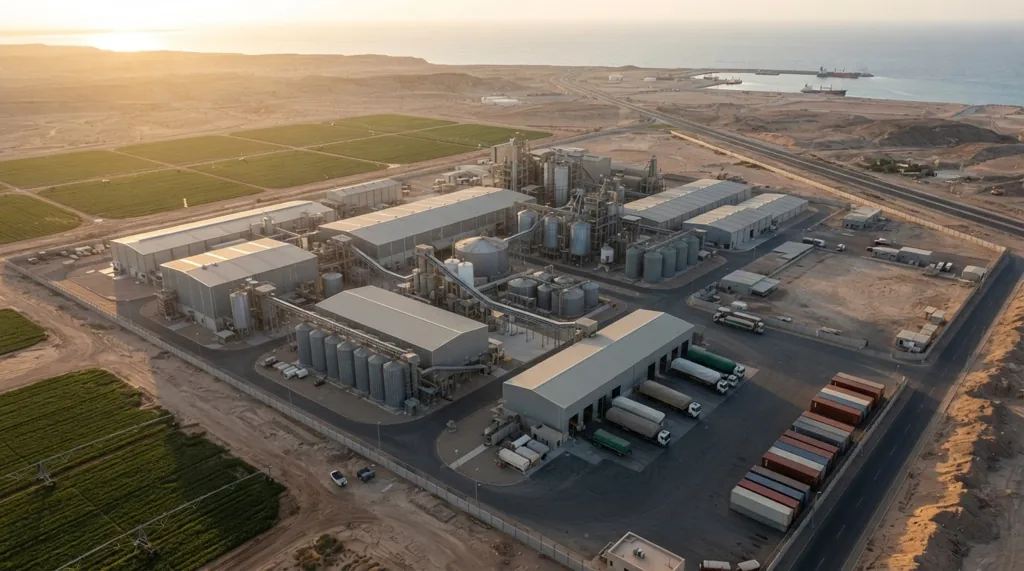
Saudi Arabia has established general requirements for novel feeds and feed products derived from biotechnology applications.
Saudi Arabia’s food and drug regulator has drafted rules that would require approval before novel and biotech animal feeds reach the market. Feed makers and importers would need safety studies, minimum toxicity tests and a registration permit from the regulator before selling.
The Saudi Food and Drug Authority (SFDA) circulated the draft technical regulation, "General requirements for novel feeds and feed products of biotechnology", for comment1. It was notified to the World Trade Organization (WTO) on 14 October 2026 under the number G/TBT/N/SAU/14582. The draft cannot be treated as a Saudi technical regulation until the SFDA approves it, and its approval date is still left blank1.
| At a glance | Details |
|---|---|
| What was published | Draft technical regulation on novel and biotech animal feeds |
| Published on | 14 October 2026 (WTO notification) |
| Who must comply | Feed companies and others placing novel feeds on the Saudi market |
| Feedback deadline / Effective date | Open for comment; no adoption date set yet |
| Final rules / Next milestone | Approval by the SFDA after comments |
What counts as a novel feed?
The draft sorts novel feeds into three groups1. Common novel feeds have a history of safe use in countries other than Saudi Arabia. Uncommon novel feeds were not widely fed to animals in the Kingdom before a cut-off date that the draft leaves blank.
The third group covers feeds made with advanced biotechnology, such as genetic modification1. These feeds change an organism’s genes in ways that ordinary breeding or natural selection could not. Their purpose may be better nutrition, animal performance, immunity or environmental gains.
A feed also qualifies as novel if it meets any one of several tests1. Examples include a new or modified molecular structure, or material from microorganisms, fungi or algae. Feeds from animals or insects, from cell or tissue cultures, or from new production methods also qualify.
The SFDA’s core approval rules
Every feed within scope must pass a safety review before marketing1. No such feed may be sold in Saudi Arabia without an SFDA permit to register a novel feed. Feed companies themselves are responsible for checking whether a product meets the definition.
The core duties for all novel feeds are set out below1.
| Area | What the draft requires |
|---|---|
| Market access | SFDA approval and registration before any sale |
| Sources | Halal sources, in line with Saudi halal feed rules |
| Packaging and labels | Compliance with existing SFDA feed packaging and label rules |
| Quality | Same standards as comparable conventional feeds |
| Comparison | Molecular, nutritional, toxicity and allergy data compared with a conventional feed |
| Environment | An assessment of possible environmental effects |
| New risks | Immediate reporting of new risks found after approval |
The SFDA may also ask applicants for extra studies run by qualified researchers using validated methods1.
Minimum safety tests
The draft sets a floor of five toxicity tests for each novel feed1. These cover acute effects when swallowed, breathed in or placed on the skin. They also cover genetic damage and short-term toxicity over 30 to 90 days.
New rules for insect and other novel proteins
Plants making novel protein must hold an SFDA licence, and farms supplying animal-origin inputs must also be licensed1. Protein must be made in dedicated plants or separate production lines. It must not contain prions, the infectious proteins linked to brain diseases in animals.
Insect protein faces tighter limits1. Insects must not be genetically modified. They must not be fed on farm manure, slaughterhouse waste or banned food waste. Species known to carry disease, protected species and invasive species are barred.
The draft lists seven approved insect species, and any other insect needs SFDA approval first1.
| Insect | Life stage allowed |
|---|---|
| Black soldier fly | Larvae |
| Yellow mealworm | Larvae |
| House cricket | Adults |
| Tropical house cricket | Adults |
| Black field cricket | Adults |
| Silkworm | Larvae |
| Locust (Locusta migratoria) | Adults |
What biotech feed makers must submit
Feeds of animal origin made with cloning or gene-splicing tools must be shown safe for people, animals and the environment1. Makers of microbial enzymes must give the enzyme’s scientific name and class number. They must also give its optimal acidity and temperature.
Makers using genetically modified microbes face a list of 37 requirements1. They must show the microbe does not cause disease and that its genetic changes are stable. Any resistance to antibiotics must be described, and each microbial strain must be registered before the product.
For genetically modified plants, applicants must describe the new trait and how it was introduced1. They must avoid gene markers that give resistance to medically important antibiotics. The plant must not become a pest or spread into the wild.
How this fits Saudi Arabia’s novel food rules
The feed draft cites the SFDA’s existing novel food regulation, SFDA.FD 5013, as a related rule1. That regulation already gives novel foods a clear approval route, backed by a guide and an online investor platform3. The SFDA describes this work as part of its Fourth Strategic Plan for 2023 to 20273.
The draft also lists Canada’s novel feed requirements among its reference documents1. For feed suppliers, the change is a formal approval gate, matching the one food makers already face.
Key terms in plain words
| Term | Meaning |
|---|---|
| Novel feed | Animal feed not widely used in Saudi Arabia before, or made in a new way |
| Technical regulation | A binding product rule issued by a government regulator |
| Pre-market assessment | A safety review a product must pass before it can be sold |
| Genetically modified | Having genes changed in a lab in ways breeding cannot achieve |
| Prion | An infectious protein that can cause brain disease in animals |
| WTO notification | Formal notice to trading partners about a planned product rule |
The next step is SFDA approval of the final regulation once comments on the draft are reviewed.
Sources
- ↩ 26_05366_00_x.pdf https://members.wto.org/crnattachments/2026/SPS/SAU/26_05366_00_x.pdf
- ↩ TBT notifications – EVS standard evs.ee | en https://www.evs.ee/en/wtonotifications/tbtnotifications
- ↩ SFDA Drives Food Innovation and Biotechnology Advancement in Saudi Arabia | General Authority for Food and Drug https://www.sfda.gov.sa/en/news/18781