

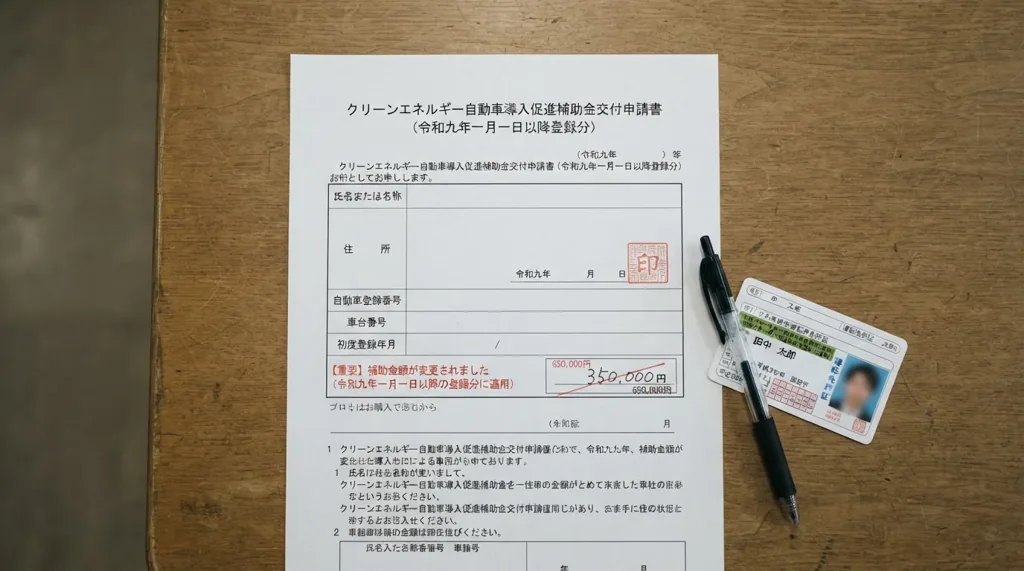
Japan’s METI cuts the top EV purchase subsidy from ¥1.25 million to ¥750,000 for cars registered from 1 January 2027.
Japan’s Ministry of Economy, Trade and Industry (METI) will cut its purchase subsidy for new electric cars by about 40% at the top. Cars newly registered from 1 January 2027 will get at most ¥750,000, down from ¥1.25 million.
METI announced the change on 21 October 2026 for its Clean Energy Vehicle (CEV) subsidy, the national grant paid to buyers of electric, plug-in hybrid and fuel-cell cars1. Applications have been arriving faster than planned, and the money was expected to run out before the 12 February 2027 closing date2. Lower payments are meant to keep the scheme open as long as possible within the existing budget2.
| At a glance | Details |
|---|---|
| What was published | Revised subsidy amounts for the CEV purchase grant |
| Published on | 21 October 2026 |
| Who must comply | Car buyers, carmakers and dealers using the CEV grant |
| Effective date | 1 January 2027 (new vehicle registration date) |
| Next milestone | Applications close 12 February 2027, or earlier if funds run out |
What is the CEV subsidy, and why is it changing?
The CEV subsidy pays part of the price of a new clean-energy car. It is funded from the government’s fiscal 2025 supplementary budget, with about ¥110 billion set aside1. Applications opened on 31 March 20261.
METI links the grant to its goal of carbon neutrality by 2050 and to building a domestic market for electric vehicles (EVs)2. The ministry said that, given current application levels, the budget would end earlier than the February 2027 deadline2. On 9 October 2026 it estimated that applications would close between early and late December 20261.
The cut applies only if the programme is still running in January 20272. Its stated aim is to keep paying subsidies for as long as possible with the money left2.
How much each type of car will get
Payments still depend on a score METI gives each model. The score rates the car and the carmaker’s wider efforts, such as building charging points and securing stable supply1. METI said it will keep this scoring method2.
The top payments, for cars scoring 130 or more, fall sharply across all four vehicle types2.
| Vehicle type (score 130+) | Before → From 1 Jan 2027 |
|---|---|
| Electric car (EV) | ¥1.25 million → ¥750,000 |
| Kei (mini) electric car | ¥550,000 → ¥440,000 |
| Plug-in hybrid (PHEV) | ¥800,000 → ¥480,000 |
| Fuel-cell car (FCV) | ¥1.45 million → ¥870,000 |
Lower score bands are also reduced2. A standard EV scoring 115 to 129 drops from ¥950,000 to ¥570,000. One scoring 100 to 114 drops from ¥650,000 to ¥390,0002.
Cuts for lower-scoring models
Models with weaker scores lose a similar share of their grant2. The bottom band, for models scoring 54 or less, falls from ¥150,000 to ¥90,000 for EVs, kei EVs and plug-in hybrids2. For fuel-cell cars in that band, it falls from ¥250,000 to ¥140,0002.
| EV score band | Before → From 1 Jan 2027 |
|---|---|
| 85 to 99 | ¥450,000 → ¥270,000 |
| 70 to 84 | ¥350,000 → ¥210,000 |
| 55 to 69 | ¥250,000 → ¥150,000 |
| 54 or less | ¥150,000 → ¥90,000 |
The same bands from 85 down apply at the same new rates to kei EVs and plug-in hybrids2. Fuel-cell cars keep their own, higher scale, such as ¥690,000 for a score of 85 to 992.
Smaller bonus for green steel
METI also adds a bonus to the grant for carmakers that cut environmental impact and use steel that supports its green transformation (GX) policy2. GX is Japan’s programme to shift industry toward lower carbon emissions.
That bonus falls from a maximum of ¥50,000 to ¥30,0002. For kei EVs, it falls from a maximum of ¥30,000 to ¥18,0002.
Who is affected and when
The new amounts apply to vehicles newly registered as new cars on or after 1 January 20272. Cars registered before that date keep the current amounts1.
Buyers, dealers and carmakers selling EVs, plug-in hybrids and fuel-cell cars in Japan are directly affected. Applications are handled first-come, first-served by date of arrival at the scheme’s office1. When the budget is used up, the window closes on the previous business day1.
The scheme is run by the Next Generation Vehicle Promotion Center, a private association that processes applications for METI1. METI said it will keep updating its estimate of when applications will close1.
Key terms in plain words
| Term | Meaning |
|---|---|
| CEV subsidy | Japan’s national grant toward buying a new clean-energy car |
| Kei car | Japan’s smallest class of passenger car, with its own size limits |
| PHEV | Plug-in hybrid, a car with a battery that charges from a socket plus a petrol engine |
| FCV | Fuel-cell vehicle, a car that makes electricity from hydrogen |
| GX | Green transformation, Japan’s policy to move industry toward low carbon |
| Supplementary budget | Extra spending approved by the government after the main annual budget |
The lower subsidy amounts take effect for cars registered on or after 1 January 20272.
Sources
- ↩ 令和7年度補正予算「クリーンエネルギー自動車導入促進補助金」 (METI/経済産業省) https://www.meti.go.jp/policy/mono_info_service/mono/automobile/cev/r7h_cev.html
- ↩ R7CEV_minaoshi.pdf https://www.meti.go.jp/policy/mono_info_service/mono/automobile/cev/R7CEV_minaoshi.pdf