

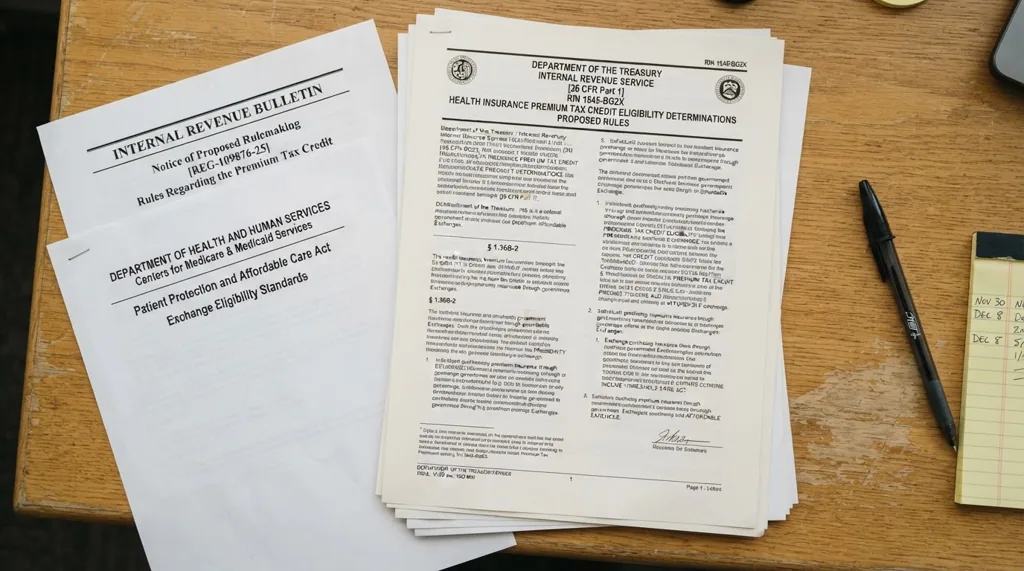
Treasury and the IRS proposed rules narrowing who can claim the health insurance premium tax credit. Comments are due Nov. 30, 2026.
The US Treasury Department and the Internal Revenue Service (IRS) have proposed new rules for the health insurance premium tax credit. Comments are due by Nov. 30, 2026, and a public hearing by phone is set for Dec. 8, 2026.
The proposed regulations were published in the Federal Register on Oct. 15, 2026, under the reference REG-101576-261. They would change who can get the credit, how it is calculated, and what people owe when advance payments were too high1. They affect people who buy individual health insurance for themselves or family members through a Health Insurance Exchange, the government-run insurance marketplace1.
| At a glance | Details |
|---|---|
| What was published | Proposed regulations and notice of public hearing |
| Published on | 15 October 2026 |
| Who can comment / Who must comply | The public; rules affect people buying Exchange health insurance |
| Feedback deadline / Effective date | 30 November 2026 (comments) |
| Final rules / Next milestone | Phone hearing on 8 December 2026, 10 a.m. ET |
What is the premium tax credit?
The premium tax credit (PTC) is a refundable credit that helps eligible people pay for health insurance bought through the marketplace2. People claim it on their tax return using Form 89622. The marketplace can also pay part of the credit in advance, straight to the insurer, to lower monthly premiums2.
These advance payments are called advance premium tax credit (APTC)2. At tax time, people compare the advance payments with the credit they actually qualify for. If the advance was too high, they may owe money back2.
Why the IRS is changing the rules
The proposals put into effect changes Congress made to the tax code in the law known as the One, Big, Beautiful Bill Act (OBBBA)1. That law, Public Law 119-21, was signed on July 4, 20251. The proposed regulations cover sections 71119 and 71301 through 71305 of the act1.
Treasury and the IRS write the detailed rules that apply the law to individual tax returns. This proposal is that step for the health insurance credit.
Who loses eligibility for the credit
In general, the credit goes to households earning between 100% and 400% of the federal poverty level, the income line the government uses to measure poverty1. Before the new law, some lawfully present immigrants earning below 100% could still claim the credit1. This applied when they could not get Medicaid, the public health program for low-income people, because of their immigration status1.
The new law removed that exception for tax years beginning after Dec. 31, 20251. These lower-income immigrants can no longer claim the credit1.
The proposal also covers people who lose Medicaid for failing new work rules, called community engagement3. Under those rules, many adults must work, volunteer, study or join a work program for at least 80 hours a month3. A person who would qualify for Medicaid except for these rules is treated as eligible for it3. That means those months do not count toward the credit3.
| Key date | What happens |
|---|---|
| Dec. 31, 2025 | Low-income immigrant exception ends for later tax years1 |
| Jan. 1, 2027 | Latest date for states to start Medicaid work rules, unless exempted3 |
| Dec. 31, 2027 | Exchange verification rules start for later tax years3 |
| Dec. 31, 2028 | Latest end of any state delay for Medicaid work rules3 |
Stricter checks before enrollment
From tax years beginning after Dec. 31, 2027, a plan bought through an Exchange that skips checks before enrollment will not qualify for the credit1. The Exchange must confirm each month that the person can enroll and can get advance payments3. It must check facts such as household income, family size, immigration status, other health coverage and home address3.
Treasury may waive these checks for people who sign up mid-year because their family size changed3. A month also will not count if the Exchange fails to act on people who did not settle past advance payments on their tax return3.
Mid-year sign-ups based on income
Exchanges allow some people to sign up outside the normal yearly window, called a special enrollment period1. The law removes credit eligibility for plans bought in a special period based on a change in expected household income1. This applies to plan years beginning after Dec. 31, 20251.
What changes for repayments and reporting
The proposal includes a section titled elimination of the excess APTC repayment limitation1. That limitation capped how much people paid back when their advance payments were higher than the credit they earned. The proposal also covers how Exchanges must report health plan information to the IRS1.
How to comment and join the hearing
Comments must arrive by Nov. 30, 2026, through the federal online portal or by mail1. The phone hearing is set for Dec. 8, 2026, at 10 a.m. ET1. Requests to speak, with an outline of topics, are also due Nov. 301. If no outlines arrive by then, the hearing will be cancelled1. Requests to attend must arrive by 5 p.m. ET on Dec. 4, 20261.
Key terms in plain words
| Term | Meaning |
|---|---|
| Premium tax credit (PTC) | A tax credit that lowers the cost of marketplace health insurance |
| Advance premium tax credit (APTC) | Part of the credit paid early to the insurer each month |
| Exchange | The government-run marketplace for buying health insurance |
| Special enrollment period | A window to sign up outside the yearly enrollment season |
| Federal poverty level | The income line the government uses to measure poverty |
| Community engagement | Medicaid work, volunteer or study rules of 80 hours a month |
The next milestone is the Nov. 30, 2026 deadline for comments and hearing requests1.
Sources
- ↩ Federal Register :: Premium Tax Credit https://www.federalregister.gov/documents/2026/10/15/2026-21056/premium-tax-credit
- ↩ The Premium Tax Credit – The basics | Internal Revenue Service https://www.irs.gov/affordable-care-act/individuals-and-families/the-premium-tax-credit-the-basics
- ↩ 2026-21056.pdf https://www.govinfo.gov/content/pkg/FR-2026-10-15/pdf/2026-21056.pdf