

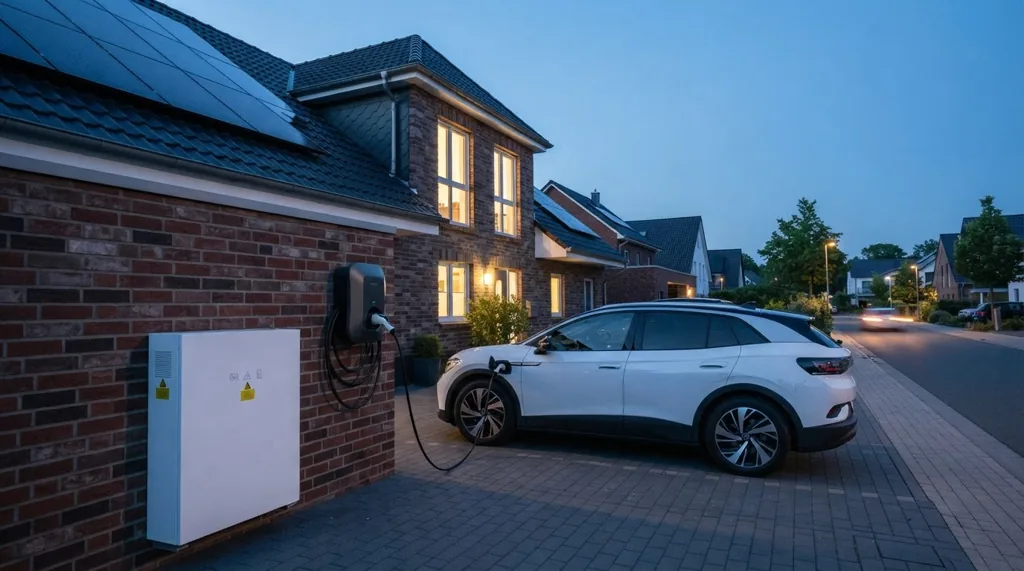
Germany’s Federal Network Agency adopted the MiSpeL rules on Oct. 1, 2026, letting batteries and bidirectional charge points mix solar and grid power, with a transition period until Sept. 30, 2027.
Germany’s Federal Network Agency on Oct. 1, 2026 adopted the MiSpeL rules, which let home and business batteries and bidirectional electric-vehicle charge points store power from both solar panels and the grid and feed it back while keeping renewable-energy support1.
The Bundesnetzagentur, Germany’s regulator for electricity, gas, telecoms, post and rail, calls the decision the "Festlegung zur Marktintegration von Speichern und Ladepunkten", or MiSpeL for short2. A Festlegung is a binding determination that the agency issues under powers granted by law.
In short, battery and charge-point owners can now mix solar power and cheap grid power in one storage unit and still keep their subsidy for the solar share. Grid operators and meter operators get until Sept. 30, 2027 to set up billing, and until then the rules apply only with their consent3.
What problem do the MiSpeL rules solve?
Until now, green power and grid power had to be kept strictly apart in storage1. Only batteries holding nothing but renewable power could receive payments under the EEG, Germany’s Renewable Energy Sources Act1. Bidirectional charge points, which charge an electric car and can also send power from the car back to the grid, were excluded1.
Storage support, old route and new options
| Question | Exclusivity option | Separation option | Flat-rate option |
|---|---|---|---|
| Grid power in storage | Ends EEG support | Allowed | Allowed |
| Charge points | Excluded | Included | Included |
| Who can use it | Pure green storage | All sizes | Solar up to 30 kWp |
| Meters | Not set | Usually two | One |
The only route so far was the so-called exclusivity option2. Under it, a battery lost its EEG support as soon as it stored any grid power2. Using that option also ruled out the levy relief available for stored grid power2.
The agency’s background paper says this conflict kept the flexibility of batteries and charge points largely unused3. Mixed use, which the paper calls "multi-use", cost owners their EEG support3.
How do batteries and charge points benefit?
Under the MiSpeL rules, EEG support continues and is also paid for renewable power that was stored first and then fed into the grid1. Power that came from the grid, was stored, and was then fed back earns a separate benefit1. Owners pay correspondingly fewer levies and grid fees on the power they drew, because the amounts fed back are netted off1.
This lets owners buy power when market prices are low and sell when prices are high1. Households, small businesses and industry that can shift their use stand to cut power costs and raise earnings this way1. The rules treat batteries and bidirectional charge points as alike as far as possible1.
The rules apply to operators who sell their power through direct marketing. They do not apply to those who receive a fixed feed-in tariff, a set payment per unit of power fed into the grid3.
What are the two MiSpeL options?
The determination opens two new ways to work out how much power qualifies for support and how much qualifies for levy relief2. The full decision consists of three documents: the ruling with its reasoning, Annex 1 on the separation option and Annex 2 on the flat-rate option2.
The separation option is open to all users and installations of every size3. A separate meter measures the battery or charge point, and every 15 minutes the system records where power came from and where it went3. The formulas usually require two meters, though in special cases one is enough1.
The flat-rate option is a simpler route for households and small businesses with a solar installation of up to 30 kWp (kilowatt-peak, a measure of solar panel capacity)3. Only one meter at the house connection, recording each quarter-hour, is needed3. The meter cabinet does not have to be rebuilt3.
Under the flat-rate option, power fed into the grid is classed as eligible for support up to a flat limit of 500 kWh per kWp3. Above that, the agency applies a buffer zone so that solar power does not receive extra support from consumers’ grid fees and levies without good reason3.
The separation option also covers other cases, such as:
- batteries placed next to a solar farm or wind turbine3
- systems that include a heat pump3
- batteries at energy-intensive industrial firms3
- batteries connected only to the grid, with no generation on site3
The final rules also work with renewable installations that receive no support, and even with no on-site generation at all1.
What limits apply to electric-vehicle charging?
For electric vehicles, the rules make vehicle-to-home and vehicle-to-grid use possible without a second meter3. The rules look at the charge point, not each car, so any bidirectional car can use any bidirectional charge point3.
Flat calculation factor for charge points
Levies and grid fees no longer apply to power fed back into the grid from a charge point3. But owners must still pay levies and grid fees on the grid power used to drive the car, including its storage losses3. Power charged elsewhere, for example at an employer, and then fed back at home gets no EEG support3.
The agency cut the flat calculation factor for charge points from 0.5 to 0.23. That shrinks the buffer zone and meets a central demand from market participants3.
What safeguards does the agency set?
When power is fed into the grid while market prices are negative, the levy relief is lost3. Support payments are also lost where the EEG provides for it3. The aim is that owners feed in power only when the market needs it3.
Grid power used for other purposes in a home or business remains subject to all levies and grid fees3. The agency says the rules give maximum room for innovation with clear limits against abuse1.
How did the MiSpeL rules change after consultation?
The agency’s renewable energy unit opened the proceeding on July 31, 20252. It published draft key points for consultation on Sept. 18, 2025, and comments were due by Oct. 24, 20252. Utilities, battery makers, carmakers, grid operators and industry groups sent in responses2.
From proceeding to transition
A working draft followed on Aug. 5, 20262. It switched to a monthly netting period and added cases with no subsidised renewable installation2. It also changed formulas to stop owners feeding in stored power regardless of market prices just to gain levy relief2. Simpler formulas for special cases were added in the final version1.
When can operators start using MiSpeL?
The determination includes a transition period until Sept. 30, 2027 for grid operators and meter operators3. During that time, owners can use either option only with consent from both operators1. The period gives these operators time to set up the IT and billing systems needed for mass use3.
The flat-rate option faces one more hurdle. It cannot be used until the European Commission grants state aid approval for its legal basis1.
Sources
- ↩ Bundesnetzagentur – Presse – Bundesnetzagentur erlässt Festlegung zur Marktintegration von Stromspeichern und Ladepunkten (MiSpeL) https://www.bundesnetzagentur.de/1116876
- ↩ Bundesnetzagentur – Homepage – Festlegung zur Marktintegration von Speichern und Ladepunkten (MiSpeL) http://www.bundesnetzagentur.de/DE/Fachthemen/ElektrizitaetundGas/ErneuerbareEnergien/EEG_Aufsicht/MiSpeL/artikel.html
- ↩ MiSpeL Erklärdokument & Sprechzettel https://www.bundesnetzagentur.de/DE/Fachthemen/ElektrizitaetundGas/ErneuerbareEnergien/EEG_Aufsicht/MiSpeL/DL/Hintergrundpapier.pdf?__blob=publicationFile&v=3