

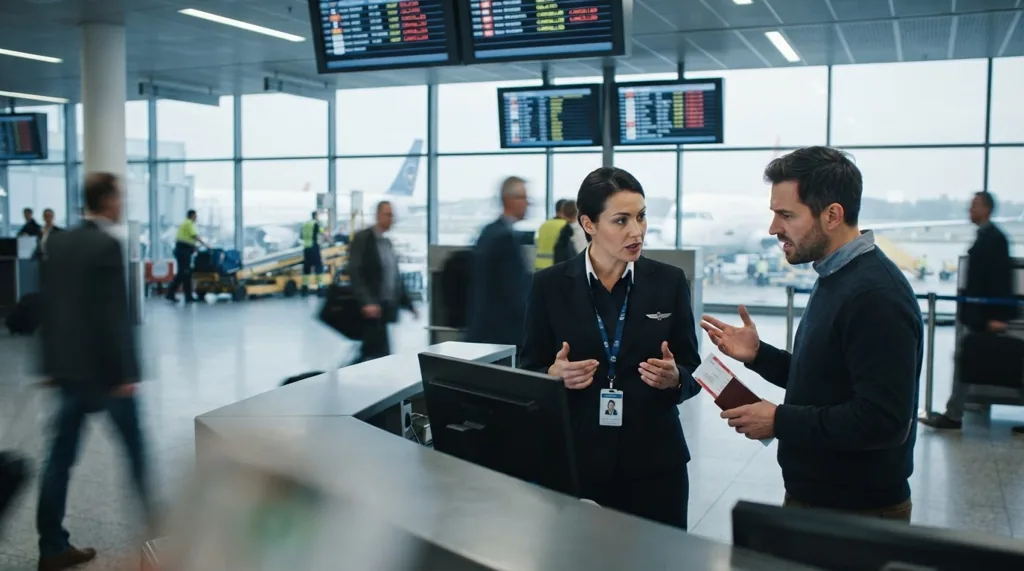
European Union Regulation (EU) 2026/2202 overhauls airline compensation, refund, assistance and fee rules, taking effect on 22 Oct. 2026 with a one-year preparation period.
The European Union has published Regulation (EU) 2026/2202, which rewrites what airlines owe passengers after denied boarding, cancellations, long delays and baggage problems, with the law taking effect on 22 Oct. 20261.
The regulation was adopted by the European Parliament and the Council on 16 September 2026 and appeared in the Official Journal of the European Union on 2 October 20261. It amends Regulation (EC) No 261/2004, the EU’s air passenger rights law, and Council Regulation (EC) No 2027/97, which covers airline liability for passengers and their baggage1.
In short, airlines keep paying fixed compensation of up to €600 for long delays and late cancellations, but must now tell passengers how to claim, answer claims within set deadlines and stop charging certain fees. Airlines, ticket sellers and large airports will need new processes, customer messages and pricing displays before the rules start to apply.
When do the new EU passenger rules apply?
The rules enter into force 20 days after publication in the Official Journal2. The EUR-Lex record gives 22 Oct. 2026 as the date of effect1.
From that moment, EU countries and companies have one year to prepare for implementation, according to the European Parliament2. That gives airlines and booking platforms a fixed window to change their systems and contracts.
Parliament approved the joint text agreed with the Council in the Conciliation Committee, a joint negotiating body of the two institutions, by 646 votes to 12, with 3 abstentions3. The Conciliation Committee had approved that text on 15 June 20261.
How much compensation must airlines pay?
Passengers can still claim compensation for delays of more than three hours, for flights cancelled less than 14 days in advance, and for denied boarding3. The amounts are unchanged and depend on flight distance2:
- €250 for journeys up to 1,500 km
- €400 for intra-EU journeys over 1,500 km and other journeys between 1,500 km and 3,500 km
- €600 for all other, longer journeys
Compensation by flight distance, EUR
Airlines may cut compensation by 50% on their longest journeys in two cases2. One is when passengers are offered rerouting to their final destination. The other is when the arrival delay does not exceed four hours.
If a plane lands at a different airport, the airline must provide a transfer to the original airport of arrival3. Passengers arriving there more than three hours late are entitled to compensation3.
Which events excuse an EU airline from paying?
The regulation defines "extraordinary circumstances", events outside an airline’s normal business and beyond its actual control1. Both conditions must be met1.
An open list names events that qualify, including natural disasters, war, adverse weather, unruly passengers and strikes by airport, air navigation or ground handling staff3. An event outside the list is judged case by case1.
Invoking such an event is not enough on its own. The airline must also prove the event caused the disruption and that all reasonable measures could not have avoided it1. It must give the passenger a clear, specific explanation in plain language1.
Even then, the duty of care stays. Airlines must provide refreshments every two hours of waiting, a meal after three hours and, when needed, overnight accommodation2. That accommodation runs for up to three nights when the disruption is beyond the airline’s control2.
What claim deadlines do airlines face?
After a disruption, airlines must send each passenger digital information about a possible right to compensation and how to claim it3. Those instructions must arrive within four days of the end of the journey3.
How a compensation claim runs
Passengers then have nine months from the actual departure date to file a claim3. Within 30 days of a claim, the airline must either pay or explain why it will not pay, and point the passenger to the complaints process3.
Passengers who choose a refund instead of rerouting will receive it automatically2. Airlines cannot require a user account or a specific app for passengers to receive this information2.
Vouchers become a voluntary option only. A passenger must give express consent on a durable medium, such as an email or a saved document, to take one1. The voucher must be worth at least the refund or compensation due, and any unused balance must be repaid automatically when it expires1.
What fees and practices are banned?
The regulation stops several charges and practices that passengers have long disputed. Key changes include2:
- no fee for taking the return flight when the outbound flight was not used
- one free personal item on board, such as a small bag or backpack
- no fee for correcting name spelling errors
- no fee for a printed boarding pass after check-in
New free-of-charge rights
| Requirement | Standard / Details |
|---|---|
| Return flight | No fee if outbound flight unused |
| Personal item | One small bag or backpack free on board |
| Name corrections | Free if spotted 48 hours before the journey |
| Boarding pass | Digital or physical, free of charge |
| Fare display | Price shown includes carry-on luggage |
Name corrections are free when spotted at least 48 hours before the journey, and a name error is no ground to deny boarding3. Passengers may choose a digital or physical boarding pass free of charge3.
Pricing displays change too. Airlines, intermediaries and search portals must show the fare including carry-on luggage at the start of booking2. Airlines may still offer cheaper fares to passengers travelling without hand luggage2.
What changes for families, airports and vulnerable passengers?
Airlines must seat any person accompanying a child under 14 next to that child without extra charge2. The same right applies to passengers with disabilities or reduced mobility, and to pregnant women2.
Passengers with disabilities or reduced mobility gain a right to compensation, rerouting and assistance if they miss a flight because the airport failed to help them reach the gate2. Unaccompanied minors gain similar protection when requested assistance is not provided3.
Larger airports carry new duties. Airports with more than 4 million passengers a year for at least three consecutive years must prepare contingency plans for mass disruption with airlines and other service providers1. National enforcement bodies, the authorities that police passenger rights in each country, will monitor those plans1.
The regulation also creates a voluntary "Union Air Passenger Rights Label"1. It shows buyers whether the EU rules apply in full to a round trip1.
Not every government backed the deal. Latvia said it could not support the compromise, and Austria abstained, saying the text weakened passengers’ position in key areas4.
Summary of Regulation (EU) 2026/2202
The table below sets out the core facts of the reform.
| Key Dimension | Details |
|---|---|
| Regulating Authority & Jurisdiction | European Parliament and Council of the EU; applies across the EU1 |
| Scope & Who Must Comply | Airlines, intermediaries, search portals and airports with over 4 million passengers a year1 |
| Core Mandate / Key Change | Clearer compensation, refund, assistance and baggage rules; new fee bans2 |
| Compensation Levels | €250, €400 or €600 by distance; 50% cut allowed in set cases2 |
| Delay Threshold | Compensation after more than three hours’ delay3 |
| Claim Deadlines | Airline instructions within 4 days; passenger claims within 9 months; airline reply within 30 days3 |
| Key Dates | Adopted 16 Sept. 2026; published 2 Oct. 2026; effect 22 Oct. 20261 |
| Implementation Window | One year for EU countries and companies to prepare2 |
| Enforcement | National enforcement bodies monitor compliance, including airport contingency plans1 |
The next milestone is 22 Oct. 2026, when the regulation takes effect and the one-year preparation period for airlines and airports begins2.
Sources
- ↩ Regulation – EU – 2026/2202 – EN – EUR-Lex https://eur-lex.europa.eu/legal-content/EN/TXT/?uri=CELEX%3A32026R2202
- ↩ European Parliament achieves upgrade to air passenger rights | News | European Parliament https://www.europarl.europa.eu/news/en/press-room/20260703IPR46273/european-parliament-achieves-upgrade-to-air-passenger-rights
- ↩ Document summary | Legislative Observatory | European Parliament https://oeil.europarl.europa.eu/oeil/en/document-summary?id=1908627
- ↩ pdf https://data.consilium.europa.eu/doc/document/ST-11389-2026-ADD-1/en/pdf