

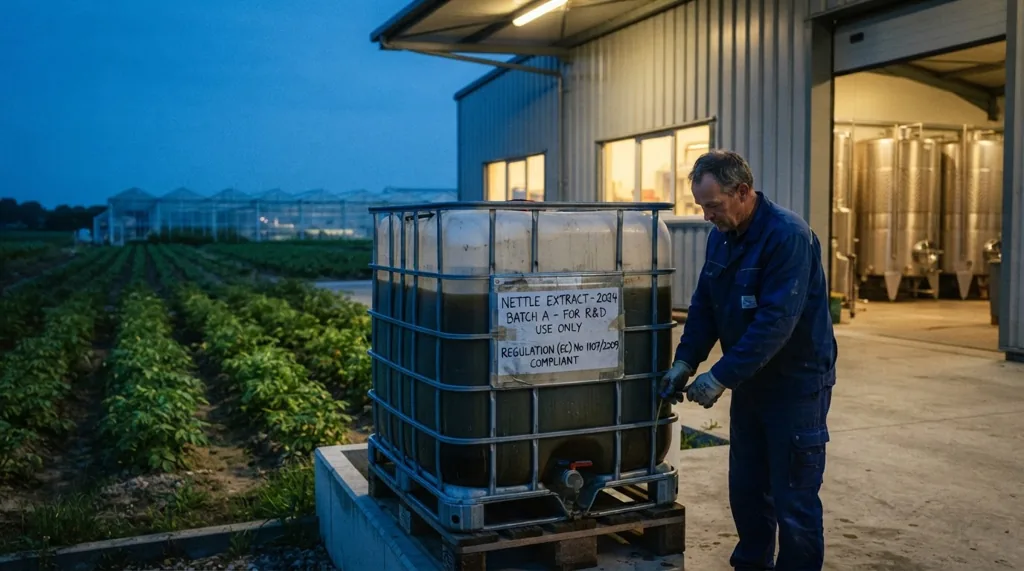
The European Commission refused to add a new nettle recipe and new crop uses to nettle’s approval, effective 12 November 2026.
The European Commission has refused to widen the approved farm uses of nettle extract as a low-risk crop protection substance. The refusal takes legal effect on the twentieth day after its 23 October 2026 publication, which falls on 12 November 2026.
The decision is Commission Implementing Regulation (EU) 2026/2340, adopted on 22 October 20261. It rejects a request to add a new nettle recipe and new crop uses to the existing approval. Nettle keeps the uses it gained in 2017, and the regulation applies directly in all EU member states1.
| At a glance | Details |
|---|---|
| What was published | Final regulation refusing an extension of use |
| Published on | 23 October 2026 |
| Who must comply | Growers, suppliers and national authorities using nettle in crop protection |
| Effective date | 12 November 2026 (20th day after publication) |
| Next milestone | Existing 2017 uses stay in place; no new uses added |
What is a basic substance, and why nettle?
A basic substance is a product mainly used for other purposes, such as food, that also helps protect crops. The EU approves these under a lighter process than full pesticides. The 2017 approval found that nettle meets the EU definition of a foodstuff and is useful in plant protection when mixed with water2.
The Commission first approved Urtica spp., the plant group that includes common nettle, on 9 March 20172. That approval took effect on 30 March 20172. It allowed nettle sprays as an insecticide, an acaricide (a mite killer) and a fungicide on a range of crops1.
What the 2017 approval already allows
The current uses stay unchanged by the new decision. They cover a list of crops and pests set out in the earlier regulation1.
| Use | Approved crops |
|---|---|
| Insecticide spray | Fruit trees, pulses, oilseeds, potato, leaf vegetables, rapeseed, root vegetables, elder, rose, Spiraea1 |
| Mite control spray | Beans and grapevine1 |
| Fungicide spray | Cabbage family, cucurbits, fruit trees, grapevine and potato1 |
| Fungicide in mulch | Cucumber, field tomato, roses and ornamental trees1 |
What the applicant asked for
The Commission received an application from Collot Agriculture on 26 September 20191. It proposed a new way of preparing nettle and many new uses. These included fungicide use on bean, cucurbits, strawberry, salads, carrot and potato1.
The request also covered insecticide use on carrot, salads, strawberry, ornamentals, asparagus and potato1. It further sought approval of nettle as a plant defence stimulator in asparagus, meaning a product that boosts a plant’s own resistance1.
Why the Commission said no
The European Food Safety Authority (EFSA), the EU’s food safety science agency, delivered a technical report on 23 March 20211. The Commission based its refusal on that report, member state comments and later information from the applicant1.
The main problem was the new recipe. It soaks the above-ground part of nettle in water and adds yeast to speed fermentation1. That yeast strain, Saccharomyces cerevisiae LAS02, is already approved as a separate active substance1.
Adding an active substance turns the mix into a full plant protection product. That puts it outside the lighter basic substance rules1.
The Commission listed further gaps:
- Not enough safety data to judge risks to farm workers, residents and bystanders1
- Not enough data on risks to consumers and to non-target wildlife1
- Not enough evidence that nettle works as a plant defence stimulator1
What changes for growers and suppliers
The regulation’s operative article is short. It states that the extension of use of nettle "is not approved"1. The new recipe and the extra crop uses will not be added to nettle’s conditions of use1.
The regulation’s recitals also point to two clean-up steps for the approval’s review report. Its list of uses should be recoded under a standard crop-use coding system from the European and Mediterranean Plant Protection Organization (EPPO)1. A second formulation type, suspension concentrate, should be recognised after it was left out by administrative oversight in 20171.
Transition timeline and key deadlines
| Key date | What happens |
|---|---|
| 9 March 2017 | Nettle approved as a basic substance2 |
| 26 September 2019 | Collot Agriculture applies for wider use1 |
| 23 March 2021 | EFSA delivers its technical report1 |
| 22 October 2026 | Commission adopts the refusal1 |
| 23 October 2026 | Refusal published in the Official Journal1 |
| 12 November 2026 | Refusal enters into force |
The regulation enters into force on the twentieth day after publication in the Official Journal of the European Union1. EU experts on the Standing Committee on Plants, Animals, Food and Feed backed the measure1.
Key terms in plain words
| Term | Meaning |
|---|---|
| Basic substance | A product with a main non-farming use, such as food, that also helps protect crops |
| Active substance | The ingredient in a pesticide that does the work against pests or disease |
| Acaricide | A product that kills mites |
| Plant defence stimulator | A product that helps a plant resist pests or disease by itself |
| EFSA | European Food Safety Authority, the EU’s food safety science agency |
| EPPO | European and Mediterranean Plant Protection Organization, which sets crop-use codes |
The refusal of wider nettle use enters into force on 12 November 2026.
Sources
- ↩ L_202602340EN.000101.fmx.xml https://eur-lex.europa.eu/legal-content/EN/TXT/HTML/?uri=OJ:L_202602340
- ↩ Implementing regulation – 2017/419 – EN – EUR-Lex https://eur-lex.europa.eu/eli/reg_impl/2017/419/oj