

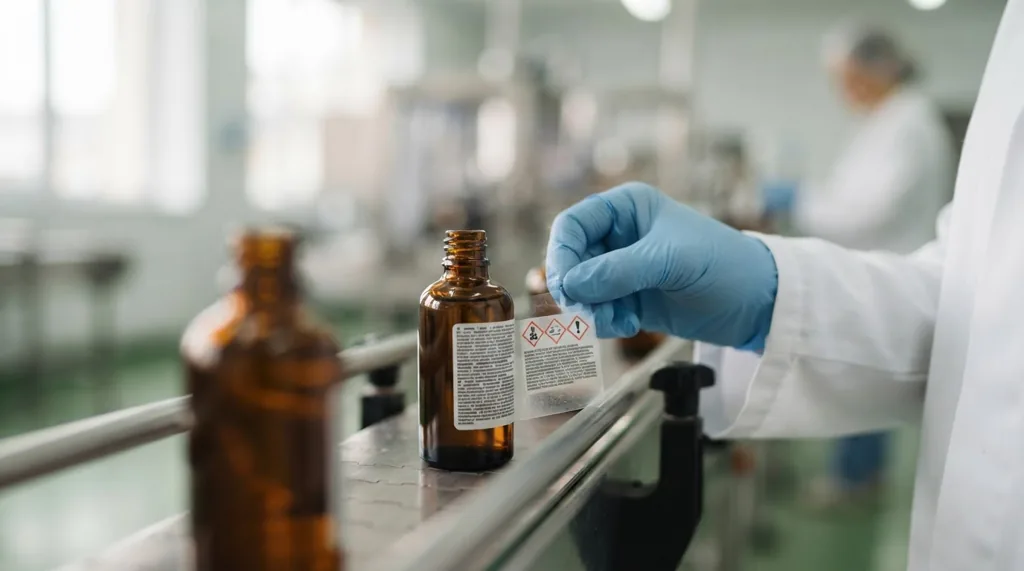
The European Parliament approved simpler cosmetics, fertiliser and chemical label rules, forcing faster withdrawal of cosmetics with banned cancer-linked substances.
The European Parliament has approved an EU law that simplifies rules for cosmetics, fertilisers and chemical labels. Cosmetics with banned cancer-linked substances must leave shops faster than first proposed, and the law now needs only final Council approval.
Parliament adopted the text on 22 October 2026, under procedure 2025/0531(COD), as a first-reading agreement with EU governments1. The law, known as the "chemicals omnibus" or "omnibus VI", changes three existing EU regulations on chemical labels, cosmetics and fertilising products1. It will enter into force 20 days after publication in the EU Official Journal, once the Council also approves it2.
| At a glance | Details |
|---|---|
| What was published | Final Parliament approval of an amending regulation |
| Published on | 22 October 2026 |
| Who must comply | Cosmetics makers, chemical suppliers, fertiliser producers |
| Effective date | 20 days after publication in the Official Journal |
| Final rules / Next milestone | Council’s formal approval, then publication |
What is the chemicals omnibus, and why does it matter?
The package is part of a wider EU effort to simplify laws and cut paperwork for business3. The Parliament links it to the Draghi report on EU competitiveness3. The European Commission proposed it on 8 July 20251.
The EU chemicals industry has 29,000 companies and 1.2 million direct jobs3. It supports 19 million people across supply chains3. The Commission estimates the changes should save the industry at least €363 million a year3.
Faster withdrawal of hazardous cosmetics
The law targets CMR substances, chemicals that can cause cancer, damage genes or harm fertility2. When such a substance is banned and no company defends its use, firms get 6 months to stop placing products on the market2. After 12 months, the products can no longer be sold at all2.
The Commission had proposed 12 and 24 months2. Current rules set no staggered transition2.
A company that wants to keep using a substance has up to 12 months from its new classification to ask for an exemption2. The phase-out clock starts only once that request is decided2. The timelines then depend on why an exemption is refused.
Other cosmetics changes
Lawmakers rejected a Commission plan to exempt CMR substances based on swallowing or breathing in2. They also kept the duty to notify the Commission before selling cosmetics containing nanomaterials, meaning extremely small particles2. However, the current six-month advance notice will no longer apply2.
The Commission must publish guidance on analysing safer alternatives one year after entry into force2. This aims to speed up the replacement of hazardous substances in cosmetics2.
What changes for chemical labels
The law revises the CLP Regulation, the EU rules on classifying, packaging and labelling chemicals2. It allows easier-to-read labels, wider use of digital labels and lighter advertising rules2.
| Labelling area | What the law requires |
|---|---|
| Consumer products | Letter height of at least 1.2 mm2 |
| Packages of 125 ml or less | Letter height of at least 0.9 mm2 |
| Containers of 10 ml or less | Some label details may go online, but not hazard symbols2 |
| Stricter new classification | Suppliers update labels within 15 months2 |
The 15-month deadline replaces the Commission’s vaguer "without undue delay" wording2. Most parts of the revised CLP rules already apply only from 1 January 2028, after an earlier postponement2.
What changes for fertiliser producers
The law simplifies the EU fertilising products regulation, (EU) 2019/10092. The Commission had proposed dropping an extended registration duty under REACH, the EU’s chemical registration system2. Lawmakers instead kept registration for substances with an EU-wide classification as particularly harmful2.
Transition timeline and key deadlines
The procedure file lists the dossier as awaiting the Council’s position1.
Key terms in plain words
| Term | Meaning |
|---|---|
| CMR substances | Chemicals that can cause cancer, damage genes or harm fertility |
| CLP Regulation | EU rules on classifying, packaging and labelling chemicals |
| REACH | EU system that requires companies to register chemicals they use |
| Exemption | Permission to keep using a banned substance under conditions |
| Digital label | Product information provided online instead of on the pack |
| Official Journal | The EU’s official publication where new laws appear |
The law enters into force 20 days after the Council approves it and it appears in the Official Journal2.
Sources
- ↩ Procedure File: 2025/0531(COD) | Legislative Observatory | European Parliament https://oeil.secure.europarl.europa.eu/oeil/en/procedure-file?reference=2025/0531(COD)
- ↩ Chemicals: deal on simplification of cosmetics, fertiliser and labelling rules | News | European Parliament https://www.europarl.europa.eu/news/en/press-room/20260616IPR45506/chemicals-deal-on-simplification-of-cosmetics-fertiliser-and-labelling-rules
- ↩ Chemicals: simplification of cosmetics, fertiliser and labelling rules | 19-10-2026 | News | European Parliament https://www.europarl.europa.eu/news/en/agenda/plenary-news/2026-10-19/12/chemicals-simplification-of-cosmetics-fertiliser-and-labelling-rules