

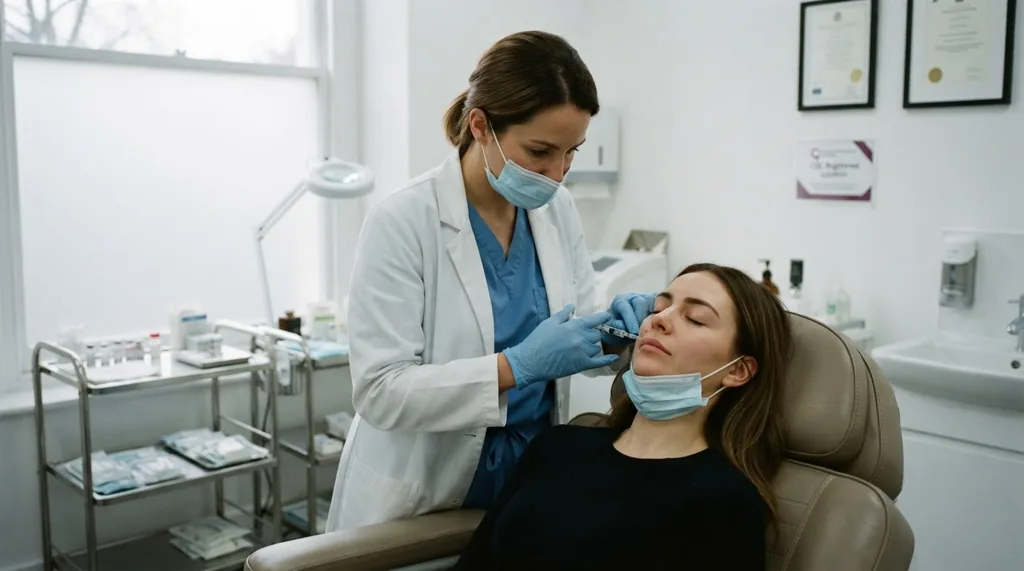
England plans to limit the riskiest cosmetic treatments to qualified health professionals and ban them for under-18s. Feedback closes 13 January 2027.
England’s health department has proposed rules that would limit the riskiest cosmetic procedures to qualified health professionals and ban them for under-18s. Feedback on the draft rules is open until 13 January 2027, and providers who break the final rules could face unlimited fines.
The Department of Health and Social Care (DHSC) published a consultation and draft regulations on 21 October 20261. The rules would cover procedures such as liquid Brazilian butt lifts, vampire facials and deep chemical peels2. The government plans to take the rules through Parliament in spring 20272.
| At a glance | Details |
|---|---|
| What was published | Consultation and draft regulations on high-risk cosmetic and wellbeing procedures |
| Published on | 21 October 2026 |
| Who can comment | Clinicians, regulators, businesses, the public and other experts |
| Feedback deadline | 13 January 2027 |
| Next milestone | Parliamentary process planned for spring 2027 |
What is changing, and why does it matter?
At present, few rules control who can perform cosmetic procedures in England1. The government says this gap has let poorly qualified practitioners perform high-risk work in places such as hotel rooms2. The draft rules would close that gap for the most dangerous treatments.
The plans follow a 2023 consultation that drew over 11,800 responses1. The government responded on 7 August 2025 and chose to deal with the highest-risk procedures first1. A licensing scheme for lower-risk treatments such as Botox and lip filler will follow separately2.
Which procedures would be covered?
The draft rules list a set of high-risk cosmetic and wellbeing treatments1. "Wellbeing" means treatments meant to improve physical health, stamina, mood or concentration, such as vitamin drips1. The list includes:
- cosmetic surgery, including filler injected anywhere other than the face
- deep chemical peels and dermal microcoring
- intravenous procedures, meaning drips or injections into a vein
- specified high-risk laser and intense pulsed light treatments
- non-resorbable facial fillers, which the body does not break down
- subcision, and blood procedures such as platelet rich plasma (PRP) therapy
- procedures that include a separate anaesthetic injection
Fillers injected outside the face, including liquid Brazilian butt lifts, would count legally as cosmetic surgery2.
Who would be allowed to perform them?
Only qualified, regulated health professionals could carry out these treatments1. Cosmetic surgery would be limited to doctors only1.
| Treatment type | Who could perform it |
|---|---|
| Cosmetic surgery, including body filler | Doctors registered with the General Medical Council |
| Other high-risk non-surgical and wellbeing treatments | Doctors, dentists, and nurses, midwives and pharmacists who can prescribe independently |
Providers offering these treatments would also need to register with the Care Quality Commission (CQC), England’s health and adult social care regulator1. Today, a provider using non-health professionals for this work falls outside CQC registration1.
Ban for under-18s
The procedures would be limited to people aged 18 and over1. Exceptions would apply when the NHS provides the procedure1. A health professional treating a medical condition would also be exempt1.
Fillers for children are already restricted under a separate law2.
Enforcement and penalties
Breaking the rules would be a criminal offence1. The CQC would enforce the rules, including investigating suspected offences1.
| Breach | Possible penalty |
|---|---|
| Offering procedures without CQC registration | A fine of any amount, up to 12 months in prison, or both |
| Letting an unqualified practitioner perform a procedure | A fine of any amount |
| Fixed penalties | Up to £4,000 |
The consultation document sets out the fines and prison term1. The department’s announcement puts fixed penalties at up to £4,0002. The CQC will also consult on guidance for providers and on the fees they would pay1.
Transition timeline and key deadlines
| Key date | What happens |
|---|---|
| 7 August 2025 | Government responds to the 2023 consultation |
| 21 October 2026 | Draft rules published for consultation |
| 13 January 2027 | Consultation closes |
| Spring 2027 | Planned start of the parliamentary process |
The consultation asks whether people agree with the plans1. It also asks which procedures and professions should be included, and how businesses would be affected1.
Key terms in plain words
| Term | Meaning |
|---|---|
| DHSC | Department of Health and Social Care, the government department for health in England |
| CQC | Care Quality Commission, which registers and inspects health and care providers in England |
| Wellbeing procedure | A treatment meant to boost health, energy or focus rather than change appearance |
| Liquid Brazilian butt lift | Filler injected into the buttocks to change their shape |
| Independent prescriber | A nurse, midwife or pharmacist trained and legally allowed to prescribe medicines |
| Fixed penalty | A set fine paid without going to court |
The consultation on the draft rules closes on 13 January 20272.
Sources
- ↩ Restrictions on the performance of high-risk cosmetic and wellbeing procedures in England: consultation document – GOV.UK https://www.gov.uk/government/consultations/restrictions-on-the-performance-of-high-risk-cosmetic-and-wellbeing-procedures-in-england/restrictions-on-the-performance-of-high-risk-cosmetic-and-wellbeing-procedures-in-england-consultation-document
- ↩ Cosmetic cowboys crackdown continues with new restrictions – GOV.UK https://www.gov.uk/government/news/cosmetic-cowboys-crackdown-continues-with-new-restrictions