

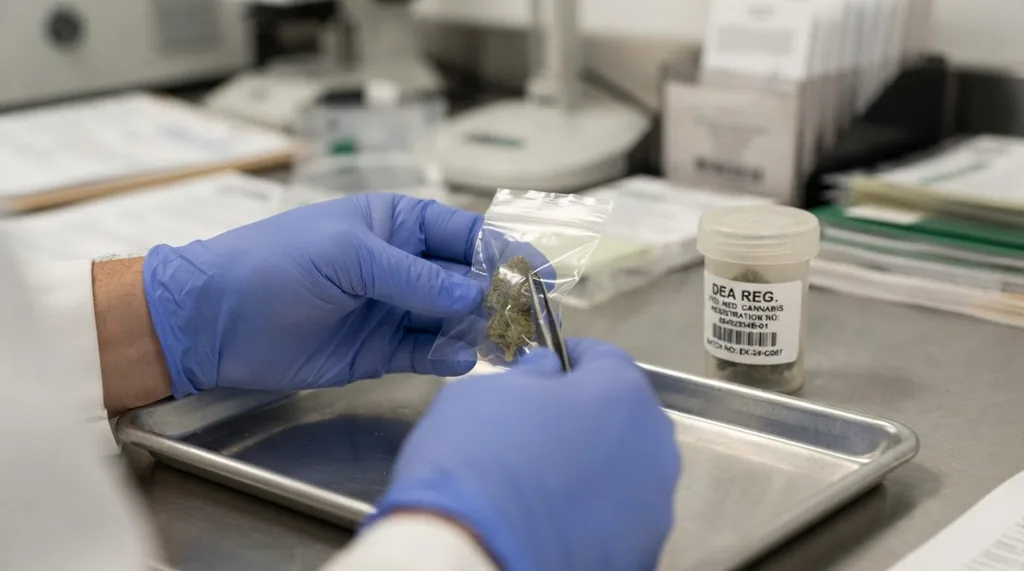
The DEA registered more than 900 state-licensed medical marijuana dispensaries. Pending applicants must build compliant supply chains by Nov. 29, 2026.
The Drug Enforcement Administration (DEA) has issued its first federal registrations to more than 900 state-licensed medical marijuana dispensaries. Applicants still waiting for approval must build fully compliant supply chains by Nov. 29, 2026.
The Justice Department announced the registrations on Oct. 30, 2026, as the first phase of the Attorney General’s order placing qualifying medical marijuana under Schedule III controls1. The DEA also published guidance on what pending applicants may do while they wait2. More registrations will follow in phases, and manufacturer and distributor applications are still under review1.
| At a glance | Details |
|---|---|
| What was published | First federal dispensary registrations, plus guidance for pending applicants |
| Published on | 30 October 2026 |
| Who must comply | State-licensed medical marijuana dispensaries, manufacturers and distributors |
| Effective date | Supply chains must comply by 29 November 2026 |
| Next milestone | Phased registrations, and review of manufacturer and distributor applications |
What did the DEA announce?
The DEA, part of the Justice Department, registered more than 900 dispensaries in its first batch1. They are located in Alabama, Florida, Mississippi, South Dakota, Texas, Virginia and West Virginia1.
Each dispensary first had to pass the DEA’s pre-registration investigation1. Applicants must also operate under a state medical marijuana system consistent with federal law and US treaty obligations1.
Who qualifies for federal registration?
The DEA started with dispensaries that applied within the initial 60-day window set by the order1. The guidance says that window ran from April 28, 2026, to June 26, 2026, following the April 28, 2026 final rule2.
A complete application needed both the form and the registration fee within that window2. State licensure alone does not grant federal registration1.
Registered dispensaries must meet federal rules on security, recordkeeping and inventory controls1. They must keep all records required for Schedule III controlled substances2.
What pending applicants may do
Applicants that applied on time are called "Timely Applicants" in the guidance2. While their applications are pending, they may keep dispensing, manufacturing or distributing medical marijuana under their state license2.
They may trade with other Timely Applicants and with DEA-registered businesses2. For example, a pending distributor can supply a pending dispensary2.
This permission ends if the applicant withdraws its application or the DEA denies it2. It also does not cover applicants that lack the required state license2.
Trading partners and due diligence
Timely Applicants and registered businesses may not trade with late or non-applicants until those businesses are registered2. Doing so could lead the DEA to deny an application or revoke a registration2.
The guidance lists basic checks on trading partners during this transition2:
- Get a copy of the partner’s DEA application confirmation and verify its document control number online.
- Get a copy of a registered partner’s DEA certificate.
- Get a copy of the partner’s state license and confirm it is active.
- Keep records of all checks made.
Registered businesses may record a pending applicant’s document control number where a registration number would normally go2.
Lab testing and existing stock
Some states require small product samples to go to licensed labs for testing2. The DEA does not intend to penalize sending small amounts to a lab that lacks DEA registration, under narrow conditions2.
The lab must be in the same state, and the sender must keep detailed records2. This applies only where no DEA-registered testing lab is lawfully available2.
Businesses have until Nov. 29, 2026 to adjust their supply chains2. Dispensaries and distributors may keep selling stock acquired before the guidance, even from non-qualifying sources2.
What the order does not cover
The order does not authorize recreational marijuana or activities outside its scope1. Marijuana outside the order remains under Schedule I controls1.
Broader rescheduling of marijuana is under a separate federal proceeding1. The Justice Department said it will keep prosecuting illegal marijuana trafficking1.
Key terms in plain words
| Term | Meaning |
|---|---|
| DEA registration | Federal permission to handle a controlled drug |
| Schedule III | The federal drug category that now covers qualifying medical marijuana |
| Schedule I | The stricter category that still covers all other marijuana |
| Timely Applicant | A business that filed a complete application between 28 April and 26 June 2026 |
| Document control number | The tracking number DEA gives an application |
| Pre-registration investigation | DEA’s check of a business before it grants registration |
Pending applicants must have compliant supply chains in place by Nov. 29, 20262.
Sources
- ↩ Office of Public Affairs | Justice Department Announces Issuance of Federal Registrations for Medical Marijuana Dispensaries | United States Department of Justice https://www.justice.gov/opa/pr/justice-department-announces-issuance-federal-registrations-medical-marijuana-dispensaries
- ↩ Timely-Applicant-Information-for-Medical-Marijuana-Applicants-10302026.pdf https://www.deadiversion.usdoj.gov/drugreg/Timely-Applicant-Information-for-Medical-Marijuana-Applicants-10302026.pdf