

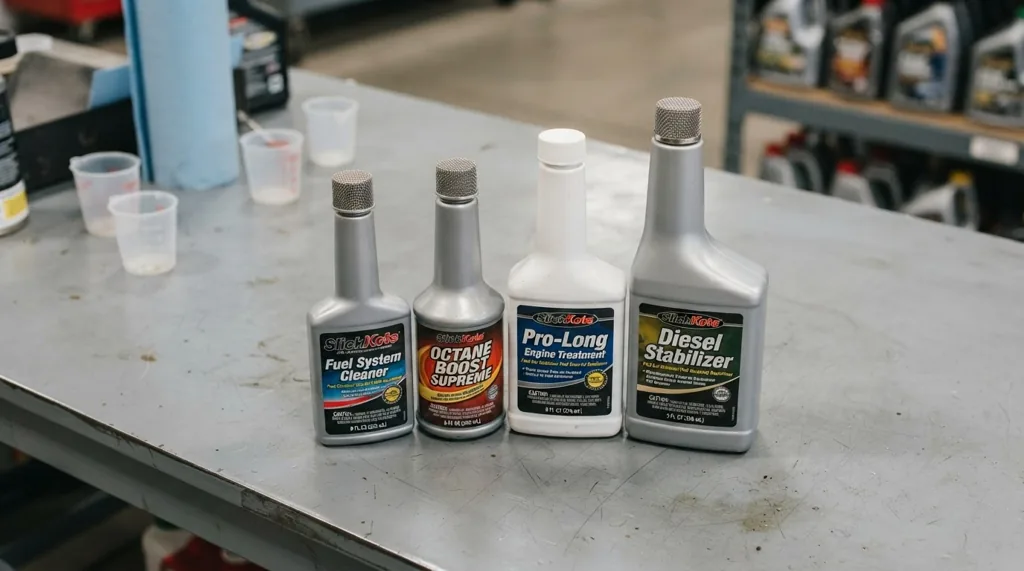
The CPSC ruled engine-care fuel additives are not flammable liquid fuels, so their containers need no flame-blocking devices from Oct. 19, 2026.
The US Consumer Product Safety Commission (CPSC) has ruled that engine-care fuel additives are not "flammable liquid fuels" under federal law. Containers for these products no longer need flame-blocking devices, starting Oct. 19, 2026.
The CPSC, the federal agency that sets safety rules for consumer products, published the interpretive rule in the Federal Register on Oct. 19, 20261. It changes the reach of the Portable Fuel Container Safety Act of 2020, a law requiring gas cans to block flames from entering the container. The rule takes effect on the day it was published, with no comment period1.
| At a glance | Details |
|---|---|
| What was published | Final interpretive rule amending 16 CFR part 1461 |
| Published on | 19 October 2026 |
| Who must comply | Makers, retailers and importers of fuel additives and fuel containers |
| Effective date | 19 October 2026 |
| Next milestone | None set. Gas can rules stay unchanged |
What the CPSC decided
The rule says "flammable liquid fuels" does not include certain fuel additives1. These are products added to fuel only to improve engine performance, clean engine parts, extend engine life, stabilize fuel or prevent weather effects. Any other purpose unrelated to creating heat or power is also covered1.
As a result, portable containers meant only for these additives are outside the flame mitigation rules in 16 CFR part 14611. Flame mitigation devices are parts that stop a flame from travelling into a container. The Commission voted 3-0 to publish the rule1.
Why the agency changed its view
In January 2023, CPSC staff took a broader view1. They said a liquid with a flash point below 140 degrees Fahrenheit generally counts as fuel if it is used in a fuel mixture to support burning. The flash point is the lowest temperature at which a liquid’s vapour can catch fire.
In December 2024, additive maker Auto-Mark, Inc., trading as Sea Foam Sales Company, sued the CPSC in federal court in Minnesota1. Sea Foam argued its products do not create heat or power and only clean fuel and oil systems. In September 2025, the court found that the additives at issue did not meet dictionary definitions of "fuel"1.
The agency also points to the Supreme Court’s 2024 Loper Bright decision1. That ruling ended the rule that courts must defer to an agency’s reasonable reading of an unclear law. The CPSC says final authority to interpret the law now lies with the courts.
What changes for additive makers
Manufacturers will not have to fit additive containers with costly flame mitigation devices meant for gasoline cans2. The CPSC says smaller manufacturers that rely on additive sales would otherwise have faced large packaging costs2.
The rule creates no new legal duties for businesses1. It adds no paperwork requirements and does not override state law. It explains how the agency reads existing law.
Costs the agency says are avoided
The CPSC labels the rule a deregulatory action under Executive Order 14192, a presidential order on cutting regulation1. Staff estimate it avoids about $545.7 million a year in compliance costs for additive makers1.
The present-value range reflects 10-year and 30-year periods, discounted at 3% and 7%1. The CPSC’s announcement describes savings of up to $10.7 billion over 30 years2.
What stays the same for gas cans
Existing flame mitigation rules for gasoline cans and other covered portable fuel containers remain unchanged2. These rules rest on voluntary industry standards that the law treats as mandatory. They include ASTM F3429/F3429M-24, ASTM F3326-21 and section 18 of UL 30:20221.
The CPSC says it has found no reported flame-jetting incidents involving the additives in containers covered by the change2.
Key terms in plain words
| Term | Meaning |
|---|---|
| CPSC | Consumer Product Safety Commission, the US agency for consumer product safety |
| Interpretive rule | A rule explaining how an agency reads an existing law, adding no new duties |
| Flame mitigation device | A part that stops a flame from entering a fuel container |
| Flash point | The lowest temperature at which a liquid’s vapour can catch fire |
| Fuel additive | A product added to fuel to clean, protect or improve an engine |
| Portable fuel container | A consumer container of 5 gallons or less for flammable liquid fuels |
The rule is in force from Oct. 19, 2026, the date of its Federal Register publication1.
Sources
- ↩ Federal Register :: Interpretation of “Flammable Liquid Fuels” With Respect to Fuel Additives https://www.federalregister.gov/documents/2026/10/19/2026-21348/interpretation-of-flammable-liquid-fuels-with-respect-to-fuel-additives
- ↩ CPSC Eliminates Unnecessary Fuel Additive Regulations, Saving American Businesses Up to $10.7 Billion | CPSC.gov https://www.cpsc.gov/Newsroom/News-Releases/2027/CPSC-Eliminates-Unnecessary-Fuel-Additive-Regulations-Saving-American-Businesses-Up-to-10-7-Billion