

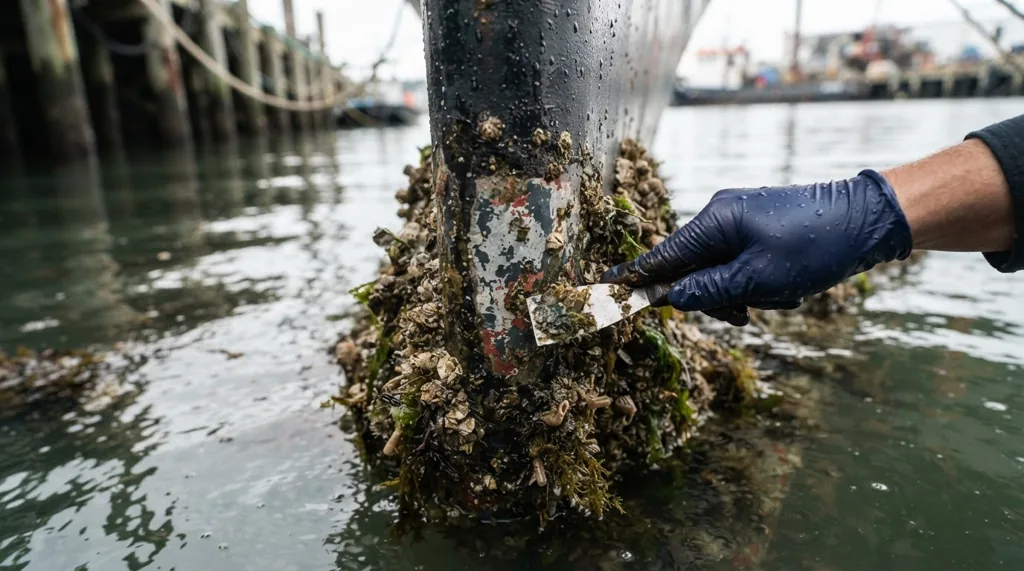
The European Commission refused to renew medetomidine for antifouling boat paints. Treated goods must leave the EU market from 8 June 2027.
The European Commission has refused to renew approval of medetomidine, a chemical used in antifouling paints for boat hulls. Boat-related goods treated with it can no longer be sold in the EU from 8 June 2027.
Commission Implementing Decision (EU) 2026/2567, adopted on 19 November 2026, says the substance’s approval for antifouling products is not renewed1. The decision appeared in the Official Journal of the European Union on 20 November 20261. A second decision, 2026/2566, cancels an earlier extension that had kept the approval alive until 31 December 20262. That second decision takes effect 20 days after its publication2.
| At a glance | Details |
|---|---|
| What was published | Final decision not to renew an active substance approval |
| Published on | 20 November 2026 |
| Who must comply | Makers, sellers and importers of antifouling products and treated goods |
| Effective date | Treated goods may stay on sale for 180 days after entry into force |
| Next milestone | Sales of treated goods end 8 June 2027 |
What is medetomidine, and why does it matter?
Medetomidine is an active substance in biocidal products of product-type 211. That category covers antifouling products, coatings that stop barnacles and other marine organisms from growing on hulls. The EU first approved it in 2015, under Implementing Regulation (EU) 2015/1731, until 31 December 20221.
How the approval ran out
An application to renew the approval was filed on 27 June 20211. Norway’s competent authority evaluated it and decided a full evaluation was needed1. The Commission then postponed the expiry date three times: to 30 June 2025, to 30 June 2026 and finally to 31 December 20262.
Why the Commission said no
The European Chemicals Agency, the EU body that assesses chemical risks, adopted its opinion on 28 May 20241. It found that medetomidine has endocrine-disrupting properties, meaning it can interfere with hormone systems in humans1. That finding meets one of the EU’s exclusion criteria, which bar approval except in narrow cases1.
The agency also found harmful hormone effects in other organisms. It judged the substance very persistent and toxic as well1. It could not set a safe exposure level, partly because data on vulnerable groups of people were limited1.
As a result, the Commission said it could not show that the substance still meets the basic conditions for approval1. It then tested the three exceptions that can save an excluded substance. None applied1.
| Exception tested | Commission finding |
|---|---|
| Risk is negligible under realistic worst-case use | Not met: the product is not used in closed systems1 |
| Substance is essential to prevent a serious environmental danger | Not met: other antifouling substances exist1 |
| Refusal would harm society out of proportion to the risk | Not met: no authorised medetomidine products are on the EU market1 |
What alternatives the regulators accepted
The agency listed 8 alternative active substances for commercial and leisure boats1. Member state representatives on the Standing Committee on Biocidal Products narrowed that list1.
Alternatives judged by member states
| Substance | Committee view |
|---|---|
| DCOIT, copper thiocyanate, dicopper oxide, tralopyril | Accepted as suitable alternatives |
| Copper flakes, tolylfluanid, dichlofluanid | Rejected: approvals expired 31 December 2025 |
| Copper pyrithione | Undecided: doubts on how well it works |
A majority accepted four substances as suitable alternatives for both commercial and leisure craft1. These are DCOIT (4,5-Dichloro-2-octyl-2H-isothiazol-3-one), copper thiocyanate, dicopper oxide and tralopyril1. The decision says all four currently have a less hazardous profile than medetomidine1.
The committee rejected copper flakes, tolylfluanid and dichlofluanid because their approvals expired on 31 December 20251. It could not decide whether copper pyrithione works well enough against the same organisms1. Non-chemical options such as silicon-based coatings and in-water cleaning were seen as useful, but possibly limited in availability or technical reach1.
What changes for paint makers and boat suppliers
The applicant and others argued that losing medetomidine would raise fuel and maintenance costs1. They also said it helps limit invasive marine species and copper resistance in marine organisms1. The Commission did not accept these arguments, given the available alternatives1.
The two numbers that bind
The decision gives firms a transition period for treated articles, meaning goods coated with or containing the substance. Such goods may be placed on the market for 180 days after entry into force1. From 8 June 2027, treated articles containing medetomidine for this use can no longer be placed on the EU market1.
Transition timeline and key deadlines
| Key date | What happens |
|---|---|
| 28 May 2024 | European Chemicals Agency adopts its opinion on medetomidine1 |
| 19 November 2026 | Commission adopts both decisions2 |
| 20 November 2026 | Non-renewal decision published in the Official Journal1 |
| 31 December 2026 | Former extended expiry date, now cancelled2 |
| 8 June 2027 | Treated goods can no longer be placed on the market1 |
The companion decision repeals Implementing Decision (EU) 2026/1089, the act behind the last extension2. It also enters into force 20 days after publication2.
Key terms in plain words
| Term | Meaning |
|---|---|
| Active substance | The chemical in a product that does the actual work, here killing or repelling marine growth |
| Biocidal product | A product that controls harmful or unwanted organisms |
| Product-type 21 | The EU category for antifouling products used on hulls and other surfaces in water |
| Endocrine disruptor | A substance that can interfere with the body’s hormone system |
| Treated article | A good coated with or containing a biocidal product |
| Exclusion criteria | Hazard tests that block approval of a substance except in narrow cases |
The next fixed milestone is 8 June 2027, when sales of medetomidine-treated goods for this use must stop1.
Sources
- ↩ Implementing decision – EU – 2026/2567 – EN – EUR-Lex https://eur-lex.europa.eu/eli/dec_impl/2026/2567/oj
- ↩ Implementing decision – EU – 2026/2566 – EN – EUR-Lex https://eur-lex.europa.eu/eli/dec_impl/2026/2566/oj