

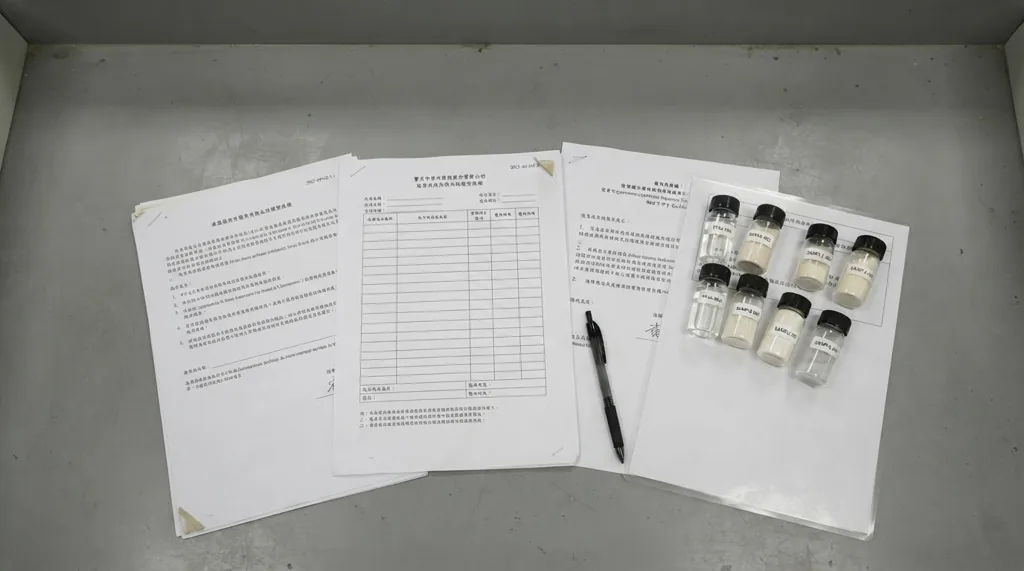
Taiwan’s environment ministry cut its draft PFAS list to 169 substances, with monthly records and quarterly reports planned from 1 January 2027.
169 forever chemicals face monthly records
Quarterly reports to the environment ministry from 2027.
Taiwan’s Ministry of Environment (MOENV) has cut its planned list of "forever chemicals" for new tracking rules from 269 to 169 substances. Firms that make or handle them would keep monthly records and report every quarter from a planned start of 1 January 2027.
The ministry set out the revised list in a press release on 12 November 2026, two days after a second consultation meeting on the draft1. The draft would list per- and polyfluoroalkyl substances (PFAS) as "concerned chemical substances", a category that brings tracking and labeling duties but no ban on uses2. The ministry says the cut moves some substances into other rules rather than freeing them from control1.
| At a glance | Details |
|---|---|
| What was published | Revised draft list of PFAS to be controlled as concerned chemical substances |
| Published on | 12 November 2026 |
| Who must comply | Businesses that make, import, sell, use or store listed PFAS above set levels |
| Effective date | Planned 1 January 2027 |
| Next milestone | Final notice, expected as early as the end of 2026 |
What are PFAS, and why does Taiwan track them?
PFAS are a large family of man-made chemicals used across industry. Taiwan already controls 508 PFAS as toxic chemical substances, following the Stockholm Convention, a global treaty on persistent pollutants1. That listing began in 2010 and is updated on a rolling basis1.
The new draft goes beyond the treaty list. The ministry took stock of PFAS actually in use in Taiwan and plans to list them for source control and hazard information1. It says this will let local industry align smoothly when the treaty adds substances in future1.
Why the list shrank from 269 to 169
The draft was first announced on 5 Aug. 2025 with 269 substances2. It was also notified to the World Trade Organization (WTO)1. After rounds of talks, the ministry removed 100 substances in four groups1.
| Change to the list | What happens |
|---|---|
| 14 substances on the Stockholm Convention lists | Upgraded separately to toxic chemical substances1 |
| 14 substances | Dropped because they do not meet the definition of PFAS used by OECD countries1 |
| 28 greenhouse gases or refrigerants | To be handled with the air pollution and climate change laws1 |
| 44 fluoropolymers | Kept off the list for now1 |
The ministry says fluoropolymers are highly stable, move little in the environment and barely build up in living things1. It added that Canada’s environment authorities also exclude them1. The second meeting on 10 November drew 231 participants from environmental groups, industry and academia1.
What changes for businesses
From the effective date, firms must record use monthly and report quarterly based on actual operations1. The ministry says this gives it immediate data on where PFAS flow1.
Dates firms must act by
Quarterly reports for the previous quarter are due by 10 April, 10 July, 10 October and 10 January2. The first report would cover the first quarter of 2027 and be due by 10 April 20272.
A two-year grace period gives firms time for three tasks1:
- take stock of the substances they hold
- prepare documents to obtain an approval document, the permit needed to handle a listed substance
- add the required wording to raw material packaging and containers
Who is covered, and who is exempt
The minutes of a June 2026 consultation meeting explain the scope. They say the draft controls listed chemicals, not finished goods or products2. Uses for research, testing, education and laboratory analysis are also outside the rules2.
Substances already governed by 21 other laws are exempt. Those laws include the rules on pesticides, medicines, medical devices, cosmetics, food safety and fire services2. In June, the ministry also said it had raised the concentration threshold for the listed PFAS from 0.1% to 1%2.
| Group of PFAS (June draft) | What the draft requires |
|---|---|
| Listed PFAS compounds at 1% or more | Rules apply to making, importing, selling, using and storing2 |
| PFAS polymers from 1% to under 30% by weight | Makers and importers label packaging "PFAS" only2 |
| PFAS polymers at 30% or more by weight | Full rules apply to making and importing2 |
Enforcement and penalties
Fines are set under Article 61 of the Toxic and Concerned Chemical Substances Control Act, the law behind the draft2. Firms whose records are incomplete, or that break rules on reporting frequency, face fines of NT$30,000 to NT$300,0002. They must also fix the problem by a set date2.
A firm that still fails to comply can be ordered to stop work or suspend business2. In serious cases, the authority can revoke its registration or permits2.
Transition timeline and key deadlines
The June minutes say the final notice and effective dates may still shift as the ministry handles comments2.
Key terms in plain words
| Term | Meaning |
|---|---|
| PFAS | Per- and polyfluoroalkyl substances, long-lasting man-made chemicals often called "forever chemicals" |
| Concerned chemical substance | A Taiwanese category for chemicals that need tracking and labeling, without a ban on uses |
| Toxic chemical substance | A stricter category, which Taiwan uses for PFAS on the Stockholm Convention lists |
| Stockholm Convention | A global treaty that limits persistent pollutants |
| Fluoropolymer | A very stable plastic-like PFAS, kept off the new list for now |
| Approval document | The permit a firm needs to handle a listed concerned chemical |
Monthly record-keeping is planned to start on 1 January 2027, with the first quarterly report due by 10 April 2027.
Sources
- ↩ 環境部超前準備強化PFAS資訊蒐集與傳遞-新聞發布|環境部新聞專區 https://enews.moenv.gov.tw/moenv-news/zh-tw/News/14487
- ↩ sp-event-file-730-1e23ad8d2a904d3a95d01b053bda939a-1.html https://www.cha.gov.tw/sp-event-file-730-1e23ad8d2a904d3a95d01b053bda939a-1.html