

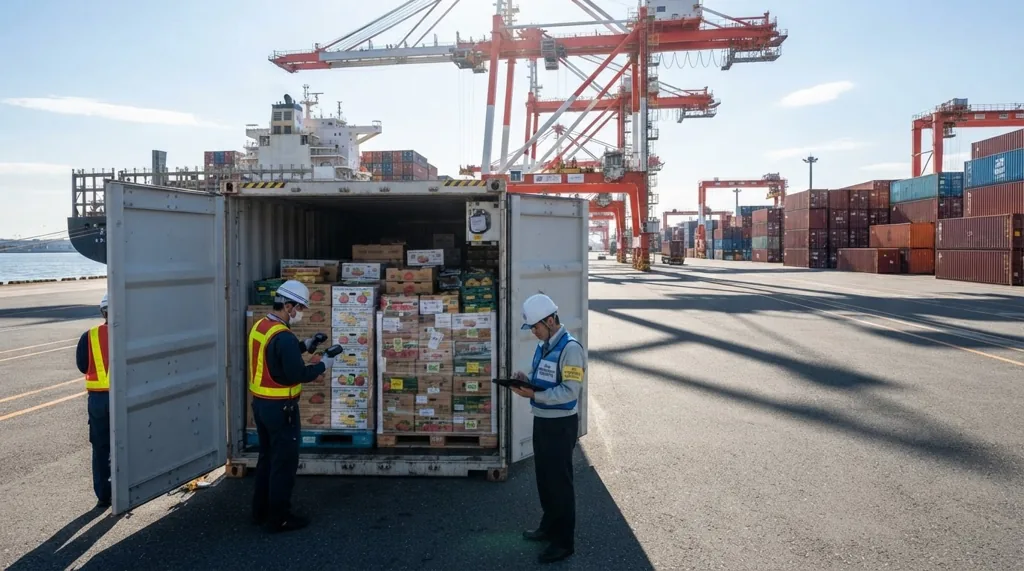
Japan has amended its regulations for enforcing the Food Sanitation Act and revised agricultural chemical residue standards to strengthen safety requirements for foods and food additives.
Japan has tightened and updated the maximum pesticide residue limits for dozens of foods covering six farm chemicals. Higher limits applied on 29 October 2026, while stricter lower limits take effect on 29 October 2027.
The Cabinet Office notice, No. 122 of 2026, amends Japan’s official specifications and standards for foods and food additives1. The Consumer Affairs Agency (CAA), Japan’s consumer protection and food standards agency, sent the details to prefectural governors and city health authorities on the same day1. Japan’s official pesticide residue database was updated to match on 29 October 20262.
| At a glance | Details |
|---|---|
| What was published | Final notice revising pesticide residue limits in foods |
| Published on | 29 October 2026 |
| Who must comply | Growers, food producers, importers and sellers of affected foods in Japan |
| Effective date | 29 October 2026 for raised limits |
| Next milestone | Lowered limits apply from 29 October 2027 |
What did Japan change?
The notice revises residue limits for six substances1. They are kasugamycin, carbaryl, tetraniliprole, triforine, prosulfocarb and mepronil1. Carbaryl is regulated both as a pesticide and as a veterinary medicine1.
A residue limit is the most of a chemical that may legally remain on a food. Under Japan’s food safety law, food that breaks these standards may not be sold3. The CAA asked local authorities to inform the businesses concerned and apply the rules without gaps1.
| Substance | What it is |
|---|---|
| Kasugamycin | Fungicide and antibiotic |
| Carbaryl | Insecticide and plant growth regulator |
| Tetraniliprole | Insecticide |
| Triforine | Fungicide |
| Prosulfocarb | Herbicide |
| Mepronil | Fungicide |
Which limits go up, and which go down?
The changes run in both directions. Some limits rise, which gives growers and exporters more room. Others fall, which makes the rules stricter for some vegetables and fruit1.
Several cuts are steep. The kasugamycin limit for onions falls from 0.2 ppm to 0.01 ppm1. The tetraniliprole limit for tomatoes drops from 2 ppm to 1 ppm1. The triforine limit for tomatoes falls from 2 ppm to 0.9 ppm1.
| Food and substance | Old limit | New limit |
|---|---|---|
| Onions, kasugamycin | 0.2 ppm | 0.01 ppm |
| Tomatoes, tetraniliprole | 2 ppm | 1 ppm |
| Rice bran, carbaryl | 50 ppm | 35 ppm |
| Japanese and Western pears, mepronil | 1 ppm | 0.7 ppm |
| Oranges, kasugamycin | 0.2 ppm | 0.5 ppm |
| Milk, tetraniliprole | 0.05 ppm | 0.2 ppm |
Many limits for meat, milk, eggs and honey are new or higher1. For example, honey gains a limit of 0.05 ppm for triforine, prosulfocarb and mepronil1.
Transition timeline and key deadlines
The notice took effect on the day it was published, 29 October 20261. Raised limits applied from that day. Lowered limits only apply from 29 October 2027, one year later1.
The delay gives growers and traders time to adjust spraying and sourcing. It covers foods such as onions, carrots, cucumbers, lemons, tomatoes, apricots, peaches and pears1.
| Key date | What happens |
|---|---|
| 29 October 2026 | Notice published, raised limits apply |
| 29 October 2027 | Lowered limits apply to listed foods |
What happens to foods with no listed limit?
Foods with no set limit fall under a default ceiling. That ceiling is the uniform limit of 0.01 ppm1.
Rules for foods without a set limit
| Rule | What the notice says |
|---|---|
| Default ceiling | Uniform limit of 0.01 ppm |
| Kasugamycin | Must not be present at all |
| Kiwifruit, melons, peaches | Limits cover whole fruit, including skin |
Kasugamycin is treated more strictly. Because it is an antibiotic, it must not be present at all in foods without a listed limit1.
The notice also redefines some foods by the part tested. Limits for kiwifruit, melons and peaches now cover the whole fruit, including skin and, for peaches, the stone1.
Why were the prosulfocarb limits cut?
The prosulfocarb limits were cut after a review of the herbicide by Japan’s farm ministry1. The Ministry of Agriculture, Forestry and Fisheries re-evaluated it under the Agricultural Chemicals Regulation Act1.
Prosulfocarb limits, before and after
| Food | Old limit | New limit |
|---|---|---|
| Onions | 0.1 ppm | 0.05 ppm |
| Peas | 0.05 ppm | 0.01 ppm |
| Broad beans | 0.05 ppm | 0.01 ppm |
| Leeks | 0.05 ppm | 0.01 ppm |
As a result, the limit for onions halves from 0.1 ppm to 0.05 ppm1. Peas, broad beans and leeks fall from 0.05 ppm to 0.01 ppm1.
What else is coming for food additives?
A separate measure is still in progress. In a September 2026 outline, the CAA proposed approving potassium acetate as a new food additive3. That step would amend the Food Sanitation Act’s enforcement rules and set purity standards for the additive3.
The CAA expects to publish the potassium acetate rules in December 20263. They would take effect on publication3.
Key terms in plain words
| Term | Meaning |
|---|---|
| Residue limit | The most of a chemical allowed to remain on a food |
| ppm | Parts per million, a measure of tiny amounts |
| Uniform limit | The default 0.01 ppm ceiling for foods with no set limit |
| Food Sanitation Act | Japan’s main food safety law |
| Food additive | A substance added to food during processing |
| Consumer Affairs Agency (CAA) | Japan’s agency for consumer protection and food standards |
The lowered pesticide residue limits take effect on 29 October 2027.
Sources
- ↩ 令和8年10月29日消食基第475号 https://www.caa.go.jp/policies/policy/standards_evaluation/pesticide_residues/notice/assets/standards_cms208_261029_01.pdf
- ↩ 残留農薬DB 検索システム https://jpn-pesticides-database.go.jp/prdb/
- ↩ 食品衛生法施行規則の一部を改正する内閣府令及び食品、添加物等の規格基準の一部を改正する告示について https://public-comment.e-gov.go.jp/pcm/download?seqNo=0000319750