

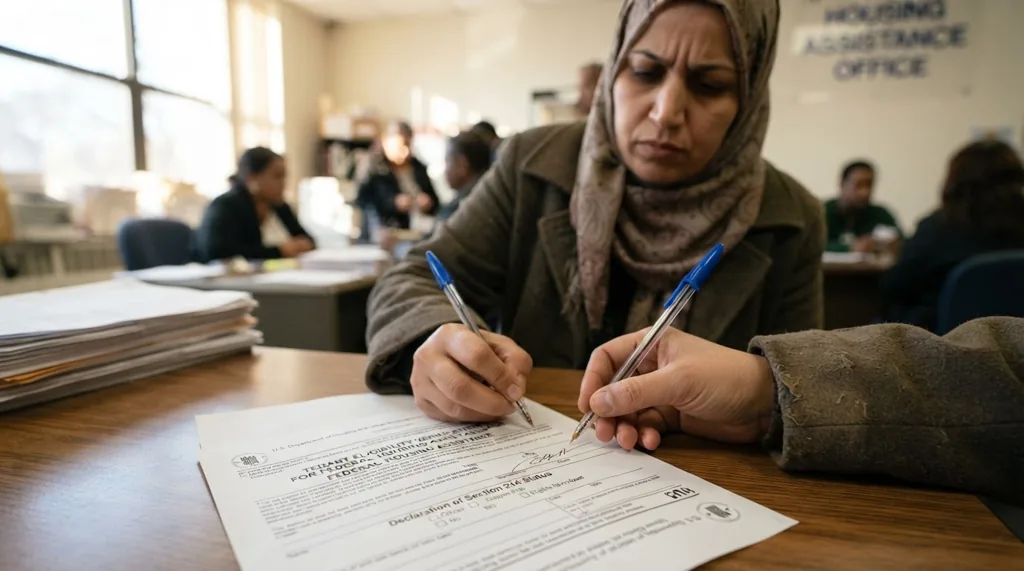
HUD will require every applicant and tenant in public housing and Section 8 to prove citizenship or eligible status from Dec. 14, 2026.
The US Department of Housing and Urban Development (HUD) will require every person in its main rental aid programs to prove US citizenship or eligible immigration status. The final rule takes effect on Dec. 14, 2026, and ends open-ended partial aid for families with mixed status.
HUD published the final rule in the Federal Register on 12 November 20261. It covers applicants and current tenants in public housing, Section 8 rental assistance and related programs, regardless of age1. Housing agencies and property owners must collect documents and run checks, and families get up to 60 days to find missing papers1.
| At a glance | Details |
|---|---|
| What was published | Final rule, "Verification of Eligible Status" |
| Published on | 12 November 2026 |
| Who must comply | Public housing agencies, assisted property owners, applicants and tenants |
| Effective date | 14 December 2026 |
| Next milestone | Tenant notices on the new requirements |
What does the rule change?
The rule rewrites HUD’s rules under Section 214 of the Housing and Community Development Act of 19801. That law bars HUD from giving certain housing aid to people other than US citizens or specified eligible noncitizens1. Under the new rule, all applicants and recipients must have their status checked, regardless of age1.
Status checks, old rules and new
| Question | Old rules | From 14 December 2026 |
|---|---|---|
| Proof from declared citizens | Not required | Documents and Social Security number |
| “Do not contend” option | Available | Removed |
| Prorated assistance | Could continue indefinitely | Temporary while checks finish |
Until now, a family member could choose not to claim eligible status and submit no documents1. The current rules also do not require proof from people who declare US citizenship2. The February proposal removed the "do not contend" option1. HUD says the final rule keeps a majority of the proposed changes1.
Which programs are covered?
The rule applies to what HUD calls Section 214 covered programs1. They include the following:
- public housing programs
- Section 8 rental assistance programs
- Housing Development Grant programs, for low-income units only
- the Section 236 program, for tenants paying below-market rent only
These programs are run by public housing agencies (PHAs) and by private owners of assisted buildings1.
What families must show
People who declare US citizenship must sign a declaration and a consent form for verification1. They must also give their Social Security number, which HUD uses in its first round of checks1. Accepted proof includes a US birth certificate, a naturalization certificate, a valid US passport or a certificate of citizenship1.
Families only need to submit proof for each member one time while they stay continuously assisted1. A new household member must submit proof by the date the agency or owner checks other parts of eligibility1.
The end of open-ended partial aid
Some households mix eligible and ineligible members. HUD has helped them through prorated assistance, meaning aid reduced to cover only the members with confirmed status1. Under the old rules, this partial aid could continue indefinitely1.
The new rule makes prorated assistance a temporary condition while all members’ status is checked, where the law allows1. HUD’s announcement said the rule targets "mixed status" households and closes what it called regulatory loopholes3.
How checks and deadlines work
Agencies and owners can give families an extra 30 days to gather papers, for 60 days in total1. Tenant notices must tell families that these extensions exist and that they may ask for one1. HUD chose 60 days rather than 90 because it saw a higher risk of fraud when proof is missing1.
Immigration status is checked through SAVE, the Systematic Alien Verification for Entitlements program. It is an online service run by US Citizenship and Immigration Services that lets government agencies check immigration status2. Under the proposal, a second SAVE check must be requested within 30 days after a family is told the first result1. The proposal also said denial notices must tell people they can ask agencies to correct their records1.
Why HUD says it acted
HUD said a joint audit with the Department of Homeland Security (DHS) found nearly 200,000 tenants with incomplete or unknown eligibility checks3. The department also said its housing serves only a quarter of eligible households in need3. HUD Secretary Turner announced the final rule on Nov. 10, 20263.
The rule by the numbers
The proposal drew 16,238 comments from tenants, landlords, housing authorities and nonprofit groups1. Under the proposal, the consent form must say that agencies or owners will tell DHS when a household member is found to be in the US unlawfully1. The final rule also requires the consent form to meet the Privacy Act of 1974, because it collects Social Security numbers1.
Key terms in plain words
| Term | Meaning |
|---|---|
| HUD | Department of Housing and Urban Development, the US federal housing agency |
| Section 214 | The 1980 law limiting HUD housing aid to citizens and certain eligible noncitizens |
| Prorated assistance | Aid reduced to cover only family members with confirmed eligible status |
| Mixed-status family | A household with both eligible and ineligible members |
| SAVE | A federal database used to check a person’s immigration status |
| PHA | Public housing agency, the local body that runs public housing and vouchers |
The rule takes effect on 14 December 20261.
Sources
- ↩ Federal Register :: Housing and Community Development Act of 1980: Verification of Eligible Status — 2026 23003 / housing and community development act of 198… https://www.federalregister.gov/documents/2026/11/12/2026-23003/housing-and-community-development-act-of-1980-verification-of-eligible-status
- ↩ Federal Register :: Housing and Community Development Act of 1980: Verification of Eligible Status — 2026 03405 / housing and community development act of 198… https://www.federalregister.gov/documents/2026/02/20/2026-03405/housing-and-community-development-act-of-1980-verification-of-eligible-status
- ↩ HUD Action Ensures All HUD-Assisted Tenants Are Fully Eligible Under the Law | HUD.gov / U.S. Department of Housing and Urban Development (HUD) https://www.hud.gov/news/hud-no-26-091