

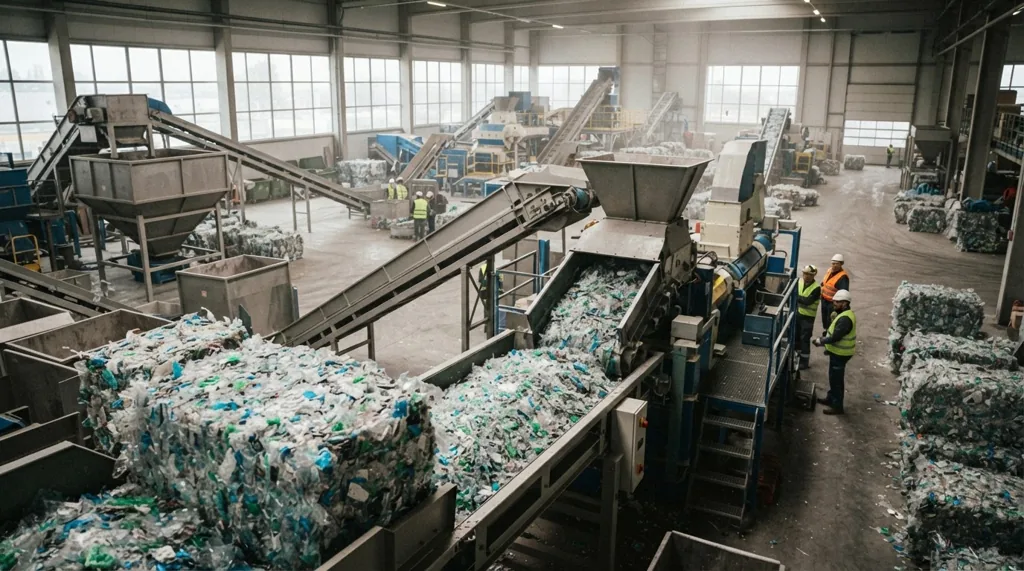
European Union has introduced coordinated regulatory notifications addressing recycled plastics through sanitary, phytosanitary, and technical barrier protocols.
The European Commission has tightened the paperwork and import checks for recycled plastic that touches food. The new rules take effect on 18 November 2026, with short grace periods for existing products.
Commission Regulation (EU) 2026/2376 was adopted on 28 October 2026 and published in the Official Journal of the European Union on 29 October 20261. It amends Regulation (EU) 2022/1616, the EU rulebook for recycled plastic food packaging and kitchenware. It covers recyclers, converters, waste processors, food packers and importers, and takes effect on 18 November 20261.
| At a glance | Details |
|---|---|
| What was published | Final Commission regulation amending the recycled plastics rules |
| Published on | 29 October 2026 |
| Who must comply | Recyclers, converters, pre-processors, food packers and importers of recycled plastic |
| Effective date | 18 November 2026 |
| Final rules / Next milestone | Grace periods of three and six months after entry into force |
What are the recycled plastics rules, and why do they matter?
Recycled plastic can carry chemical traces from its past life, such as detergents, fuels or paint2. Such contaminants are unknown and appear in random amounts, so lab tests on finished products cannot easily catch them2. EU controls therefore focus on how recycled plastic is made, and official checks audit recycling plants2.
Regulation (EU) 2022/1616 sets out this approach2. It requires recycling technologies to be proven suitable and certain recycling processes to be approved before use2. At present, only two technologies are accepted: mechanical recycling of polyethylene terephthalate (PET) and recycling from a closed and controlled chain2.
Why the Commission changed the rules
The regulation says experience since 2022 showed gaps1. Rules on registering recycling plants needed more detail. The use of compliance paperwork along the supply chain also needed clarifying1.
Imports were a further concern. Plastic waste, recycled plastic and finished products made from it are increasingly imported into the EU1. The Commission wants to stop non-compliant material from entering the EU market and to keep track of where it came from1.
New paperwork across the supply chain
Until now, only recyclers and converters had to issue a declaration of compliance, a signed statement that a product meets the rules1. Recyclers issued Declaration A and converters, the firms turning recycled plastic into products, issued Declaration B1. Now every business stage except retail must provide a declaration1.
| Declaration | Who issues it and why |
|---|---|
| Declaration A | Recyclers, as before |
| Declaration B | Converters, as before |
| Declaration C | A simpler form for final production stages, without new batch numbers |
| Declaration P | Firms at each sorting and cleaning stage, for each batch of input plastic |
Declaration C must still list the recycling plants used to make the product’s parts1. Batches covered by Declaration P must carry a batch number so they can be identified1.
Businesses may only accept recycled plastic, articles or packed food that comes with the right declaration1. Firms must hold supporting documents when they issue a declaration. They must give these documents to the authorities within ten working days of a request1.
What changes for food packers
Food companies that pack food in recycled plastic get an exemption1. They do not need to give retailers or their distributors a declaration if two conditions are met1:
- Labels or other documents give retailers and consumers the information needed for safe use.
- Any recycled content information matches the declaration the food company received.
Recycled plastics rules at a glance
| Dimension | Requirement / Provision |
|---|---|
| Who must declare | Every business stage except retail |
| Supporting documents | Given to authorities within ten working days of a request |
| Food packers | Exempt from declarations to retailers if labels carry the needed information |
| Imports | Declaration goes to customs at release onto the EU market |
| Effective date | 18 November 2026 |
The rules also now allow off-cuts and scraps of recycled plastic to be reprocessed1. This follows the principles already used for new plastic under Regulation (EU) No 10/20111.
How import checks at the border will work
EU customs authorities will receive the declaration of compliance when an importer asks to release goods onto the EU market1. New customs product codes are being introduced for this purpose1. Declarations for recycled plastic from outside the EU must state the customs codes used to import it1.
What importers must provide
| Document / Filing | Issuing authority or requirement |
|---|---|
| Declaration of compliance | Given to customs when release onto the EU market is requested |
| Customs codes on the declaration | Required for recycled plastic from outside the EU |
| New customs product codes | Kitchenware, tableware and PET only |
The codes apply only to kitchenware, tableware and PET, including PET in multi-layer materials1. They do not cover packed food, appliances or food processing equipment, even if made from PET1. The regulation says codes for every plastic and stage would be too many and could cause mistakes at the border1.
The online register and testing limits
The EU keeps a public register of recyclers, recycling plants and novel technologies2. The regulation creates an electronic system where firms enter and update their own details, under national authorities’ supervision1. It also adds clearer status options for each recycling plant over its lifetime1.
The Commission took the old registration system offline on 11 September 2026 to upgrade it2. It said the new system should be available towards the end of October, with the exact date to be announced2. The regulation also sets maximum limits for sorted input plastic, with ISO 12418-2:2012 named as an accepted test method1.
Transition timeline and key deadlines
Products that met the old rules get a grace period1. Those needing Declarations A or B may stay on sale for three months after entry into force without the new declaration format1. Products needing Declarations C or P get six months, because those stages had no declaration before1.
| Key date | What happens |
|---|---|
| 11 September 2026 | Old online registration system taken offline |
| 28 October 2026 | Regulation adopted |
| 29 October 2026 | Regulation published in the Official Journal |
| 18 November 2026 | New rules take effect |
Products made from goods placed on the market during these periods may be sold until stocks run out1.
Key terms in plain words
| Term | Meaning |
|---|---|
| Declaration of compliance | A signed statement that a product meets EU rules |
| Converter | A firm that turns recycled plastic into finished items such as bottles |
| Pre-processing | Collecting, sorting, shredding and washing plastic waste before cleaning |
| Decontamination | The cleaning step that removes harmful traces from used plastic |
| Release for free circulation | The customs step that lets imported goods onto the EU market |
| PET | Polyethylene terephthalate, the only plastic now recycled with an approved technology |
The amended recycled plastics rules take effect on 18 November 20261.
Sources
- ↩ Regulation – EU – 2026/2376 – EN – EUR-Lex https://eur-lex.europa.eu/eli/reg/2026/2376/oj/eng
- ↩ Plastic Recycling – Food Safety – European Commission https://food.ec.europa.eu/food-safety/chemical-safety/food-contact-materials/plastic-recycling_en