

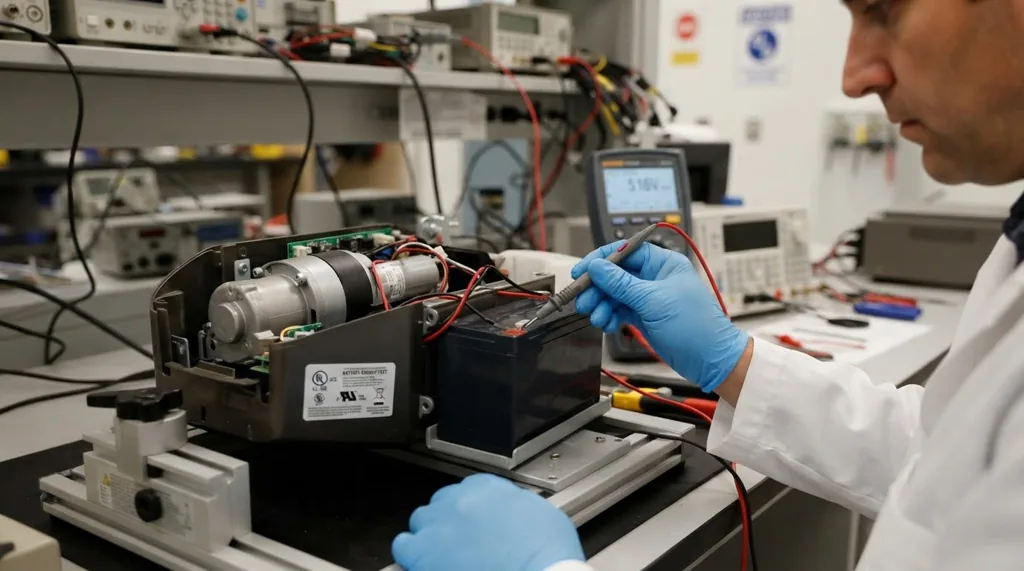
The CPSC updated its garage door opener safety rule to add battery backup tests, effective Dec. 29, 2026, unless serious objections arrive.
The US Consumer Product Safety Commission (CPSC) has updated its mandatory safety rule for home garage door openers. The change adds battery backup tests and takes effect on Dec. 29, 2026, unless significant objections arrive by Nov. 30, 2026.
The CPSC, the federal agency that sets safety rules for consumer products, published the change as a direct final rule on Oct. 30, 20261. It aligns the federal rule at 16 CFR part 1211 with the Seventh Edition of UL 325, a private safety standard for door and gate openers1. If the agency receives a significant adverse comment, it will withdraw the affected part of the rule before it takes effect2.
| At a glance | Details |
|---|---|
| What was published | Direct final rule amending the garage door opener safety standard |
| Published on | 30 October 2026 |
| Who must comply | Makers and importers of automatic residential garage door openers |
| Feedback deadline / Effective date | 30 November 2026 / 29 December 2026 |
| Final rules / Next milestone | Rule takes effect unless significant objections lead to withdrawal |
What is this rule, and why does it matter?
Federal law treats the entrapment protection parts of UL 325 as a binding consumer product safety rule2. Entrapment protection means features that stop a closing door from trapping or crushing a person. The CPSC first wrote these requirements into federal rules on June 19, 19912.
Garage door opener rule at a glance
| Dimension | Provision |
|---|---|
| Authority | US Consumer Product Safety Commission |
| Rule | 16 CFR part 1211, aligned with UL 325 Seventh Edition |
| Scope | Openers for buildings of one to four single-family units |
| Voltage limit | Openers rated 600 volts or less |
| Reversal time | Within 2 seconds of hitting an obstruction |
The rule covers openers that serve a residential building of one to four single-family units3. It also covers openers rated 600 volts or less3. Under the existing rule, a downward-moving door must start reversing within 2 seconds of hitting an obstruction3.
How UL changes become federal rules
Under the 1990 law, UL must tell the CPSC about any revision to UL 3252. The revision becomes part of the federal rule unless the CPSC objects within 30 days2. UL notified the agency of the latest revisions on Sept. 23, 20252.
The CPSC accepted those revisions in October 20251. The Seventh Edition of UL 325 itself was published on Sept. 15, 20252. The agency last updated the garage door opener rule in 20242. Commissioners voted 3–0 to publish the new notice2.
| Key date | What happens |
|---|---|
| 15 September 2025 | UL publishes UL 325, Seventh Edition |
| 23 September 2025 | UL notifies the CPSC of the revisions |
| October 2025 | CPSC accepts the revisions |
| 30 October 2026 | Direct final rule published |
| 30 November 2026 | Deadline for significant adverse comments |
| 29 December 2026 | Rule takes effect |
New tests for battery backup openers
The biggest change concerns openers that run on battery power. The rule now states plainly that it covers battery-powered operators, including those with battery backup systems2. New provisions set requirements for both vertical and horizontally sliding doors with battery backup2.
A battery backup opener must either keep its safety features working or stop working altogether2. In practice, the system checks for enough charge to finish a full open and close cycle1. If the charge is too low, the door stays open and will not run until the battery is charged or mains power returns1.
Testing happens twice. First the battery is fully charged. Then the same battery is drained to the opener’s lowest operating voltage, following the maker’s instructions2. The goal is to make sure the opener can still detect an object and open the door during a power cut1.
Clearer rules for backup safety sensors
Garage door openers also carry a secondary entrapment protection device. This is a second safety feature, such as a sensor, that acts if the main system fails1. The opener checks that this device is present at least once during each close cycle1.
Backup sensor check, old and new
| Question | Old rule | New rule |
|---|---|---|
| What the opener monitors | Presence and correct operation | Presence only |
| How often | At least once each close cycle | At least once each close cycle |
The old text required the opener to monitor the device’s "presence and correct operation"1. The new rule deletes "and correct operation"2. The UL technical committee found there was no practical way to test what correct operation means1. Detecting that the device is present is enough to show it will respond1.
| Area | What the rule now says |
|---|---|
| Scope | Covers battery-powered openers and battery backups |
| Battery tests | Run at full charge, then at lowest operating voltage |
| Low battery | Door stays open and opener stops working |
| Backup sensor check | Presence checked once per close cycle |
| Instructions | Apply to the opener or the full system |
What changes for manufacturers
The instruction manual sections drop misleading references to "residential garage doors"2. The printed instructions now apply to a door that is part of an opener system, not a door alone2. The rule adds the words "or system" in several places to make this clear2.
The rule also restores language from an earlier revision that had been left out by mistake2. It does not change certification or recordkeeping requirements2. A read-only copy of UL 325:2025 is free to view on UL’s website2.
How the direct final rule process works
A direct final rule skips the usual proposal stage because the agency expects no serious objections2. The CPSC said public comment would not change the revisions it already accepted in 20252. A significant adverse comment is one that explains why the rule is inappropriate or would not work without changes2.
The dates that bind
Comments go to docket CPSC-2015-0025 on the federal regulations portal1. Confidential business information may be sent by email instead1.
Key terms in plain words
| Term | Meaning |
|---|---|
| CPSC | Consumer Product Safety Commission, the US agency that sets product safety rules |
| UL 325 | A private safety standard for door, gate and window openers |
| Entrapment protection | Features that stop a closing door from trapping a person |
| Secondary entrapment protection | A backup safety device, such as a sensor, used if the main system fails |
| Direct final rule | A rule that takes effect on a set date unless serious objections arrive |
| Significant adverse comment | An objection explaining why the rule is wrong or would not work |
The rule takes effect on Dec. 29, 2026, unless the CPSC receives significant adverse comments by Nov. 30, 20261.
Sources
- ↩ Federal Register :: Safety Standard for Automatic Residential Garage Door Operators https://www.federalregister.gov/d/2026-22213
- ↩ 2026-22213.pdf https://www.govinfo.gov/content/pkg/FR-2026-10-30/pdf/2026-22213.pdf
- ↩ CFR-2015-title16-vol2-part1211.pdf https://www.govinfo.gov/content/pkg/CFR-2015-title16-vol2/pdf/CFR-2015-title16-vol2-part1211.pdf