

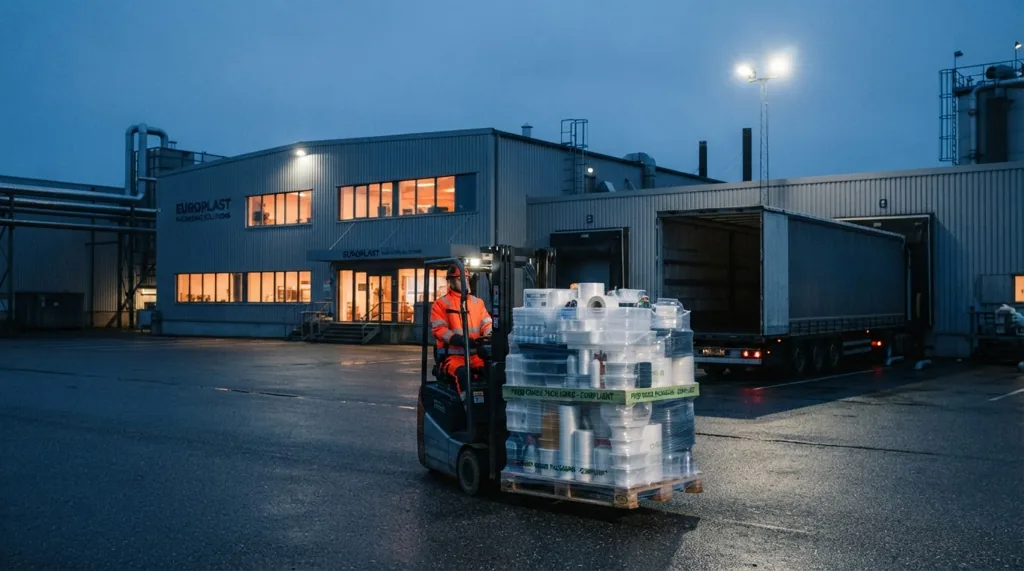
The European Commission approved four new substances for plastic food packaging, each with strict use limits, effective 18 November 2026.
The European Commission has added four new substances to the EU list of chemicals allowed in plastic food packaging and kitchenware. Each one comes with strict limits on how it may be used, and the change takes effect on 18 November 2026.
Commission Regulation (EU) 2026/2412 was adopted on 28 October 2026 and published in the Official Journal of the European Union on 29 October 20261. It amends the list in Regulation (EU) No 10/2011, the EU rulebook for plastic materials that touch food. The new rules enter into force on the twentieth day after publication and apply directly in every member state1.
| At a glance | Details |
|---|---|
| What was published | Final regulation amending the EU list of approved plastic substances |
| Published on | 29 October 2026 |
| Who must comply | Makers and users of plastic materials and articles that touch food |
| Effective date | 18 November 2026 |
| Final rules / Next milestone | Rules are final and apply directly in all member states |
What is the approved substances list, and why does it matter?
Regulation (EU) No 10/2011 sets specific rules for plastic materials and articles that come into contact with food. Its Annex I holds the EU list of authorised substances, the only chemicals that may be intentionally used to make such plastics1. A substance not on the list cannot be used on purpose in these products.
Food contact materials include packaging, containers, kitchen utensils, cutlery and dishes. They also cover food processing equipment and containers used to transport food2. Chemicals in these materials can move into food and drinks, which is why each substance is checked before approval2.
How the safety checks led to this decision
The European Food Safety Authority (EFSA), the EU agency that gives scientific advice on food risks, assessed each substance first2. Its expert panel reviews evidence submitted by applicants and the scientific literature2. The Commission then based the four new entries on EFSA opinions adopted between 2021 and 20241.
| Key date | What happens |
|---|---|
| 25 November 2021 | EFSA opinion on chopped carbon fibres |
| 26 January 2022 | EFSA opinion on nano precipitated calcium carbonate |
| 8 June 2023 | EFSA opinion on a PLA additive |
| 12 March 2024 | EFSA opinion on the NMDA and MODA mixture |
| 18 November 2026 | New list entries take effect |
The Standing Committee on Plants, Animals, Food and Feed backed the measure before adoption1.
The four new substances and their limits
Each new substance is approved only for narrow uses1. The table sets out the main conditions.
| Substance | What the rules allow |
|---|---|
| Chopped carbon fibres (FCM No 1086) | Up to 40% by weight in PEEK plastic only |
| Nano precipitated calcium carbonate, uncoated (FCM No 1087) | Filler for all food types except infant formula |
| PLA additive (FCM No 1088) | Up to 15% by weight in PLA without starch |
| NMDA and MODA mixture (FCM No 1090) | Building block for polyamide plastics only |
The carbon fibres must be made from polyacrylonitrile and contain at least 95% carbon by weight1. They must not be nanoscale in any dimension, meaning a diameter above 100 nanometres1. PEEK stands for polyether ether ketone, a type of plastic1.
The calcium carbonate approval covers only uncoated particles in nanoform1. EFSA could not conclude on its safety in contact with infant formula, so that use is banned1.
What changes for packaging and polymer makers
The PLA additive targets single-use films, trays and containers for fresh foods1. PLA stands for polylactic acid, a type of plastic. The additive may contact food for up to 10 days at 40 °C1. Allowed foods are water, fresh or chilled fruit and vegetables, and vinegar1.
Limits on the PLA additive and NMDA/MODA mixture
| Requirement | Standard / Details |
|---|---|
| PLA additive share | Up to 15% by weight, no starch |
| PLA additive contact | Up to 10 days at 40 °C |
| PLA additive migration | 0.05 mg per kg of food |
| NMDA and MODA migration | 0.05 mg per kg of food combined |
| Small related molecules | 5 mg per kg of food |
| Infant formula, human milk | NMDA and MODA mixture not allowed |
Its migration into food must not exceed 0.05 mg per kg of food1. Starch, or additives that work like starch, must not be present, because they could raise migration1.
The NMDA and MODA mixture may be used only with terephthalic acid to make polyamide plastics1. It must not be used for products touching infant formula or human milk1. Combined migration of the two chemicals must stay within 0.05 mg per kg of food1. Small related molecules below 1,000 daltons must not exceed 5 mg per kg of food1.
How compliance checks will work
The regulation adds two warning notes to the list’s compliance testing table1. These notes flag where products are most likely to fail.
Key provisions of Regulation (EU) 2026/2412
| Dimension | Requirement / Provision |
|---|---|
| Scope | Plastic materials and articles that touch food |
| New substances | Four entries added to the EU list |
| Testing notes | Two warnings on migration risks added |
| Effective date | 18 November 2026 |
- For the calcium carbonate, total migration into food could exceed the legal cap in contact with acidic foods1.
- For the PLA additive, its specific limit could be exceeded when testers use simulated foods other than 3% acetic acid1.
Testing must take these risks into account when firms check that products meet the rules1. The regulation is directly applicable in all member states, so no national law is needed to bring it in1.
Key terms in plain words
| Term | Meaning |
|---|---|
| Food contact materials | Packaging, utensils and equipment that touch food or drink |
| Authorised substances list | The EU list of chemicals allowed in food-contact plastics |
| Migration | Chemicals moving from a material into the food |
| Specific migration limit (SML) | The legal cap on how much of one substance may enter food |
| Overall migration limit (OML) | The legal cap on total substances moving into food |
| Food simulant | A test liquid that stands in for real food in lab checks |
The four new entries take effect on 18 November 2026, twenty days after publication in the Official Journal1.
Sources
- ↩ Regulation – EU – 2026/2412 – EN – EUR-Lex https://eur-lex.europa.eu/eli/reg/2026/2412/oj/eng
- ↩ Food contact materials | EFSA https://www.efsa.europa.eu/en/topics/topic/food-contact-materials