

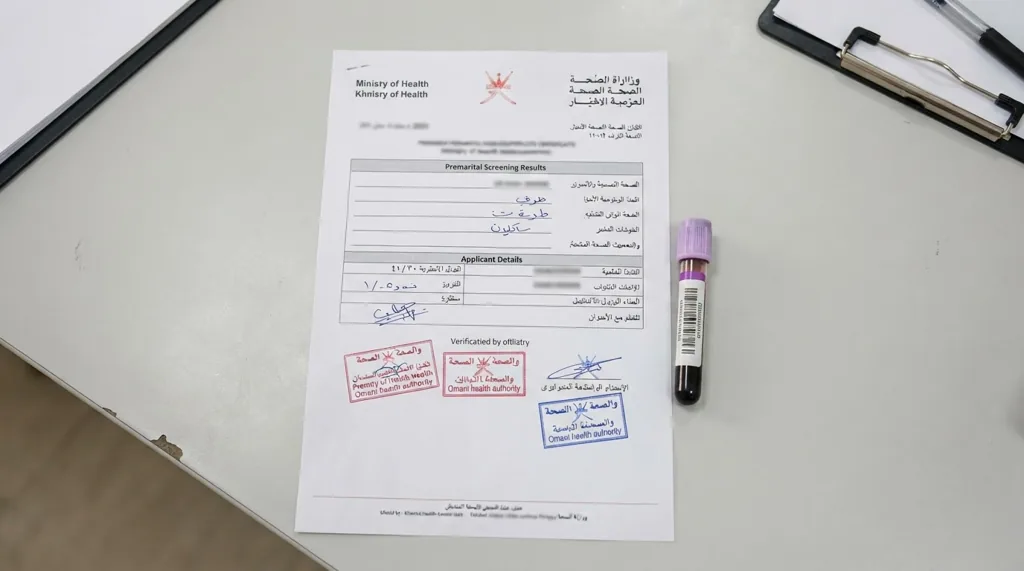
Oman’s Ministry of Health now requires couples tested abroad to submit full lab reports for eight tests, stamped by three authorities.
Oman’s Ministry of Health has set out strict rules for couples who take premarital medical tests abroad. Results without full lab reports and three layers of official stamps will not be accepted.
The ministry published two notices on 19 and 20 October 2026 covering screening done outside Oman1. They apply whether the other partner is Omani or non-Omani, and both partners must be screened before the marriage contract is signed2. The in-person checks will stay in place until the ministry offers the service on its electronic health platform2.
| At a glance | Details |
|---|---|
| What was published | Two Ministry of Health notices on premarital screening abroad |
| Published on | 19 October 2026 and 20 October 2026 |
| Who must comply | Both partners screened outside Oman, Omani or non-Omani |
| Effective date | No separate start date given in the notices |
| Next milestone | Launch of the screening service on the electronic health platform |
What is premarital screening, and why does it matter?
Premarital screening is a set of blood tests taken before marriage. It looks for inherited blood disorders and infectious diseases. Under Royal Decree No. 111/2025, both partners must take the screening before the marriage contract is concluded2.
The duty applies wherever the tests are done. The notice states this holds "regardless of whether the screening is conducted inside or outside" Oman2. Couples marrying abroad, or using a foreign clinic, therefore face the same test list as couples tested at home.
The eight tests the ministry requires
Tests done abroad must be equivalent to the screening the ministry has approved1. The first notice lists eight required tests1.
| Test | What it checks |
|---|---|
| Complete Blood Count (CBC) | General blood health |
| Hemoglobinopathy Panel (HPLC) or equivalent | Inherited hemoglobin disorders |
| Sickle Cell Solubility Test | Sickle cell trait |
| Serum Ferritin Test | Iron stores |
| Human Immunodeficiency Virus (HIV) Test | HIV infection |
| Hepatitis B Surface Antigen (HBsAg) Test | Hepatitis B infection |
| Hepatitis C Virus Antibodies (HCV Ab) Test | Hepatitis C infection |
| Syphilis Screening Test (RPR/VDRL) | Syphilis infection |
The tests must be done at a healthcare institution accredited in the country where they take place2.
Why a simple health certificate is not enough
Applicants must hand in the full laboratory results report, properly authenticated1. A certificate that only says a person is free from diseases will not be accepted1. Foreign lab results will also be rejected unless the relevant authorities have attested them1.
How the three-step authentication works
The second notice names three bodies that must authenticate the results2. Each adds its own stamp in turn.
| Step | Who authenticates the results |
|---|---|
| 1 | The healthcare institution that did the tests |
| 2 | The health authority of that country |
| 3 | Oman’s Ministry of Foreign Affairs |
After that, applicants must visit one of the ministry’s approved government healthcare institutions in Oman2. Staff there check and authenticate the results. Applicants also receive premarital medical counselling before getting a Premarital Screening Certificate2.
Where results can be verified in Oman
The ministry lists approved health centres, polyclinics and hospitals across 11 governorates2. These include Muscat, Dhofar, North Al Batinah, South Al Batinah, Musandam, Al Wusta and Al Buraimi2. Examples are Salalah Al Gharbiah Health Centre, Sohar Health Polyclinic, Khasab Health Polyclinic and Duqm Hospital2.
This spreads the verification work beyond the capital. Couples in remote areas such as Musandam or Al Wusta have a named local site.
What changes for couples and clinics
For couples, the main change is paperwork. Results must cover every listed test, come from an accredited lab, and carry all three stamps2. Missing any step means the results cannot be used1.
For foreign laboratories, the notices set a clear standard. Their reports must match the test list and show detailed results, not a short summary1. For Omani health centres on the list, the notices add verification and counselling work2.
When the rules apply and what comes next
The notices give no separate start date or grace period. They describe the requirements as applying now to anyone screened outside Oman2.
| Key date | What happens |
|---|---|
| 19 October 2026 | Notice No. 1 lists the eight required tests |
| 20 October 2026 | Notice No. 2 sets the authentication steps and approved centres |
| 21 October 2026 | Both notices updated on the ministry website |
| Not yet announced | Screening service goes online on the electronic health platform |
The in-person visit stays mandatory until the online service is announced2.
Key terms in plain words
| Term | Meaning |
|---|---|
| Premarital screening | Blood tests both partners take before marriage |
| Royal Decree No. 111/2025 | The law that makes premarital screening mandatory in Oman |
| Authentication | Official stamps confirming a document is genuine |
| Hereditary blood disorders | Blood diseases passed from parents to children, such as sickle cell |
| Accredited institution | A health facility officially approved by its country |
| Premarital medical counselling | A talk with health staff about test results before marriage |
The next milestone is the ministry’s announcement that the screening service is available on its electronic health platform2.
Sources
- ↩ Notice No. 1: Premarital Screening https://www.moh.gov.om/en/media-center/news/notice-no-1-premarital-screening-2/
- ↩ Notice No. 2: Premarital Screening https://www.moh.gov.om/en/media-center/news/notice-no-2-premarital-screening/