

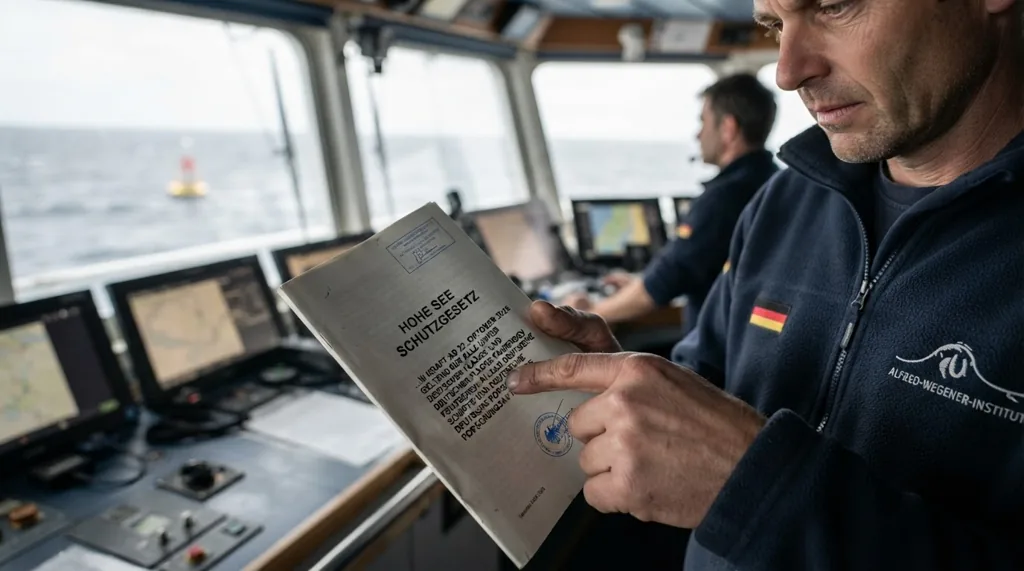
Germany’s High Seas Protection Act applies from 22 October 2026, binding German organisations, researchers and German-flagged ships to UN high seas treaty rules.
Germany has announced in its Federal Law Gazette that its High Seas Protection Act is now in force. From 22 October 2026, German organisations, researchers and German-flagged ships on the high seas must follow the UN high seas treaty’s rules.
The gazette notice, BGBl. 2026 I Nr. 315, was published on 22 October 2026 and signed on 16 October 20261. The Federal Environment Ministry led the work on it1. The next big step is the first conference of treaty members, planned for January 2027 in New York2.
| At a glance | Details |
|---|---|
| What was published | Gazette notice that the High Seas Protection Act is in force |
| Published on | 22 October 2026 |
| Who must comply | German organisations and people, including German-flagged ships and German high seas researchers |
| Effective date | 22 October 2026 |
| Next milestone | First conference of treaty members, January 2027, New York |
What is the High Seas Protection Act?
The act is Germany’s law for carrying out the UN agreement on marine life in areas beyond national waters3. That treaty is known as the BBNJ Agreement, short for Biodiversity Beyond National Jurisdiction2. The act itself first appeared in the gazette as BGBl. 2026 I Nr. 117 on 29 April 20263.
The high seas cover about half of the Earth’s surface and two thirds of the ocean2. Until now, there were no shared environmental rules for these waters2. The UN treaty entered into force internationally in January 20264.
Why the law applies from 22 October
Germany joined the UN treaty in September 20262. Federal Environment Minister Carsten Schneider handed over the ratification document at the United Nations in New York2. The treaty and the German act become binding thirty days after joining, on 22 October2.
Unlike many countries, Germany needed a second law to say how the treaty works at home4. The ministry said this would ensure German organisations and German-flagged ships on the high seas follow the rules4.
| Key date | What happens |
|---|---|
| 26 February 2026 | Bundestag passes the High Seas Protection Act |
| 29 April 2026 | Act published in the gazette |
| September 2026 | Germany joins the UN treaty |
| 22 October 2026 | Treaty and act binding for German actors |
| January 2027 | First conference of treaty members |
Who must follow the new rules
The rules cover German organisations and people2. The ministry names ships under the German flag and German high seas researchers as examples2. They must now follow the rules of the UN agreement2.
The Bundestag passed the act on 26 February 2026 in a version amended by its environment committee5. The CDU/CSU, SPD, Greens and Left voted for it, while the AfD voted against5.
What the act changes in practice
The government said three of the treaty’s four main parts needed German law5. These cover marine genetic resources, protected areas at sea, and environmental impact assessments5.
| Area | What the act does |
|---|---|
| Marine genetic resources | Collects data on sampling and use and feeds it to the treaty’s information system |
| Marine protected areas | Lets protected areas be set by government regulation |
| Environmental checks | Makes the nature agency the approval body for treaty impact checks |
| Emergency measures | Includes checks on vessels and offshore installations |
Marine genetic resources are samples of sea plants, animals and microbes, plus the digital genetic data drawn from them5. The act requires that information on taking and using these samples is gathered at national level5. It is then fed into the treaty’s information-sharing system5. The government said this ensures scientific records and openness about sampling and use5.
The role of Germany’s nature agency
The Federal Agency for Nature Conservation (BfN) gains new duties under the act5. It is to become the approval authority for impact assessments under the treaty5. These are checks on how an activity may harm the marine environment.
Existing approval powers of the Federal Environment Agency stay in place5. The same applies to the Federal Maritime and Hydrographic Agency5. The government also listed checks on vessels and offshore installations as emergency measures5.
What happens next at UN level
The first treaty conference will take place in January 2027 in New York2. Germany will negotiate there as a voting member2. The conference will decide in detail how protected areas are named, impact checks are run and genetic resources are shared fairly2.
Protected areas will only be named at later conferences2. Germany also funds the "Living High Seas" project with 20 million euros to help partner countries in the Global South draft protected area proposals4.
Key terms in plain words
| Term | Meaning |
|---|---|
| High seas | Ocean areas beyond any country’s national waters |
| BBNJ Agreement | UN treaty on protecting marine life beyond national waters |
| Marine genetic resources | Samples of sea life that carry genetic material of possible value |
| Environmental impact assessment | A check on how a planned activity could harm nature |
| Marine protected area | A defined sea area managed to protect nature over the long term |
| Federal Law Gazette (BGBl.) | Germany’s official journal where laws are published |
The next official milestone is the first conference of treaty members in New York in January 2027.
Sources
- ↩ Bundesgesetzblatt Teil I – Bekanntmachung über das Inkrafttreten des Hochseeschutzgesetzes – Bundesgesetzblatt https://www.recht.bund.de/bgbl/1/2026/315/VO.html
- ↩ BMUKN: UN-Hochseeschutzabkommen https://www.bundesumweltministerium.de/themen/meeresschutz/un-hochseeschutzabkommen
- ↩ Bundesgesetzblatt Teil I – Gesetz zur Ausführung des Übereinkommens im Rahmen des Seerechtsübereinkommens der Vereinten Nationen über die Erhaltung und nachhaltige Nutzung der biologischen Vielfalt der Meere von Gebieten außerhalb nationaler Hoheitsbefugnisse – Bundesgesetzblatt https://www.recht.bund.de/bgbl/1/2026/117/VO.html
- ↩ BMUKN: UN BBNJ Agreement https://www.bundesumweltministerium.de/en/topics/marine-conservation/un-bbnj-agreement
- ↩ Erhaltung und nachhaltige Nutzung der biologischen Vielfalt der Meere – Deutscher Bundestag https://www.bundestag.de/dokumente/textarchiv/2026/kw09-de-seerecht-1140420