

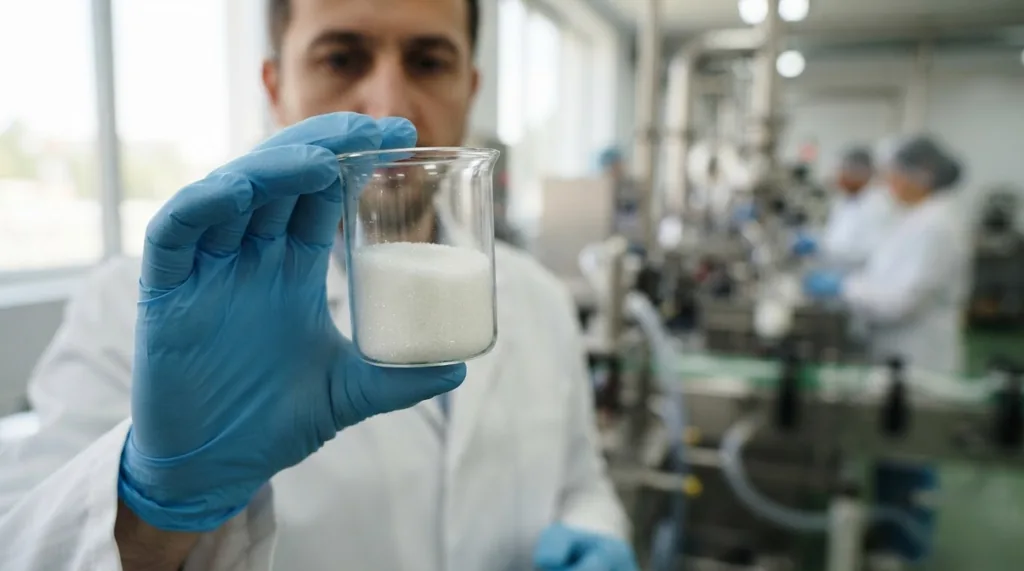
The European Commission now lets producers make the stevia sweetener E 960c(ii) with a new yeast and caps kaurenoic acid, from 8 November 2026.
The European Commission has widened the legal recipe for a stevia-based sweetener so that producers can make it with a new genetically modified yeast. The change also adds a strict new purity limit and takes effect 20 days after its 19 October 2026 publication.
Commission Regulation (EU) 2026/2309, adopted on 16 October 2026, updates the official quality standards for rebaudioside M, a sweet compound made from stevia leaf extract1. It covers firms that make or sell this sweetener, known by its food additive code E 960c(ii), anywhere in the European Union (EU). The rules apply directly in every member state and enter into force on the 20th day after publication1.
| At a glance | Details |
|---|---|
| What was published | Final Commission Regulation (EU) 2026/2309 |
| Published on | 19 October 2026 |
| Who must comply | Producers and sellers of the sweetener E 960c(ii) in the EU |
| Effective date | 20th day after publication, which is 8 November 2026 |
| Next milestone | The rules apply directly in all member states from that date |
What is rebaudioside M, and why does it matter?
Rebaudioside M belongs to the steviol glycosides, the sweet compounds found in the stevia plant. The EU already allows "enzymatically produced steviol glycosides" as a food additive under the code E 960c1. One version, E 960c(ii), is made by converting a highly purified stevia extract with enzymes, proteins that speed up a chemical change1.
Every approved food additive in the EU has a legal specification. This is a detailed description of what the substance is, how it is made and how pure it must be. Those descriptions sit in Regulation (EU) No 231/2012, which this new measure amends1.
What the new rules change
Until now, the enzymes used to make E 960c(ii) could only come from genetically modified E. coli bacteria, in three named strains1. The new text allows the same enzymes to come from a genetically modified yeast, K. phaffii strain CGMCC 75391.
The regulation also rewrites the definition of the sweetener. The starting material is a rebaudioside A extract that is 95% steviol glycosides, taken from the Stevia rebaudiana Bertoni plant1. The finished product must contain at least 95% rebaudioside M1.
| Area | What the regulation requires |
|---|---|
| Allowed enzyme sources | E. coli strains pPM294, pFAF170 and pSK401, or K. phaffii CGMCC 75391 |
| Starting material | Rebaudioside A extract with 95% steviol glycosides1 |
| Final product | Not less than 95% rebaudioside M1 |
| Living cells and DNA | Must not be detected in the additive1 |
| Kaurenoic acid | Not more than 0.3 mg/kg1 |
A new purity limit for kaurenoic acid
The regulation adds a new line to the purity rules. Kaurenoic acid must not exceed 0.3 milligrams per kilogram in the sweetener1. Firms must measure it using liquid chromatography-mass spectrometry, a laboratory method that separates and identifies chemicals1.
The text also keeps a clear safeguard on genetic modification. Living cells of the bacteria or the yeast, and their DNA, must not be detected in the finished additive1.
How the safety review shaped the rules
The change began with an application sent to the Commission on 22 December 20221. The applicant first asked to change a different version, E 960c(i), but later switched its request to E 960c(ii) during the safety review2.
The European Food Safety Authority (EFSA), the EU’s food safety adviser, published its opinion on 14 May 20251. It found no safety concern with using the new yeast strain to make the sweetener1. EFSA also recommended a specific entry for kaurenoic acid, which the final text now includes1.
How the measure moved to adoption
The Commission sent the draft regulation to the Council of the European Union on 23 July 2026, under Council document 12169/262. The draft carried the same recitals and legal articles as the final text2.
The Standing Committee on Plants, Animals, Food and Feed, made up of member state experts, backed the measure1. The Commission then adopted it on 16 October 2026, and it appeared in the Official Journal on 19 October 20263.
What changes for food and sweetener makers
Producers of E 960c(ii) gain a second approved way to make the enzymes they need. Those using the new yeast must meet the same 95% purity floor and the new kaurenoic acid cap1.
Existing producers that use E. coli remain covered by the specification. They must also meet the new kaurenoic acid limit, because it applies to the whole E 960c(ii) entry1.
Key terms in plain words
| Term | Meaning |
|---|---|
| Steviol glycosides | Sweet compounds taken from the stevia plant |
| Rebaudioside M | One very sweet steviol glycoside, sold as E 960c(ii) |
| Specification | The legal description of an additive’s identity, making and purity |
| Enzyme | A protein that speeds up a chemical change |
| Kaurenoic acid | A substance that now has a maximum limit in the sweetener |
| EFSA | The European Food Safety Authority, the EU’s food safety adviser |
The new specification for E 960c(ii) enters into force on 8 November 2026.
Sources
- ↩ L_202602309EN.000101.fmx.xml https://eur-lex.europa.eu/legal-content/EN/TXT/HTML/?uri=OJ:L_202602309
- ↩ pdf https://data.consilium.europa.eu/doc/document/ST-12169-2026-INIT/en/pdf
- ↩ Official Journal L series daily view – EUR-Lex https://eur-lex.europa.eu/oj/daily-view/L-series/default.html?ojDate=19102026