

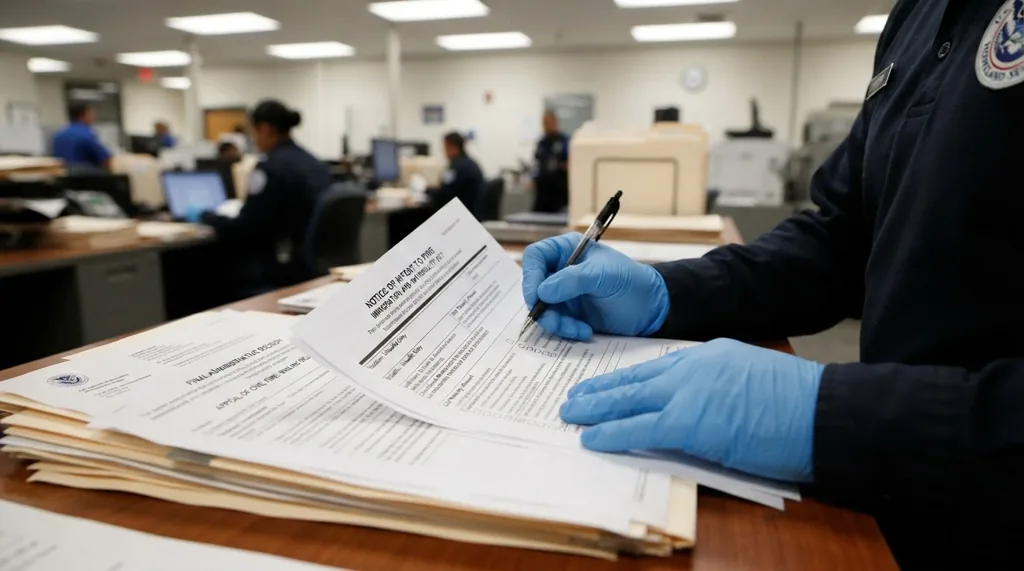
DHS and the Justice Department made their faster immigration fines process permanent on Oct. 14, 2026, adding late appeals for documented mail delays.
The US Department of Homeland Security and the Justice Department have made their fast-track immigration fines process permanent. The final rule took effect on Oct. 14, 2026, and adds one change: some late appeals will now be accepted when the mail was delayed.
The final rule was published in the Federal Register on Oct. 14, 2026, and confirms an interim rule first issued on June 27, 20251. It covers people who enter the country unlawfully or fail to leave after a removal or voluntary departure order2. A federal court in Massachusetts has already found that challengers to the 2025 interim rule are likely to succeed on parts of their case3.
| At a glance | Details |
|---|---|
| What was published | Final rule confirming the June 2025 interim rule, with one change |
| Published on | 14 October 2026 |
| Who must comply | Noncitizens who enter unlawfully or stay after a removal or voluntary departure order |
| Effective date | 14 October 2026 |
| Next milestone | Pending Massachusetts court case over the 2025 interim rule |
What the final rule does
The rule is issued jointly by Immigration and Customs Enforcement (ICE), part of the Department of Homeland Security (DHS), and the Executive Office for Immigration Review (EOIR), the Justice Department office that runs the immigration courts2. It is published as document 2026-21024 at 91 FR 65390 and amends 8 CFR parts 281, 1003 and 12801.
The rule finalizes the June 2025 interim rule with one change2. ICE may now accept a late appeal when the person shows documented mail delivery delays that ICE finds were beyond their control2.
The interim rule was effective on the day it was published and invited public comment until July 28, 20254. The final rule responds to those comments2.
Who faces the fines
The rules apply to three groups of people2:
- people who willfully fail or refuse to leave after a final removal order, or who act to block their removal
- people who do not leave within the period set in a voluntary departure order
- people caught while entering or trying to enter the country unlawfully
Congress set the fine ranges, and DHS has adjusted them for inflation2. The amounts did not change in this rule.
How the faster process works
Before the interim rule, DHS used older general fine procedures written mainly for airlines and other carriers2. Those required a notice of intent to fine, served in person or by certified mail, and a wait of at least 30 days for a reply2.
Now a DHS immigration officer can open the process by issuing a written decision and order imposing the fine2. The order must state the legal basis, the type and amount of the fine, and the reasons2. DHS may serve it in person or by regular mail2.
Appeal deadlines and the new mail-delay exemption
A person must file a notice of appeal within 15 business days of being served2. If no timely appeal is filed, the order becomes final2.
A supervisory officer who did not issue the first order decides the appeal on the written record2. There are no in-person interviews, and the person cannot appeal to the Board of Immigration Appeals (BIA), the Justice Department’s immigration appeals body2. DHS may reopen a decision at any time to reduce or cancel the fine2.
The single new element is the mail-delay exemption2. It applies only when delays are documented and ICE agrees they were outside the person’s control2.
Why the government says it needs the rule
The departments say the faster process helps enforce removal orders and border security2. They cite about 1.5 million people on ICE’s non-detained docket with final removal orders before the interim rule2. In fiscal year 2024, EOIR issued more than 282,000 final removal orders, but only about 10% were carried out2.
DHS has also said it will cancel most failure-to-depart fines for people who use the CBP Home app, run by US Customs and Border Protection, to arrange and complete their own departure2.
The court challenge in Massachusetts
On Sept. 30, 2026, the US District Court for the District of Massachusetts ruled on a motion to stay the interim rule3. The judge found the challengers likely to show that fines were imposed without checking whether each person’s failure to leave was willful or voluntary3. The judge also found them likely to show the interim rule was issued without the usual public comment3.
The court noted that ICE had started nearly 10,000 fine notices for failure to depart between March and June 20253. One plaintiff says she faces about $1.8 million in fines3.
Key terms in plain words
| Term | Meaning |
|---|---|
| Interim final rule | A rule that takes effect at once, with public comment taken afterward |
| Final rule | The settled version of a rule after comments are reviewed |
| Voluntary departure order | A court order allowing a person to leave the country by a set date |
| Final removal order | A court order requiring a person to be deported |
| Stay | A court order pausing a government action while a case continues |
| Served | Formally delivered to the person, here by hand or regular mail |
The final rule has been in force since Oct. 14, 20261.
Sources
- ↩ Federal Register :: Imposition and Collection of Civil Penalties for Certain Immigration-Related Violations — 2026 21024 / imposition and collection of civil penalties… https://www.federalregister.gov/documents/2026/10/14/2026-21024/imposition-and-collection-of-civil-penalties-for-certain-immigration-related-violations
- ↩ AGENCY: https://www.federalregister.gov/documents/full_text/html/2026/10/14/2026-21024.html
- ↩ 113-decision-and-order-granting-stay.pdf https://www.publicjustice.net/wp-content/uploads/2026/10/113-decision-and-order-granting-stay.pdf
- ↩ Federal Register :: Imposition and Collection of Civil Penalties for Certain Immigration-Related Violations — 2025 11965 / imposition and collection of civil penalties… https://www.federalregister.gov/documents/2025/06/27/2025-11965/imposition-and-collection-of-civil-penalties-for-certain-immigration-related-violations