

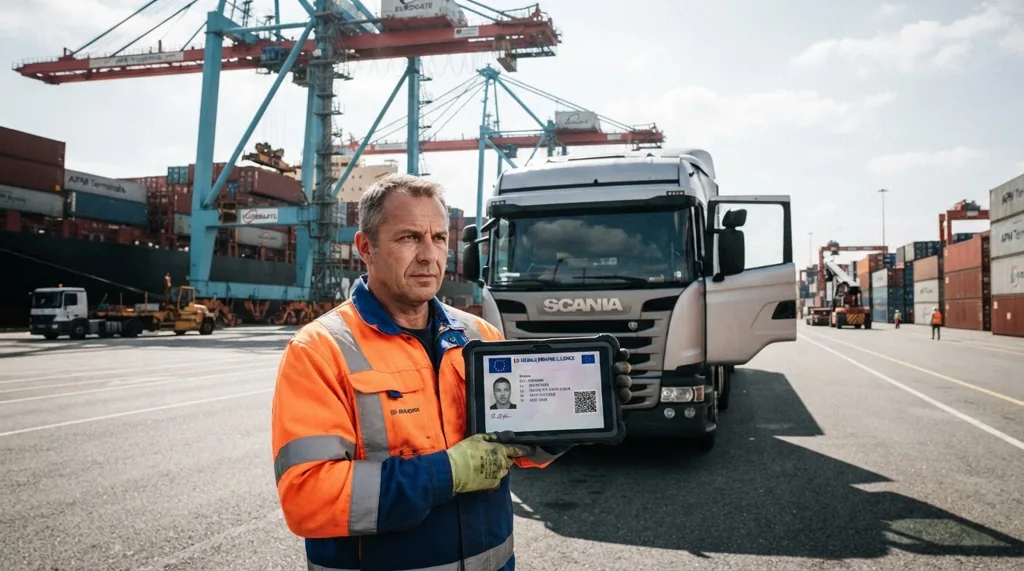
The European Commission set technical rules for phone-based driving licences. Member states must list their issuing authorities by 3 November 2027.
The European Commission has set the technical rules for digital driving licences stored on mobile phones across the EU. National licensing authorities must send the Commission details of who issues these licences by 3 November 2027.
The rules are Commission Implementing Regulation (EU) 2026/2266, adopted on 13 October 2026 and published in the Official Journal of the EU on 14 October 20261. They apply to national authorities that issue and manage mobile driving licences under the EU’s 2025 driving licence law2. They also cover the exchange of mobile licences issued by countries outside the EU2.
| At a glance | Details |
|---|---|
| What was published | Final implementing regulation (EU) 2026/2266 |
| Published on | 14 October 2026 |
| Who must comply | National licence-issuing authorities in EU member states |
| Key deadline | 3 November 2027 for member states to list their issuing authorities |
| Next milestone | Commission builds a trusted list of issuing authorities |
What is a mobile driving licence, and why does it matter?
Directive (EU) 2025/2205, the EU’s new driving licence law, introduces a fully digital licence on a phone or other device3. It will be issued into the EU Digital Identity Wallet, a government-backed phone app for official documents3. The Commission says it will make replacing, renewing and exchanging licences easier when people move between EU countries3.
After a brief transition period, digital licences will be issued by default in all member states3. Physical licences will stay available on request, for example for people without a smartphone3. The directive entered into force on 25 November 2025 and becomes applicable in four years, after countries write it into national law3.
The new regulation fills in the technical detail. It aims to make sure every country’s mobile licence works with every other country’s checking systems2.
What issuing authorities must do
Every mobile licence must meet the technical specifications in Annex I of the regulation2. Licences must be issued as trusted digital certificates under the EU’s electronic identity law, Regulation (EU) No 910/20142. Authorities must use set protocols to load licences into the digital identity wallets2.
Authorities must also keep the data in every valid mobile licence accurate2. The regulation’s preamble says the data on a person’s physical and mobile licences must match exactly2.
| Area | What the regulation requires |
|---|---|
| Technical format | Licences meet the specifications in Annex I2 |
| Trust level | Issued as trusted digital certificates under Regulation (EU) No 910/20142 |
| Accuracy | Data in every valid mobile licence is correct2 |
| Security incidents | Some incidents are reported to the Commission2 |
| Design | Countries tell the Commission about their visual design rules2 |
How checkers verify a licence
Checkers must confirm a licence is genuine and valid using the technical tools set under the electronic identity law2. The preamble says verifiers should not rely on how the licence looks on screen1. Member states may also use the EU driving licence network, an existing EU system for checking licences in any format1.
Countries can set their own design rules for how licences look. They must tell the Commission about these rules, and the Commission will share them with other member states2. The Commission will also publish the look of each country’s mobile licence on its website2.
Validity, revocation and confiscation
Each mobile licence has a "technical validity period", the life of the digital security code that protects its data2. Authorities may choose any period, and the licence expires when it runs out2. That expiry does not end the holder’s legal right to drive2.
How a cross-border confiscation works
For licences with a technical validity period of more than one hour, authorities must cancel the digital licence in at least five situations2:
- the wallet holding the licence has had its own certificate cancelled
- another country has decided to exchange the licence
- another member state has decided to replace the licence
- the licence or the right to drive has been cancelled, withdrawn, suspended or restricted
- another member state has notified a confiscation2
A phone cannot be seized like a plastic card, so the regulation creates a new confiscation process1. An authorised user in the confiscating country notifies the issuing country through the EU driving licence network2. The issuing country must then cancel the current mobile licence as soon as possible and offer a new one2.
The new licence must carry a note of the confiscation date, the confiscating country and the end date2. That note stays until the confiscation period has passed2.
Security incidents and reporting deadlines
Some issuing authorities already report security incidents under EU cybersecurity and electronic identity laws2. They must now also tell the Commission when an incident affects the issuance or validity of mobile licences2. This applies only where the Commission would not otherwise be informed2.
By 3 November 2027, member states must send the Commission the information on their issuing authorities listed in Annex II2. They must use a secure electronic channel the Commission provides, and report any later changes immediately2. The preamble says the Commission will use this to build a trusted list, so verifiers can check a licence came from an authorised issuer1.
Exchanging licences between countries
The regulation sets steps for swapping a licence when a holder moves to another member state2. The country doing the exchange must first check which formats the applicant holds, physical or mobile2. The preamble says the rules uphold the "one holder, one licence" principle while getting holders their new licence quickly1.
Key terms in plain words
| Term | Meaning |
|---|---|
| Mobile driving licence | A digital driving licence stored on a phone or other device |
| EU Digital Identity Wallet | A government-backed app that stores official digital documents |
| Implementing regulation | Detailed Commission rules that put an existing EU law into practice |
| Technical validity period | How long the licence’s digital security code stays valid |
| Revoke | Cancel the digital security code so the mobile licence stops working |
| EU driving licence network | An existing EU system countries use to check licences |
The next deadline is 3 November 2027, when member states must notify the Commission of their mobile licence issuing authorities2.
Sources
- ↩ Implementing regulation – EU – 2026/2266 – EN – EUR-Lex https://eur-lex.europa.eu/eli/reg_impl/2026/2266/oj
- ↩ L_202602266EN.000101.fmx.xml https://eur-lex.europa.eu/legal-content/EN/TXT/HTML/?uri=OJ:L_202602266
- ↩ Modernised EU rules on driving licences and driving disqualifications enter into force – Mobility and Transport https://transport.ec.europa.eu/news-events/news/modernised-eu-rules-driving-licences-and-driving-disqualifications-enter-force-2025-11-25_en