

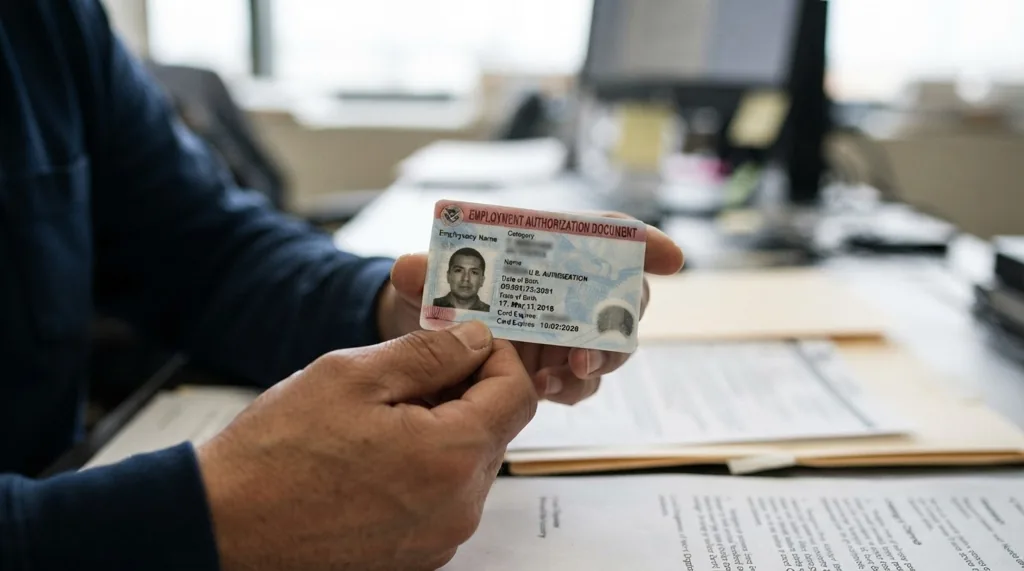
DHS made permanent its end to automatic work permit extensions for renewals, effective Oct. 14, 2026.
The US Department of Homeland Security (DHS) has made permanent its end to automatic extensions of work permits for many foreign workers. The final rule took effect on Oct. 14, 2026, so renewal applicants can lose the right to work while they wait for a decision.
The final rule keeps, without changes, an interim rule that DHS first published on Oct. 30, 20251. It affects foreign nationals who hold an employment authorization document (EAD), the card that proves they may work in the United States, and the employers who hire them. DHS took public comments on the interim rule and has now answered them in the final text1.
| At a glance | Details |
|---|---|
| What was published | Final rule confirming an interim rule |
| Published on | 14 October 2026 |
| Who must comply | Work permit holders renewing in certain categories, and their employers |
| Effective date | 14 October 2026 |
| Next milestone | No further step announced; the rule is now final |
What changes for work permit renewals?
Under the old rules, a worker who filed a renewal on time kept a valid work permit while the application was pending. The interim rule ended that practice for renewal applications filed on or after Oct. 30, 20252. The final rule now reaffirms and finalizes those provisions1.
DHS says the automatic extension let a worker keep working before officials finished checking eligibility and security records1. Those checks include vetting and screening, the background and security reviews done before a benefit is granted. The agency says it wants these completed before granting a new period of work authorization1.
Why DHS says it acted
DHS says ending the extensions enhances benefit integrity and puts proper vetting first1. It links the rule to two presidential executive orders, numbers 14159 and 14161, on immigration enforcement and security screening1.
The legal basis is section 103(a) of the Immigration and Nationality Act (INA), the main US immigration law1. That section lets the Secretary of Homeland Security write rules to enforce immigration laws1.
Who keeps an automatic extension
The rule does not cancel every extension. Several groups are still covered.
TPS is a program that lets people from certain crisis-hit countries live and work in the US for a set time. Under a 2025 law, TPS-related work permits may be extended for up to 1 year or the length of TPS, whichever is shorter3.
How the old extension worked
DHS first allowed automatic extensions of up to 180 days. On Dec. 13, 2024, a final rule permanently raised that limit to up to 540 days for certain renewal applicants3. The interim rule ended that 540-day benefit for new filings2.
The groups that had qualified included refugees, asylees, asylum applicants and people with pending green card applications3. Some spouses of workers on H-1B, L-1 and E visas also qualified3.
What it means for employers
Employers check work permits using Form I-9, the federal form that confirms a worker may legally work. Under the old system, an expired card plus a renewal receipt notice counted as proof of continued work rights3. For renewals filed on or after Oct. 30, 2025, that receipt no longer extends the card’s validity2.
As a result, a worker whose card expires before a decision may lose work authorization until USCIS rules on the renewal. The final rule’s comment response includes a section on employer burdens and business continuity1.
How the rule was made
DHS issued the interim rule without first taking comments, then invited them until Dec. 1, 20252. The final rule answers comments on the agency’s legal authority, processing times and economic effects1. DHS made no changes to the interim rule’s text1.
The rule is published as Federal Register document 2026-20955 under DHS docket USCIS-2025-02711. US Citizenship and Immigration Services (USCIS), the agency that handles work permits, runs the program1.
Key terms in plain words
| Term | Meaning |
|---|---|
| Employment authorization document (EAD) | A card proving a foreign national may work in the US |
| Automatic extension | Extra validity a card got just by filing a renewal on time |
| Interim final rule | A rule that takes effect at once, with comments taken afterwards |
| Vetting | Background and security checks before a benefit is granted |
| Temporary Protected Status (TPS) | Temporary permission to stay for people from crisis-hit countries |
| Form I-9 | The form employers use to confirm a worker may legally work |
The final rule has been in force since Oct. 14, 2026, and DHS has announced no further step1.
Sources
- ↩ Federal Register :: Removal of Automatic Extensions for Certain Employment Authorization Documents https://www.federalregister.gov/documents/2026/10/14/2026-20955/removal-of-automatic-extensions-for-certain-employment-authorization-documents
- ↩ Federal Register :: Removal of the Automatic Extension of Employment Authorization Documents https://www.federalregister.gov/documents/2025/10/30/2025-19702/removal-of-the-automatic-extension-of-employment-authorization-documents
- ↩ Automatic Employment Authorization Document (EAD) Extension | USCIS https://www.uscis.gov/archive/automatic-employment-authorization-document-ead-extension