

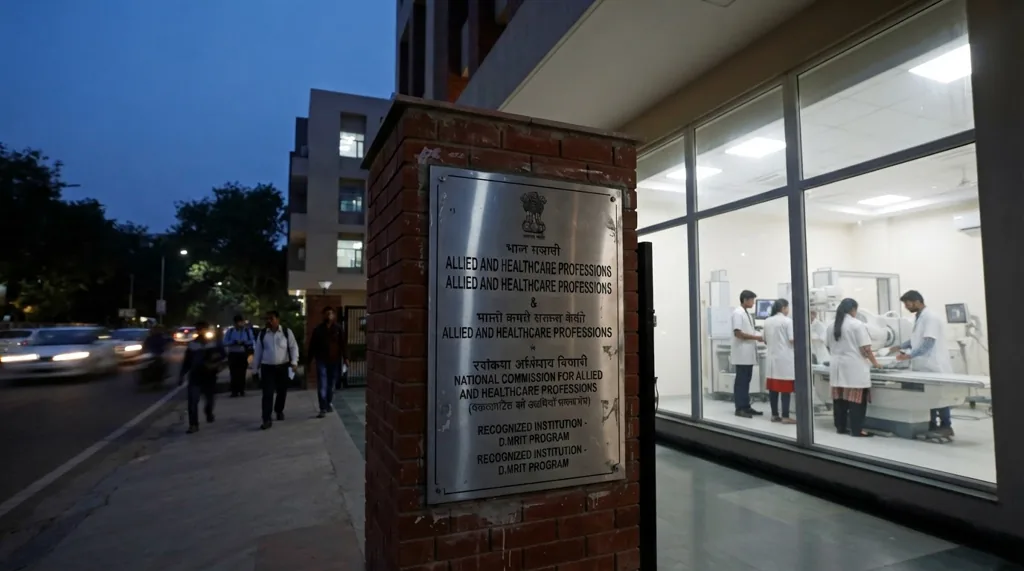
India’s NCAHP has notified boards to inspect and rate allied health colleges and a radiology diploma curriculum compulsory from academic year 2027–28.
India’s allied health regulator has notified rules to inspect and rate allied health colleges, impose a national radiology diploma syllabus from 2027–28, and require registration to practise.
The National Commission for Allied and Healthcare Professions (NCAHP) is the national regulator for allied and healthcare professions, a group that includes radiology and imaging technologists. The Ministry of Health and Family Welfare announced the package on Oct. 7, 20261.
In short, colleges that train allied health workers will now be inspected and publicly rated, and diploma-level radiology courses must follow one national syllabus. Practitioners must hold a valid registration, renewed every five years through ongoing training, to work legally.
What did NCAHP notify in October 2026?
The ministry’s press release lists three instruments, all made under the National Commission for Allied and Healthcare Professions Act, 20211. They are:
- the Autonomous Boards and Central Assessment Committee (Establishment, Constitution, Functions and Powers) Regulations, 2026;
- a competency-based curriculum for the Diploma in Medical Radiology and Imaging Technology (D.MRIT);
- the Registration of Allied and Healthcare Professionals Regulations, 2026.
The boards regulations are the newest step. The registration rules came earlier and were published in the Gazette of India on Sept. 15, 20261. The press release says the boards regulations make that registration process work across central and state registers1.
How will the new boards rate allied health colleges?
The boards regulations set up Autonomous Boards under each State Allied and Healthcare Council, the state-level body for these professions1. Each board will have 10 to 20 members, including a President, drawn from recognised professional categories1.
The work is split across several boards:
- Undergraduate and Postgraduate Boards apply course standards and oversee faculty development, training and research.
- An Assessment and Rating Board inspects institutions and rates them.
- An Ethics and Registration Board checks professionals’ documents and recommends them for registration.
The Assessment and Rating Board carries the most weight for colleges. It will judge applications for recognition and Letters of Permission, the approval needed to run a course1. It will also inspect institutions, review their annual disclosures, appoint assessors, and publish ratings on the State Council website1.
The Ethics and Registration Board will also handle complaints and breaches of professional conduct. It can make recommendations on a professional’s registration as a result1.
What happens in states without a council?
Some states and Union Territories do not yet have a working State Council. For them, the regulations create a Central Assessment Committee (CAC), supervised by NCAHP and supported by its secretariat1.
The CAC does the job of the Autonomous Boards in those areas. It must follow the same checking, inspection and rating procedures1. It will have 10 to 30 members, including a President, with extra members where needed to cover states and territories without councils1.
Members can be removed for a conflict of interest, breach of code or abuse of position, among other grounds. Each member must first get a hearing1.
When must colleges adopt the D.MRIT radiology curriculum?
NCAHP notified the D.MRIT curriculum on Sept. 30, 2026, under its One Nation One Curriculum policy, a drive for a single syllabus per course across India1. Any institution running or planning to run the course must adopt it from academic year 2027–281. Institutions may choose to start in academic year 2026–271.
Radiology curriculum dates
The D.MRIT is a two-year programme. Entry requires Class 12 in the science stream with Physics, Chemistry and Biology from a recognised board1. It includes a six-month clinical internship in radiology and imaging, done under supervision1.
Graduates are meant to support X-ray, CT scan, sonography, mammography and fluoroscopy services. These services are needed at primary health centres, hospitals and diagnostic centres1. The internship covers patient care, radiation safety and the use of imaging equipment1.
The diploma adds a lower rung to existing bachelor’s and master’s curricula in the same field. Those were released on April 24, 2025, for use from academic year 2026–271. NCAHP has now released 20 competency-based curricula across allied health professions1.
What do the registration rules require of professionals?
A person may practise a recognised allied and healthcare profession only after registering1. The gazette notice, dated Aug. 31, 2026, says the registration rules take effect on the date they are published in the Gazette2.
Registration processing fees, Rs
To register with a State Council, an applicant must hold a recognised qualification, pass the exit exam set by the Commission, and live in that state2. Until the Commission sets an exit exam, the institution’s final exam counts as one2. The State Council must accept or reject an application within 30 working days2.
Each professional gets a Unique Identification (UID) number through a central portal, plus a certificate with a QR code2. The State and Central Registers will be public, so patients can check whether a professional is registered1. A person on the Central Register may practise in any state, if they follow the notice steps in the rules2.
Applicants refused by a State Council can appeal to the Commission within one month2. The appeal carries a processing fee of Rs 5,000 and must be decided within 90 working days2. Adding a further approved qualification to the Central Register costs a fee of Rs 1,0002.
How do renewal and training hours work?
Registration is valid for five years2. To renew, a professional must complete continuing professional development (CPD), meaning ongoing training such as workshops and conferences. The minimum is 15 hours a year and 75 hours over the five-year period2. Online training may make up no more than 50% of the total2.
Renewal requirements
| Requirement | Standard / Details |
|---|---|
| Validity | Five years per registration |
| Yearly training | At least 15 CPD hours a year |
| Five-year training | 75 CPD hours in total |
| Online share | No more than 50% of training |
| Filing time | Apply six months before expiry |
Renewal applications go to the State Council six months before registration expires2. If no application arrives before expiry, the entry is marked "inactive", and the professional may not practise during that time2.
The rules also cover other groups1. Students in internships or clinical training get interim registration, which their institution must start, at no fee1. Indian citizens with foreign qualifications can register once their qualification is recognised or assessed for equivalence1. Temporary registration covers set purposes such as fellowships and research1.
NCAHP is also working on provisional registration for current practitioners who lack the required qualification1. They would get the option of a bridge course to qualify for full registration1.
Summary of the NCAHP allied health regulations
The table below sets out the main points of the October 2026 package.
| Key Dimension | Details |
|---|---|
| Regulating Authority & Jurisdiction | NCAHP, under the Ministry of Health and Family Welfare, India1 |
| Legal basis | National Commission for Allied and Healthcare Professions Act, 20211 |
| Scope & Who Must Comply | Allied health colleges, State Councils, and allied and healthcare professionals1 |
| Core Mandate / Key Change | Boards and a CAC inspect and publicly rate institutions; registration required to practise1 |
| Board size | Autonomous Boards 10 to 20 members; CAC 10 to 30 members1 |
| Compliance Thresholds | CPD of 15 hours a year and 75 hours per five years; online up to 50%2 |
| Fees | Rs 5,000 appeal fee; Rs 1,000 for an added qualification2 |
| Key Dates & Implementation Milestones | Registration rules gazetted Sept. 15, 2026; D.MRIT notified Sept. 30, 2026; compulsory from 2027–281 |
| Penalties / Enforcement Action | Lapsed registration marked inactive, with no right to practise2 |
The next fixed milestone is academic year 2027–28, when every institution offering the D.MRIT must teach the national curriculum1.
Sources
- ↩ Press Release Page | Press Information Bureau https://www.pib.gov.in/PressReleasePage.aspx?PRID=2320314
- ↩ 276186.pdf https://egazette.gov.in/WriteReadData/2026/276186.pdf