
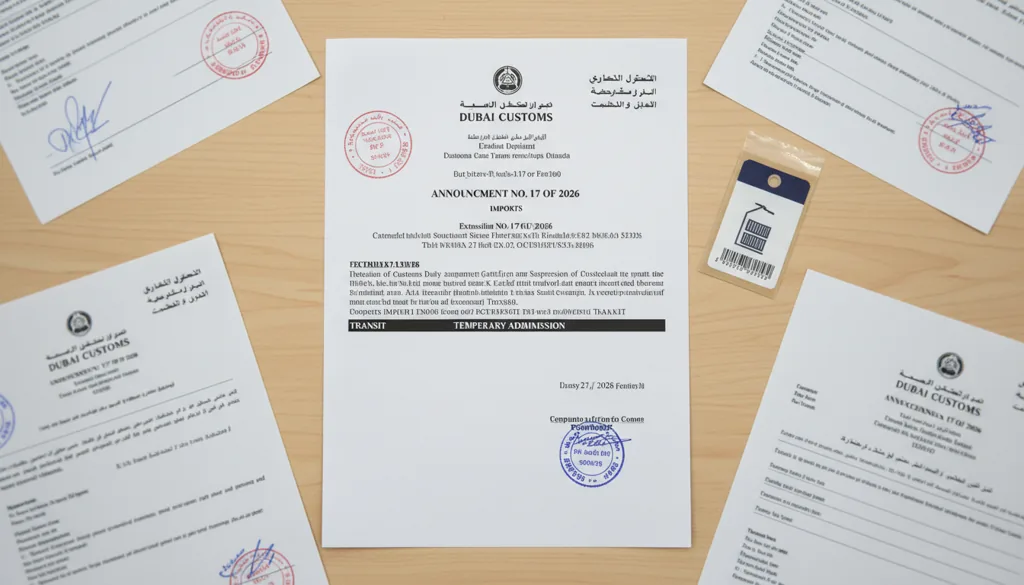
United Arab Emirates extended the customs duty suspension period for eligible declarations by an additional 60 days, bringing the total suspension to 180 days effective from September 24, 2026.
Dubai Customs has extended the period in which eligible customs declarations can keep their duty suspended by 60 days, bringing the total suspension to 180 days from Sept. 24, 2026.
The measure covers goods entering the United Arab Emirates for re-export, temporary admission and transit. It gives companies longer to complete those customs arrangements before suspended duty becomes payable, rather than removing the duty permanently.
The change is intended to ease financial and administrative pressure on businesses holding goods in Dubai. The immediate cash benefit goes to the importer or other company responsible for the customs declaration, although the company remains responsible for meeting the conditions of the suspended status.
Dubai’s 180-day window
The additional period applies to eligible declarations whose existing suspension expires within the dates set by the new announcement. The covered cases are those expiring after Feb. 27, 2026 and up to Oct. 31, 2026.1
Dates bounding the extension
That makes the measure a temporary bridge for shipments already moving through the customs system, rather than a new permanent duty exemption. The duty remains suspended while the approved customs arrangement continues, but the goods must still follow the rules attached to that arrangement.
Customs Announcement No. 17 of 2026 says the extension adds 60 days to the existing period, taking the total to 180 days. It also says the extra time starts when the original suspended-status period ends, not when the announcement is issued.1
That timing matters for companies with different declaration dates. A shipment that reaches the end of its original period earlier will enter the extension earlier, while a later declaration will retain its original suspension until its own expiry date.
The notice took effect when issued and applies temporarily to the declarations covered by its terms. Dubai Customs described the measure as part of efforts to reduce financial and administrative burdens on businesses.2
Three customs statuses
The first group covered is goods imported for re-export. These goods can enter Dubai without the suspended duty becoming immediately payable, provided the customs arrangement is maintained and the goods later leave the UAE under the applicable procedures.
Three statuses that qualify
The second is temporary admission, which covers goods brought into the country for a limited purpose rather than ordinary domestic sale. Examples can include equipment or other commercial goods that are expected to leave again, though the announcement itself defines the eligible customs status rather than listing individual products.
The third is all forms of transit. Transit goods pass through the customs territory under controls that keep them moving to another destination, so the added time can be relevant where a shipment has not completed its transit process by the original deadline. Dubai Customs listed all three categories in its announcement.2
The extension therefore reaches different kinds of trade movement without setting a new product list or tariff schedule. Its common feature is the customs status attached to the declaration, not the type of merchandise inside the shipment.
For importers and brokers, that distinction is central. A declaration for domestic release is not brought into the extension simply because the goods are delayed, while a qualifying declaration can benefit even if the goods belong to very different commercial sectors.
The September expiry dates
The September start date applies to the new national measure described in the announcement. From Sept. 24, 2026, the additional period will run from the point at which each eligible declaration reaches the end of its original suspension.2
The two extensions, side by side
| Notice No. 12 of 2026 | Announcement No. 17 of 2026 | |
|---|---|---|
| Issued | June 18, 2026 | Effective Sept. 24, 2026 |
| Extra time added | To 120 days total | 60 more days, to 180 |
| Expiries covered | After Feb. 27 through July 31, 2026 | After Feb. 27 through Oct. 31, 2026 |
| Extra time starts | At original expiry | At original expiry, not issue date |
The practical result is a rolling deadline rather than one final date for every shipment. Declarations expiring between the relevant dates can receive the extra time, but the 60 days attach to the individual declaration and its existing customs status.
The earlier extension was Customs Announcement No. 12 of 2026, issued on June 18. That step increased the suspension period to 120 days for eligible arrangements expiring after Feb. 27 and through July 31, 2026.2
The new action reaches further into the calendar by including cases expiring through Oct. 31. That creates a wider window for shipments that would otherwise have reached the end of their suspended status during the second half of 2026.
The announcement also leaves the added period in place until another customs notice suspends or ends it. Dubai Customs said it may extend the period again under its approved rules and procedures.2
That provision gives the authority room to adjust the arrangement without issuing a new permanent customs law. It also means the current deadline structure can change through a later announcement, making the status of each declaration important to the final duty outcome.
VAT and financial guarantees
The customs extension is separate from the United Arab Emirates’ value-added tax system, but the two regimes meet in suspended customs arrangements. The Federal Tax Authority guide says goods under temporary admission, customs warehousing, transit or re-export by the same person are not treated as imported for import VAT while the conditions hold.3
Days of suspended duty, by step
That treatment can prevent import VAT from becoming due at the initial entry stage. It does not turn the arrangement into a general tax-free import, because the VAT position can change if the suspension conditions are broken.
For the VAT relief, the importer must provide a financial guarantee to the Federal Tax Authority for the VAT that would otherwise be charged. The guarantee is returned when the goods leave the UAE in line with the relevant customs conditions.3
The guide also says a clearing agent with the relevant registration may use its own guarantee and seek a guarantee or cash deposit from the importer. That places a cash and documentation burden on the party arranging the clearance, even where the duty and import VAT are temporarily suspended.
Import VAT is normally charged at 5% on the customs value of imported goods, which includes items such as insurance, freight, customs fees and excise tax where applicable. The suspension arrangement changes when that tax is accounted for, but it does not erase every tax obligation connected with the goods.3
For a company whose shipment qualifies, the longer customs period can therefore protect cash flow on both duty and, where the VAT conditions are met, import VAT. The commercial benefit depends on keeping the goods within the approved status and completing the required export, transit or admission process.
The earlier 120-day step
The latest announcement is an extension of an extension, not a replacement of the customs categories. Customs Announcement No. 17 refers back to Notice No. 12 of 2026 and describes itself as a further temporary extension for suspended-duty cases.1
The sequence shows how Dubai is handling declarations that reached or were approaching their deadlines during 2026. The first step moved eligible cases to 120 days, while the second adds another 60 days and sets the total at 180 days.
The additional time can lower the immediate delivered cost of goods held under the qualifying arrangements because duty remains unpaid for longer. It does not reduce the underlying duty rate, and it does not change the commercial purpose of re-export, temporary admission or transit.
The distinction matters for accounting and pricing. A company may postpone a customs payment, but it cannot treat the postponement as a permanent saving unless the goods ultimately satisfy the conditions for the relevant customs status.
The guide on export-related VAT also links zero-rating to goods being physically exported or placed into a customs suspension regime within 90 days, with official and commercial evidence retained.3 That separate deadline shows why the longer customs window will not automatically extend every VAT or export requirement.
The central effect is therefore time, not exemption. Eligible Dubai declarations receive more room to complete their approved movement, while the duty, evidence and guarantee obligations remain tied to the shipment’s final treatment.
For goods arriving before the current extension ends, the next financial question will be whether the declaration is completed within its revised period. For goods that remain in a suspended status after that point, the outcome will depend on any later Dubai Customs announcement and on whether the original conditions have been met.
Sources
- ↩ Customs Announcement No. (17 / 2026) https://www.dubaicustoms.gov.ae/en/PoliciesAndNotices/Notices/CN17_26.pdf
- ↩ Dubai Customs extends customs duty suspension by 60 days to ease trade costs https://gulfnews.com/business/markets/dubai-customs-extends-customs-duty-suspension-by-60-days-to-ease-trade-costs-1.500686518
- ↩ E-Commerce VAT Guide https://tax.gov.ae/DownloadOpenTextFile?fileUrl=en%2FVAT_VAT_Guides%2FE_Commerce%2FE_Commerce_VAT%20Guide_EN_09_08_2020_EN.pdf