
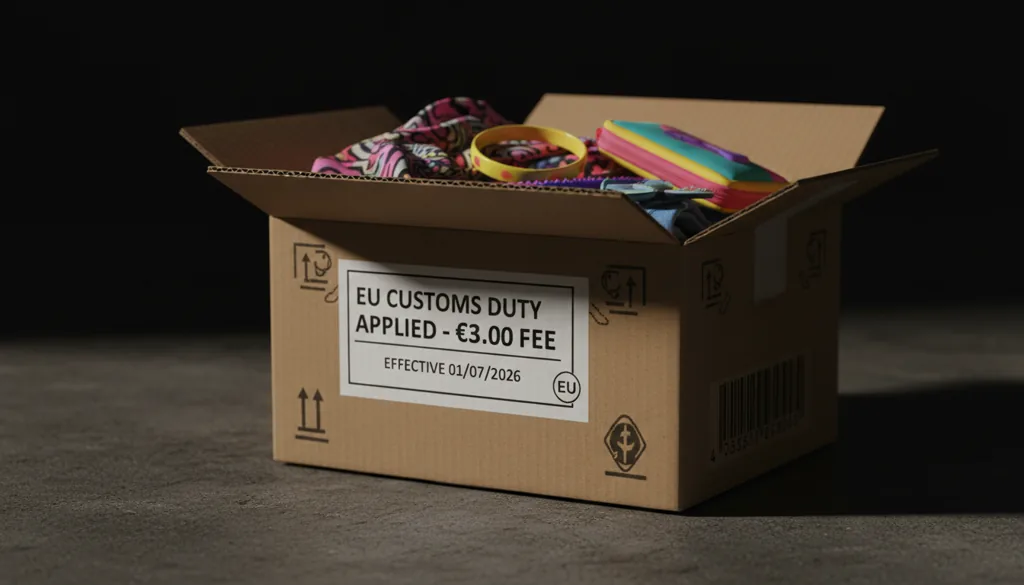
The European Union is introducing a temporary €3 customs duty on low-value e-commerce consignments starting July 1, 2026, alongside upcoming handling fees and the abolition of the previous €150 duty-free exemption threshold.
The European Union will impose a temporary €3 customs duty on low-value e-commerce goods from outside the bloc from July 1, 2026, while removing the existing €150 duty-free threshold.
The charge will cover parcels worth up to €150 containing goods such as clothing, toys, electronics and other consumer products. It will apply to online shipments entering the EU from non-EU countries, rather than to goods moving between member states. The measure is part of the EU’s wider customs reform, which aims to bring small online imports into the same duty system as bulk imports handled by traditional retailers.
The immediate purpose is to close a duty gap around cheap online parcels and improve customs control over goods entering the single market. The seller or importer pays the duty through the customs process, although the cost can feed into the delivered price of the goods. The Commission describes the measure as a business charge rather than a tax imposed directly on consumers, according to its frequently asked questions.
The July charge on parcels
From 1 July 2026, every low-value shipment from outside the EU will lose the customs-duty exemption that currently applies below €150. The temporary rate will be €3 for each item or customs category covered by the shipment, and will remain in place until July 1, 2028. Normal customs duties are then due to replace the flat charge, depending on the type of product.1
Low-value imports, before and after 1 July 2026
| Question | Until 30 June 2026 | From 1 July 2026 |
|---|---|---|
| Customs duty on parcels up to €150 | Exempt below €150 | €3 per classification |
| Who pays | No duty to pay | Seller or importer |
| How long it lasts | Standing exemption | Temporary, to 1 July 2028 |
| What follows | — | Normal duties by product type |
That structure means the parcel itself is not always the unit that determines the bill. Five T-shirts falling under one tariff classification would attract a single €3 charge under the Commission’s example, while a shipment containing three T-shirts and a watch would attract €6 because the goods fall into two classifications. The practical burden therefore depends on how products are grouped and declared, not only on the number of parcels crossing the border.
The rule covers all goods sold through distance sales in shipments up to €150, regardless of whether the import uses the Import One Stop Shop, a special VAT arrangement or standard VAT treatment. Goods benefiting from preferential trade agreements or Customs Union measures can be excluded in specific cases where VAT was not collected through the Import One Stop Shop and the shipment is declared in the required form.1 This leaves tariff classification and the customs declaration central to the amount payable.
For companies handling e-commerce imports, the core obligation is that the seller or importer must declare and pay the duty. That moves the financial and administrative task away from the individual consumer and towards the commercial parties arranging the sale and import. The Commission said the new system is intended to make online platforms and sellers key actors in meeting customs obligations.2
Why the €150 threshold is ending
The old exemption was created when customs authorities had limited information about large numbers of small shipments. The EU says electronic customs data are now available for imported goods, reducing the administrative reason for allowing low-value parcels to enter without duty. The change also reflects the way e-commerce has shifted purchases from bulk retail imports towards direct shipments to consumers.
What the control operation found
The scale of the traffic has made that shift visible in customs operations. Small shipments accounted for 97% of shipments in 2025, according to the EU’s account of a large customs control operation. A check of 20,000 toys and small electronic products found that more than half failed to meet EU product standards, while 84% of the products selected for laboratory testing were found to be dangerous.2
The duty reform is therefore linked to safety and enforcement as well as revenue. The EU has described undervaluation, false declarations and the splitting of imports as ways in which the previous system could be used to avoid duties or checks. Bringing low-value online goods into the duty framework gives customs authorities a clearer financial and data trail, although the flat charge itself cannot determine whether a product is safe.
That combination also explains why the measure reaches beyond the large platforms most associated with cross-border shopping. The EU says the duty applies without distinction according to the origin country or logistics operator. Its stated aim is to put direct online imports and goods brought in bulk for traditional retail on a more equal footing.1 In practice, the €3 charge is likely to matter most for low-priced goods where duty has previously represented no part of the import calculation.
Counting goods by classification
The most important operational issue is how customs identifies the goods inside a parcel. The duty is charged per tariff classification, so several units of one product type can attract one charge while different product types in the same order can create several charges. A parcel containing silk and wool blouses, for example, would be treated as containing two product categories even if it arrived as one package.3
Charge per shipment, by number of classifications
That approach makes product data more important for platforms, sellers, carriers and customs brokers. A single order can contain multiple duty-bearing categories, and the count may change when the product description or classification changes. The rule does not turn every physical unit into a separate €3 payment; it links the charge to the classification of the goods declared for the shipment.
The arrangement is expressly temporary. It is designed as an interim method until the EU’s customs data system can calculate ordinary duties for e-commerce transactions. The European Commission and member states described the simplified calculation as necessary before the wider customs infrastructure is ready in mid-2028.4 This gives businesses a two-stage change rather than one permanent tariff.
The result is a new cost structure for orders that previously crossed the border without customs duty. A low-value parcel containing one classification may face a modest charge, while a mixed basket can accumulate several fixed amounts. The effect will be strongest where the duty represents a large share of the value of inexpensive goods, particularly clothing, toys and small consumer electronics.
VAT systems remain separate
The customs change sits on top of the EU’s existing VAT arrangements for online imports. The Import One Stop Shop, known as IOSS, allows a taxable person to declare and pay VAT on distance sales of imported goods in shipments with an intrinsic value of no more than €150. It is a VAT reporting system, not a replacement for customs duty.
VAT thresholds and the duty threshold
Those VAT rules began changing on July 1, 2021, when the EU removed the import VAT exemption for small shipments worth up to €22. The same package of reforms introduced IOSS and special arrangements for collecting VAT on low-value imports.5 The €150 customs threshold has therefore survived as a duty threshold after the earlier VAT exemption was removed.
The distinction matters because a shipment can still use an existing VAT process while also attracting the new customs charge. The €3 duty applies regardless of the VAT scheme used for the distance sale, subject to the specific exclusions set out in the guidance. Platforms may also be treated as deemed suppliers for VAT purposes when they facilitate qualifying imported sales.6
This creates two linked but separate data obligations. VAT records identify the sale and the tax due, while customs information must identify the goods, their classification, value and duty treatment. The Commission’s guidance says online sales of imported goods will be subject to the new customs rules even where the seller already uses IOSS. The end of the duty exemption therefore changes the customs calculation without replacing the VAT framework.
Data rules and the next fee
The reform also brings a later product-data requirement. Product identifiers will become mandatory for distance sales of imported goods from Nov. 1, 2026, although customs declarations can include them voluntarily from July 1. The identifiers are intended to help authorities trace products and block goods that are unsafe or fail EU rules.1
The transition, date by date
| Date | Who it catches | What falls due |
|---|---|---|
| 8 June 2026 | Implementing rules published | Official Journal publication |
| 1 July 2026 | All low-value imports | €3 duty begins; product IDs voluntary from this date |
| 1 Nov 2026 | Distance sales of imported goods | Product identifiers mandatory |
| 1 July 2028 | All low-value imports | Normal customs tariffs replace the €3 charge |
That November deadline will arrive four months after the €3 duty begins. Businesses will therefore move first to the temporary charge and then to a more detailed product-data obligation during the same transition period. The change is particularly relevant to online marketplaces and sellers, which the reform places closer to the formal import process than under the previous system.
A separate Union handling fee is also planned, but it is not the same measure as the €3 duty. The fee is intended to cover customs processing costs, while its amount and application date were still to be decided in the Commission’s guidance. A Council position had supported collecting such a fee from November 2026, creating the prospect of another e-commerce cost during the temporary duty period.4
The legal framework is being assembled through several instruments rather than one isolated notice. Council Regulation (EU) 2026/382 provides the basis for the temporary duty, while amendments to the delegated and implementing customs rules support its practical operation. The implementing rules were published in the Official Journal on June 8, 2026, and the reform is set to run until 1 July 2028, when normal customs tariffs are scheduled to take over.1
For importers and customs intermediaries, the immediate commercial question is how the new charge will be built into declarations, invoices and platform systems. The wider question is whether the temporary flat rate can control a trade in which small parcels dominate customs traffic. Once the EU Customs Data Hub is operational, the EU intends to replace the simplified charge with ordinary duties calculated by product, making classification and product data more decisive for every low-value online shipment.4
Sources
- ↩ Temporary €3 Flat Fee on Low-Value EU Imports https://taxation-customs.ec.europa.eu/news/guidance-and-legal-text-temporary-flat-fee-low-value-imports-which-will-apply-until-1-july-2028-2026-06-08_en
- ↩ Large-scale EU customs action reveals most third-country e-commerce goods fail EU standards https://taxation-customs.ec.europa.eu/news/large-scale-eu-customs-control-action-shows-most-third-country-e-commerce-goods-do-not-follow-2026-01-07_en
- ↩ EU to Charge €3 Fee on Shein, Temu Parcels From July 2026 https://www.tovima.com/finance/eu-to-charge-e3-fee-on-shein-temu-parcels-from-july-2026/
- ↩ EU to Remove 150 EUR Customs Duty Exemption from 2026 https://taxation-customs.ec.europa.eu/news/e-commerce-150-eur-customs-duty-exemption-threshold-be-removed-2026-2025-11-13_en
- ↩ VAT One Stop Shop for e-Commerce in the EU https://vat-one-stop-shop.ec.europa.eu/index_en
- ↩ One Stop Shop for VAT e-Commerce https://vat-one-stop-shop.ec.europa.eu/one-stop-shop_en