
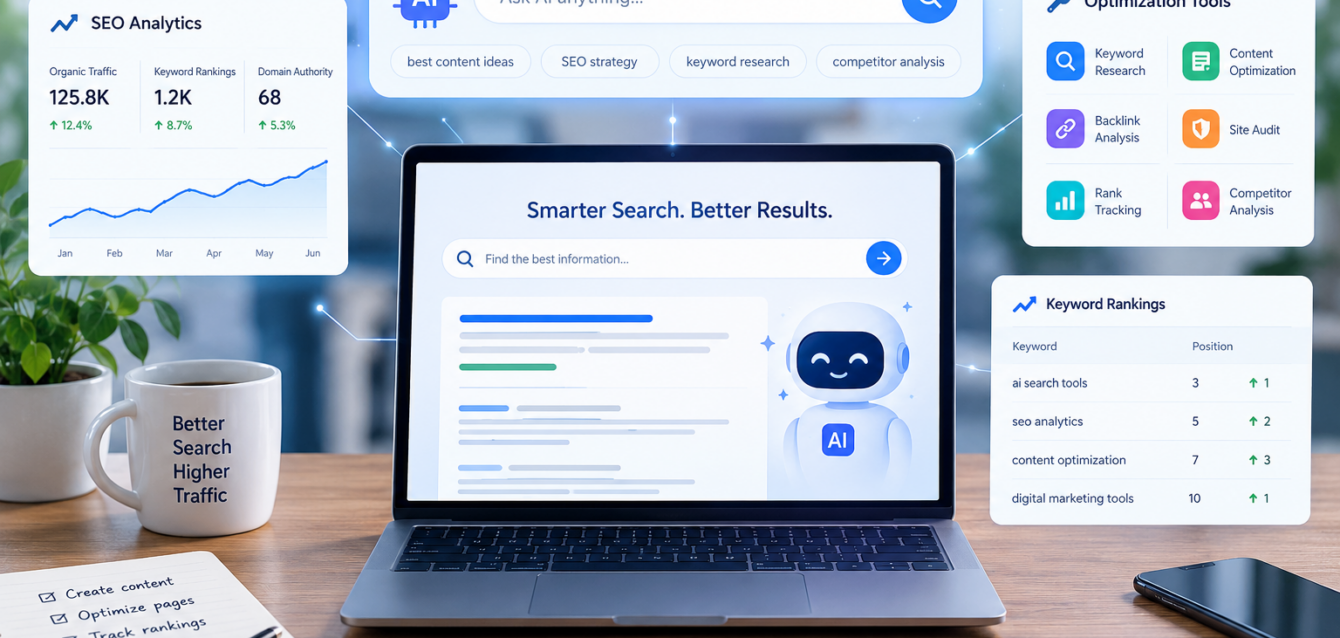
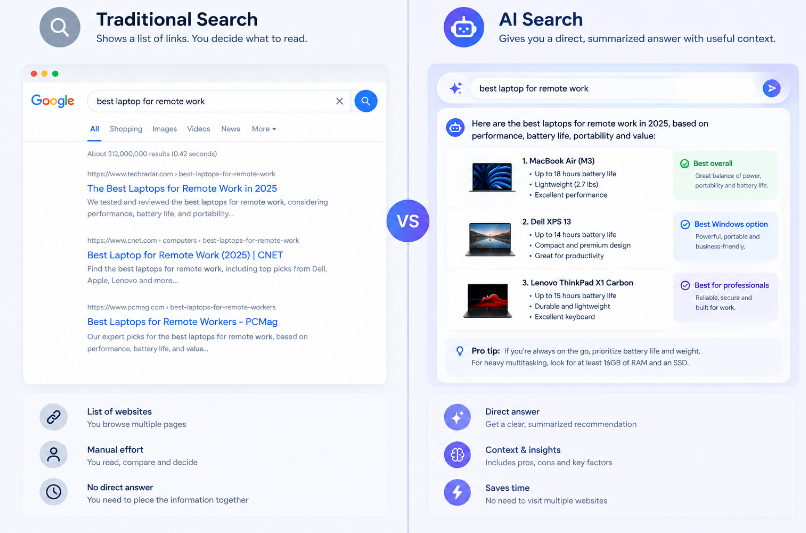
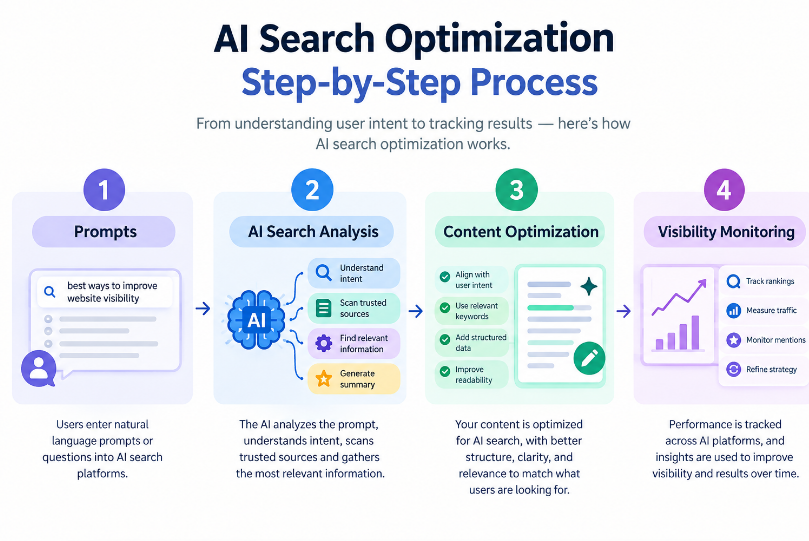
The way people find out about brands, products, services, and information is being changed by AI search. Rather than routinely ai search optimization tools opening a traditional search result, users can ask ChatGPT, Gemini, Perplexity, Google AI Overviews, or other answer engines and get a direct response.
This presents a new problem for marketers. Although a website can rank highly in Google it may still fail to appear in the answers generated by AI. AI search optimisation tools overcome this issue by keeping an eye on mentions, citations, competitors, prompts, sentiment, and other signals.
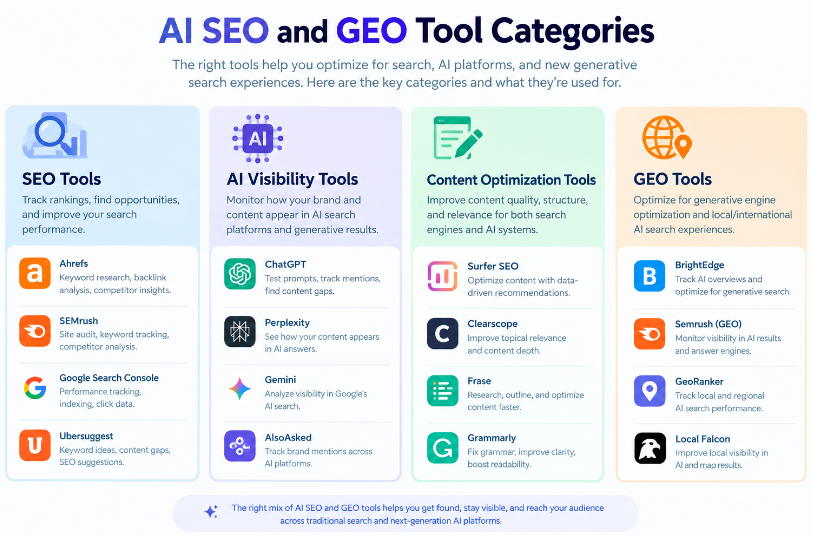
The tools mentioned below are not the same; some of them concentrate primarily on monitoring AI visibility, whereas others combine AI search data with SEO, content optimization, technical audits, or enterprise reporting. The appropriate choice will depend on what you want to measure and on how much of the optimization process you are prepared to carry out within a single platform.
What counts as AI search optimization?
The process of AI search optimization is about increasing the likelihood that a brand will be mentioned, quoted, or correctly portrayed in answers generated by AI.
You might also come across other terms such as AEO, GEO, generative engine optimization, LLM optimization, and AI visibility. Although the terminology differs, the general aim is the same: to understand the way in which AI systems display your business and to improve the sources and content that affect those answers.
Traditional SEO generally concentrates on rankings, impressions, clicks, backlinks, and organic traffic. AI search raises other questions:
Does the AI platform refer to the brand?
Which competitors appear instead?
What websites are mentioned in the answer?
Which pages from your own website are referred to?
What kinds of prompts cause your brand to appear?
What is the brand like?
Does the level of visibility differ between the ChatGPT, Gemini, Perplexity, and Google AI features?
Can AI crawlers reach important pages?
AI search optimization tools offer data concerning some or all of these questions.
It is likewise necessary to remember that AI answers do not constitute traditional search rankings since the results may differ according to the prompt, the platform, the user’s location, the language and the available sources among other factors; for this reason the majority of AI visibility platforms assess patterns based on groups of prompts rather than considering a single AI response as a fixed ranking position.
How to Choose an AI Search Optimization Tool
Before you choose a platform, make sure you have clearly identified the particular problem you need to solve.
1.Look at the AI platforms that it is keeping an eye on.
It is not the case that all tools cover the same engines; some are concerned with the features of ChatGPT and Google AI, whereas others also keep an eye on Gemini, Perplexity, Claude, Copilot, Grok, or other platforms.
Wide coverage would be useful if your audience uses a number of AI systems.
2. Examine prompt tracking
Prompt-level tracking shows the real questions that are being monitored, which is helpful when you need to understand the visibility for particular commercial, informational, or comparative searches.
A platform which enables the use of custom prompts can be very useful for businesses that have a specific set of important customer questions.
3. Check citation analysis
Mentions and citations are not the same thing; it is possible for a brand to be mentioned in an answer even if its website is not used as a source.
Citation analysis can be used to find out which pages and third-party websites affect the answers given by AI.
4. Consider competitor analysis
Competitor tracking can show the places where another company is listed and your brand isn’t. Moreover, some of the platforms also indicate which sources are helping competitors to gain visibility.
5. Search for the optimization suggestions
Although monitoring is useful it doesn’t automatically show you what changes to make; some tools link the visibility data to content recommendations, technical checks, citation opportunities, or outreach ideas.
6. Consider reporting requirements
Companies and bigger marketing teams might require dashboards, exports, scheduled reports, APIs, or support for multiple brands, while a smaller business might need nothing more than prompt tracking and a basic visibility report.
7. Check the way the platform measures visibility
It is important to take this into account since AI results are dynamic. You should examine the platform’s methodology and find out if it makes use of custom prompts, search-backed prompts, sampled conversations, or some other method of measurement.
15 Best AI Search Optimization Tools
1. Ahrefs Brand Radar
Ahrefs Brand Radar is an AI visibility tool that is part of the Ahrefs platform and keeps an eye on the way brands are portrayed in AI-generated answers, offering a range of metrics including mentions, citations, impressions, and AI Share of Voice.
A notable feature of it is its capability to use custom prompts. Ahrefs has developed a more comprehensive AI Visibility Index which is based on a large number of search-backed prompts. The platform links its AI visibility research with other signals such as search, YouTube, and Reddit.
Brand Radar is especially relevant to SEO teams who currently use Ahrefs and wish to expand their existing search research to include AI visibility.
Useful for:
SEO teams
Content marketers
Agencies
Brands already using Ahrefs
Competitor and citation research
The prices will depend on the Ahrefs plan and the product access, so customers should look at the current Brand Radar pricing before they buy.
2. Semrush AI Visibility Toolkit
The Semrush AI Visibility Toolkit is designed with the aim of understanding how brands are portrayed in answers that are generated by AI. At the moment, the tool offers features such as the measurement of AI visibility, tracking of brand mentions, comparisons with competitors, the discovery of prompts, sentiment analysis, and a technical audit of websites for AI crawlers.
The platform also includes an AI Visibility Score and enables users to look at visibility on a per-AI-system basis. This provides teams with the means of comparing AI visibility with broader SEO data within the Semrush ecosystem.
The tool could be useful to companies which currently use Semrush for keyword research, technical SEO, competitive analysis, and content workflows.
Useful for:
SEO professionals
Marketing teams
Agencies
Businesses already using Semrush
Teams that want SEO and AI visibility data together
3. OtterlyAI
OtterlyAI is designed particularly with AI search monitoring and optimisation in mind. It keeps an eye on a brand’s presence across AI-powered search systems and gives information regarding mentions, citations, competitors, and prompts.
The software’s optimization features are not limited to basic monitoring; OtterlyAI provides GEO audits to check if AI crawlers can access a website, carries out content audits, conducts citation gap analysis, and gives prioritized recommendations.
The platform is also able to detect third-party websites which AI systems refer to when competitors show up in the answers. This in turn helps marketers to identify both on-page and off-page opportunities.
Useful for:
SEO teams
GEO specialists
Agencies
Content teams
Businesses wanting technical AI crawler checks
4. Profound
Profound is an AI-powered search intelligence platform designed with the aim of understanding how brands are portrayed across answer engines, and its product range covers visibility monitoring, prompt analysis, competitive intelligence, citations, sentiment, and other AI search signals.
In 2026 Profound launched FactCheck, a feature which checks the factual accuracy of AI-generated claims concerning a brand against the information kept by the business.
The company called Profound is especially aimed at large marketing organizations which require extensive AI search monitoring and brand intelligence.
Useful for:
Enterprise marketing teams
Large brands
Agencies
Brand and reputation teams
Organizations monitoring AI-generated representations
5. Peec AI
Peec AI specializes in monitoring AI visibility and tracking share-of-voice. The platform checks whether a brand is mentioned in AI responses and offers metrics relating to visibility, position, sentiment, and share of voice.
It also enables users to identify the sources that AI models refer to when formulating relevant prompts. The Actions product converts the visibility data into prioritized recommendations by taking account of competitive gaps and source opportunities.
Peec also offers analytics relating to AI referrals, enabling the connected analytics data to be examined in order to look at the traffic which comes from AI assistants.
Useful for:
Marketing teams
SEO professionals
Agencies
Brands tracking competitors
Teams interested in AI visibility and referral data
6. Scrunch
Scrunch is presented as a platform for AI customer experience and for improving AI search visibility. The monitoring tools used by the platform keep an eye on prompts, citations, brand performance, and changes in AI search visibility.
The platform includes an Agent Experience Platform which is intended to enable businesses to understand the way in which AI agents interact with their websites and to optimise the information available to those agents.
The AI Search Trends feature is designed to assist businesses in spotting topics, trends, and the areas in which demand for AI search is changing.
Useful for:
Enterprise brands
Agencies
Businesses with complex websites
Teams interested in both AI visibility and agent experiences
7. AthenaHQ
AthenaHQ is a platform using artificial intelligence to keep an eye on how brands are portrayed on a number of AI search services.
The product information it now provides covers tracking across a range of systems such as ChatGPT, Perplexity, Gemini, Claude, Copilot, Grok, and the Google AI features. It also features competitive intelligence, citation analysis, content gaps, and optimization functions.
The platform is intended for a number of marketing positions, such as those in SEO, AEO/GEO, PR, content, and brand.
Useful for:
SEO teams
PR teams
Content marketers
Brand teams
Organizations monitoring multiple AI platforms
8. BrightEdge AI Catalyst
The BrightEdge AI Catalyst takes the BrightEdge SEO platform into the realm of AI search by monitoring brand mentions and citations on various AI platforms, including ChatGPT, Perplexity, Google AI Overviews, Google AI Mode, and Gemini.
The tool also includes prompt research, competitor comparisons, citation analysis, and suggestions. Since it is part of BrightEdge’s wider enterprise SEO environment, it can be of value to companies that would like to have both traditional search and AI search reporting within the same system.
It is more suitable for large organisations than for individuals who are looking for a lightweight standalone tracker.
Useful for:
Enterprise SEO teams
Large brands
Agencies
Organizations already using BrightEdge
Teams managing traditional and AI search together
9. Conductor
The conductor provides a platform designed for use in a business environment that includes both traditional SEO and AI search, with its AI Search Performance feature monitoring visibility on systems such as ChatGPT, Perplexity, and Google AI Overviews.
The platform offers information relating to competitiveness, sentiment, and citations. It also includes an Ask Conductor feature which enables users to ask questions regarding their own AI search data and obtain an analysis based on the information available in the platform.
It can be of use to teams which need AI search monitoring to be linked with their content, website, and wider digital marketing workflows.
Useful for:
Enterprise SEO teams
Large marketing departments
Content teams
Agencies managing larger accounts
Organizations wanting an integrated SEO platform
10. SEOmonitor
SEOmonitor combines traditional rank tracking with AI search measurement, and its AI Search Tracking feature measures brand mentions, citations, citation position, and sentiment in the answers that are generated by AI.
The AI Visibility Index currently concentrates on ChatGPT and Google AI Overviews, assigning weights to visibility based on search-volume data from its research database.
This method could be of interest to SEO professionals who wish to compare traditional organic visibility with AI search visibility in terms of related search demand.
Useful for:
SEO agencies
Consultants
SEO teams
Businesses that already use SEOmonitor
Teams wanting AI and traditional search metrics together
11. Keyword.com
Keyword.com is best known for its rank tracking, but the company now also provides AI visibility tracking.
The AI visibility tools on the platform keep an eye on references to the brand, citations, AI-generated answers, competitors’ visibility, and public sentiment. The system enables tracking across a number of AI systems and gives users the ability to sort and monitor AI search terms.
A useful feature is the fact that conventional Google rank tracking correlates with AI visibility data, enabling teams to compare their performance in different search environments.
Keyword.com also offers API access to its AI visibility data, which could be useful for agencies or for internal reporting systems.
Useful for:
SEO agencies
Consultants
Growth teams
Multi-location businesses
Teams requiring API or reporting access
12. Nightwatch
Nightwatch is a platform which provides SEO rank tracking and also allows for the monitoring of Google’s AI Overviews.
The AI Overview Tracking feature enables users to keep an eye on the visibility of their brand and domain across the keywords which cause Google to generate AI summaries. The figures recorded include visibility and domain citation rates.
Nightwatch differs from platforms that are based completely on broad AI search monitoring since it is useful when your main need is conventional SEO tracking along with some insight into Google’s AI search features.
Useful for:
SEO professionals
Rank-tracking users
Agencies
Businesses focused on Google search
Teams monitoring AI Overviews alongside rankings
13. thruuu
thruuu carries out SEO analysis and search-result research and also provides monitoring of Google AI Overviews.
The AI Overview feature is able to check how often a brand is mentioned, how frequently a domain is cited, and how many of the tracked keywords produce AI summaries.
For marketers who at the moment are concentrating their AI search strategy on Google, this offers a more focused and practical perspective on AI search visibility without the need for a large enterprise platform.
Useful for:
SEO consultants
Content marketers
Agencies
Users researching Google SERPs
Teams focused on AI Overviews
14. Writesonic GEO
Writesonic has gone beyond AI content generation with the introduction of its GEO feature, which is used for monitoring and improving AI search visibility.
The GEO tools enable users to keep track of brand visibility, mentions, citations, competitors, prompts, and AI responses. The platform also gives recommendations and includes an Action Center which covers content, citations, and technical optimization.
Writesonic also includes reporting and integrations for AI visibility data, which makes it suitable for teams who want to combine content creation with AI search optimization within the same overall platform.
Useful for:
Content teams
SEO professionals
Agencies
Businesses using Writesonic for content
Teams that want optimization workflows alongside monitoring
15. Similarweb AI Brand Visibility
Similarweb has now included AI-powered capabilities for monitoring brand visibility as part of its wider digital intelligence platform.
The company’s AI visibility products offer information on how brands are displayed across various AI systems, such as Gemini, Perplexity, and the Google AI features. Moreover, the platform places a focus on understanding the downstream effects of AI recommendations and the way AI-influenced discovery relates to website behaviour.
A wider view of the market and traffic can be of value to companies which require more than just prompt-level monitoring and would like to have AI visibility information together with digital market intelligence.
Useful for:
Enterprise marketing teams
Digital intelligence teams
Large brands
Competitive research teams
Organizations analyzing AI visibility alongside traffic data
AI Search Optimization Tools Comparison
| Tool | Main focus | Useful for |
| Ahrefs Brand Radar | AI visibility, mentions, citations, SOV | SEO professionals and agencies |
| Semrush AI Visibility Toolkit | AI visibility, prompts, competitors, technical issues | SEO and digital marketing teams |
| OtterlyAI | AI monitoring, GEO audits, citation gaps | GEO specialists and SEO teams |
| Profound | AI search intelligence and brand monitoring | Enterprise marketing teams |
| Peec AI | AI visibility, position, sentiment, SOV | Marketing and SEO teams |
| Scrunch | AI visibility and AI agent experience | Enterprise teams and agencies |
| AthenaHQ | Multi-platform AI visibility and competitor tracking | SEO, content, PR, and brand teams |
| BrightEdge AI Catalyst | AI search and enterprise SEO | Enterprise SEO teams |
| Conductor | AI search, SEO, and content intelligence | Enterprise SEO and content teams |
| SEOmonitor | AI visibility and rank tracking | SEO agencies and consultants |
| Keyword.com | Rank tracking and AI visibility | SEO teams and agencies |
| Nightwatch | Google AI Overview tracking | SEO professionals and agencies |
| thruuu | Google AI Overview and SERP analysis | SEO and content professionals |
| Writesonic GEO | GEO monitoring and AI visibility optimization | Content marketers and SEO teams |
| Similarweb | AI brand visibility and digital intelligence | Digital marketing and research teams |
The table is designed to be descriptive notational rather than providing a ranking since the various platforms assess different aspects of AI search and so the best choice will vary according to the workflow and the reporting requirements.
How to Choose the Right Tool
The first step is to determine if you need monitoring or optimization.
If all you want to do is find out whether your brand is mentioned in AI answers, then a visibility tracker will suffice. You should look for prompt tracking, mentions, citations, competitors, and historical reporting.
If you wish to actively enhance your visibility, then look for tools which can detect content gaps and citation opportunities. Tools that carry out technical AI crawls can also be of use when you need to check that important pages can be accessed and interpreted by the relevant crawlers.
The choice should also take into account your existing SEO stack. Since your team is already heavily using Ahrefs, Semrush, BrightEdge, Conductor, SEOmonitor, or another well-established SEO platform, making use of the AI visibility features of that platform might mean that there would be no need to keep another separate dashboard.
Another important factor is platform coverage. A business which has customers using ChatGPT, Gemini, and Perplexity will require more extensive coverage than a group mainly interested in Google AI Overviews.
For agencies, the need to produce reports and to manage multiple clients may be more important than possessing the greatest number of individual optimization features; enterprise teams might therefore require APIs, dashboards, permissions, integrations, and analysis at the market level.
In the end, you should look at the methodology involved. Unlike traditional Google ranking, AI visibility can vary from one prompt to another and from one session to another, and different tools may measure different samples. For a useful platform it is important that it makes it reasonably clear what it tracks and how its metrics are calculated.
What AI Search Optimization Cannot Guarantee
The use of an AI search optimization platform does not ensure that a brand will be listed in ChatGPT, Gemini, Perplexity, Google AI Overviews, or another AI system.
These systems can give different responses even when the questions are similar, the answers possibly depending on the query, the web sources available, the user’s location, the language used, the behaviour of the platform, changes to the model, and other factors.
These tools are therefore intended for the purpose of measurement and for enabling optimized decisions rather than ensuring placement.
A good workflow usually incorporates AI visibility data together with useful website content, technical accessibility, reliable external sources SEO tools traditional SEO, and continuous measurement.
Conclusion
AI search optimization is now an extra layer in search strategy not acting as a replacement for traditional SEO.
The various tools deal with the problem from different angles. Ahrefs and Semrush link AI visibility with existing SEO platforms. OtterlyAI places a strong emphasis on GEO monitoring and on carrying out actionable optimizations. Profound and BrightEdge are geared towards enterprise applications. Peec, Scrunch, AthenaHQ, and Writesonic offer specific AI visibility features. SEOmonitor, Keyword.com, Nightwatch, and thruuu associate AI search monitoring with more conventional SEO workflows. Similarweb incorporates AI visibility into its broader digital intelligence environment.
The key is to select a tool according to the information that you really need; you should therefore look at the AI platforms, the measurement methodology, the prompt tracking, the citation analysis, the competitor research, the optimization recommendations, the reporting, the integrations, and the pricing.
Since AI search is still in its development phase, the most useful platform will probably be the one which provides your team with accurate data that they are able to understand and take action on, not just one that produces another visibility score.
FAQs
Is AI search optimization identical to SEO?
Not at all, there is overlap, especially in the areas of technical accessibility, content quality, topical relevance, and authority. The fact is that traditional SEO focuses on visibility within search results, whereas AI search optimization also takes into account whether brands and pages appear in the generated answers and citations.
What is the difference between AEO and GEO?
They are frequently used in the same way, even though they can have slightly different meanings according to the platform or the marketer; AEO usually means optimizing for answer engines, and GEO generally refers to Generative Engine Optimization and visibility in generative AI responses.
Can a website end up ranking well on Google while having low AI visibility?
Certainly. Traditional search rankings and AI-generated answers are determined in different ways, since an AI system can choose sources on the basis of factors other than a page’s standard Google ranking.
Should small businesses make use of an AI visibility tool?
It varies from one business to another; if a small company is getting substantial traffic or leads as a result of AI-powered discovery it might find it worthwhile to monitor its situation, while a business that has limited search activity could obtain greater value from having solid website fundamentals and from traditional SEO.
How frequently should AI visibility be checked?
There is no single schedule that applies to all cases; those running active AI search campaigns might check it regularly, whereas smaller businesses could look at their visibility less often. The key point is to use a consistent method of measurement so that changes can be compared over time.
Do the AI visibility tools monitor every ChatGPT conversation?
Usually, no. AI visibility platforms make use of their own methods of measurement, datasets, prompts, or sampled responses. They do not have the ability to see users’ private ChatGPT conversations. Hence, the results must be regarded as structured measurements rather than as a full record of every AI interaction.
What is the importance of citations in AI search?
Citations indicate the sources that an AI system consulted or referred to when formulating a response. By examining those sources, marketers can find out which information affects AI responses and spot any gaps in content or authority.
Can AI search optimization take the place of traditional SEO?
Certainly. Traditional search is still an important means of discovering information, and many AI systems also rely on the information that is available on the web. AI search optimisation should be seen as an extra layer that operates alongside technical SEO, content, digital PR, and other search activities.
What else should I measure apart from AI mentions?
Useful measures may be citations, visibility percentage, share of voice, position, sentiment, competitor presence, the number of cited pages, prompt-level performance, and AI-referred website traffic provided that the platform supports it.
Can the AI visibility scores of different tools be directly compared?
It doesn’t have to. Various platforms may make use of different prompts, datasets, engines, weighting systems, locations, and methods of calculation. Because of this, it is better to stick with a single platform when measuring changes over time rather than regard the scores from different vendors as identical metrics.